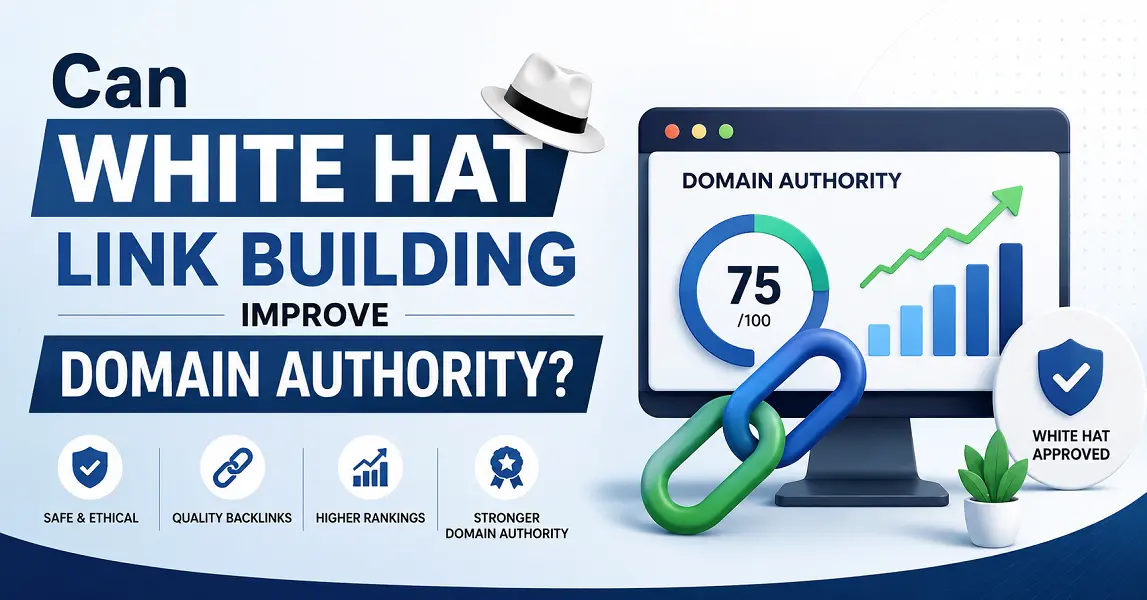
Most marketers talk about Domain Authority as if it’s the ultimate SEO scorecard, but it’s really just a third-party estimate of how strong your site might be in search. Useful, yes, but not something Google directly uses to rank pages. Still, it gives a quick way to gauge how you stack up against competitors.
The real question isn’t about the metric itself; it’s about what actually moves it. Can ethical, white hat link building improve your site’s authority and drive real rankings? The short answer: yes, when done right, it influences both perception (DA) and performance (search visibility).
Domain Authority and White Hat Link Building: What’s Actually Going On Under the Hood
Let’s slow down before we get tactical. Understanding why authority scores move is the difference between campaigns that compound and campaigns that stall out after three months.
Third-Party Scores vs. How Google Actually Thinks
Moz DA and Ahrefs DR are proxies, educated estimates, not direct inputs into Google’s algorithm. Google operates on its own internal signals: PageRank, trust indicators, and topical relevance across your entire link graph. That said, DA still earns its place as a competitive benchmarking tool and a clear language for client reporting.
When your team commits to white hat link building through genuinely earned, editorially placed mentions, the payoff tends to surface in both third-party scores and Google’s actual ranking behavior. One tends to follow the other.
How Search Engines Actually Read a Link
Search engines evaluate incoming links along three dimensions: equity, relevance, and trust. A contextual mention from a niche-aligned site tells Google far more about your credibility than a generic directory listing ever could.
Anchor text patterns matter too; branded, partial-match, and naked URL anchors all suggest an organic, uncontrived profile. And link velocity? That’s critical. Rapid, unnatural spikes set off algorithmic alarms. Steady, diversified growth over time builds something much harder to shake: lasting credibility.
Realistic Timelines for Authority Movement
New domains typically start showing meaningful DA movement somewhere in the 4–6 month window. Established sites in competitive verticals often see correlation shifts faster because they already have crawl equity working in their favor.
Setting grounded targets, something like moving from DA 15 to DA 28 within nine months, keeps your team from abandoning a solid campaign prematurely. Patience isn’t just a virtue here. It’s literally built into how search engines process and validate new link signals.
The Core Principles That Separate Sustainable Link Building From Dangerous Shortcuts
Now that timelines are set, let’s talk about the principles that keep your site safe while your competitors play risky games.
Earning Links vs. Engineering Them
Genuine white hat link building is about being referenced, not about placement schemes. Editorial mentions, expert quotes, and original data citations are earned. PBNs, link farms, and paid sidebar placements are manufactured. One aligns with Google’s guidelines and survives algorithm updates. The other doesn’t.
Relevance Beats Raw Metrics. Every Time.
A DA 45 link from a site completely outside your industry will often move rankings less than a DA 28 link from a closely aligned publication. When you’re evaluating link prospects, look at audience overlap, content quality, topical focus, and real traffic, not just a number. Relevance is frequently what separates a link that shifts rankings from one that essentially does nothing.
Quality Over Volume, Always
Three strong links from respected publications will move your DA and your rankings more reliably than thirty low-grade directory submissions. Full stop. High-quality white hat SEO backlinks share certain consistent traits: contextual placement, editorial independence, genuine traffic, and tight topical alignment. Chasing volume is tempting. Chasing quality is smarter.
Profile Diversity Is Its Own Signal
Individual link quality matters enormously. But cumulative profile diversity matters just as much. A healthy link profile mixes dofollow and nofollow links, branded and URL-based anchors, and links pointing to both your homepage and your inner pages. That variety tells search engines your growth is organic, not manufactured by someone working through a spreadsheet of link targets.
Before You Build a Single Link: Getting Your Foundation Right
Skip this section, and you’ll waste a lot of equity on a site that can’t convert it properly.
Technical and UX Housekeeping Comes First
Powerful links pointing at a technically broken site are largely wasted. Before any outreach campaign goes live, confirm crawlability, clean up indexation errors, improve page speed, and make sure the mobile experience holds up under current standards. These aren’t exciting tasks; nobody has ever bragged about fixing a crawl budget issue at a dinner party, but they’re essential prerequisites for helping your site actually increase website authority from the links you earn.
Build Assets Worth Linking To
Original data studies, interactive calculators, deeply researched guides, and downloadable templates consistently attract organic citations over time. The key is mapping each asset to the specific journalists, bloggers, or community members most likely to reference it.
Assets built around proprietary data or uncommon industry insight generate far more natural links than generic blog content ever will.
Ethical Link Building Strategies That Move the Needle
Your site is ready. Your assets are in place. Now let’s talk about execution.
Digital PR Campaigns That Earn Real Editorial Placements
Turning your proprietary data or expert commentary into press-ready story angles is one of the fastest paths to high-authority editorial links at scale. Journalists are always hunting fresh angles backed by original data. HARO alternatives and live media request channels connect you to reporters who are actively looking for exactly what you can offer, and those placements carry serious authority signals when executed well.
Strategic Guest Contributions, Done the Right Way
Guest articles on relevant, high-traffic publications offer a consistent, scalable link channel. But the pitch has to lead with genuine value for the host’s audience, not your backlink needs. One truly useful, well-placed guest contribution outperforms ten thin articles published on obscure blogs that nobody reads. Anchor text placement should feel natural within the editorial context, never forced.
Thought Leadership That Generates Links as a Byproduct
Founders and internal experts who show up on podcasts, webinars, and industry panels earn links through show notes, speaker bios, and recap articles, often without any outreach at all. These links are a byproduct of actual visibility and expertise. Repurposing those appearances across formats compounds the link-earning value of each one.
Measuring Authority Growth With a Structured Framework
Marketers typically allocate a significant share, often between 28–36%, of their total SEO budgets specifically toward link building. That’s not a side project expense; it’s a core investment in long-term search visibility.
Because of that, having a clear and structured measurement framework is essential. It helps you track progress, demonstrate ROI, and make your link-building efforts easier to justify to stakeholders.
Set Measurable Baselines and Realistic Goals
Start by documenting your current DA, referring domain count, organic traffic, and key ranking positions. From there, set niche-appropriate targets. A DA 10 site in a low-competition vertical can realistically reach DA 25 within 12 months of consistent, ethical link building, if the strategy is sound and the execution is steady.
Track KPIs That Actually Connect to Business Outcomes
DA is a useful proxy, but it’s not the finish line. The metrics that genuinely connect to business results are referring domain growth, organic traffic trends, keyword ranking movement, and assisted conversions. Track these monthly. When new links get crawled, expect a 4–8 week lag before meaningful ranking movement appears. Early data without that context can mislead your entire team.
Where This Leaves You
White hat link building isn’t a shortcut; it’s a long-term strategy that compounds when done with consistency and intent. When you focus on earning relevant, high-quality links, you’re not just nudging a third-party metric upward; you’re strengthening the signals that actually influence search visibility.
The smarter approach is to stop chasing authority scores in isolation and start building a presence that naturally attracts links over time. Commit to sustainable tactics, measure what truly impacts growth, and give your strategy enough runway, because real authority isn’t built quickly, but it is built to last.
Frequently Asked Questions
Does ethical link building directly improve DA or just rankings?
Both, indirectly. Earning strong editorial links improves third-party DA scores while sending genuine authority signals to Google, which typically translates into ranking improvements over a 3–6 month window.
How many quality backlinks before DA starts moving?
No universal number exists, but most sites see measurable movement after consistently earning 8–15 high-quality referring domains per month from topically relevant, editorially independent publications.
Which anchor text types are safest for building authority?
Branded anchors, naked URLs, and natural partial-match phrases carry the lowest risk. Repeatedly using heavily optimized exact-match anchors can trigger over-optimization flags, especially on newer domains with thin profiles.
Can DA improve without building backlinks at all?
Technically, yes, through internal optimization and content improvements. Practically, it’s extremely slow. Referring domain count remains one of the strongest correlates with both DA movement and organic ranking gains.