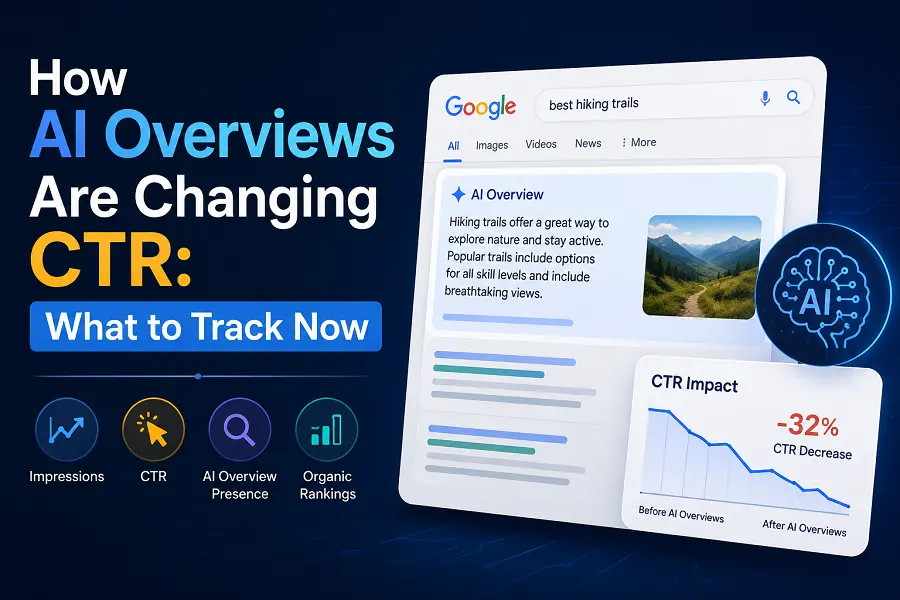
It is a bit like watching a sudden fog roll into a busy high street. The shops are still there, but suddenly fewer people are walking through the front doors because they found what they needed from a signpost at the edge of town. In the digital world, this is exactly what Google’s AI Overviews have done to organic Click-Through Rates (CTR).
This isn’t just a minor fluctuation in the algorithm; it is a fundamental shift in how users interact with search. According to a comprehensive study by Ahrefs covering December 2025, the presence of an AI Overview reduces the organic click-through rate for position one content by a staggering 58%. Understanding how to correctly measure and adapt to these shifting CTRs is a key factor in evaluating the real health of your digital strategy. Don’t worry, this isn’t as complicated as it sounds.
We will break down how to properly track CTR changes on affected queries, how to separate organic ranking performance from AI interference, and how to measure the value of being cited inside the overview. Our goal is not just to give you dry metrics, but to provide an actionable plan. You need to be confident that your marketing investments are actually working, rather than being swallowed by the “zero-click” abyss.
CTR Changes on AI Overview Queries
Imagine you are trying to measure the success of a billboard, but every time someone stops to read it, a digital screen pops up and gives them the exact same answer without them needing to walk into your store. To evaluate your digital channels, you first need to separate queries that trigger AI Overviews from those that do not.
Firstly, we identify AI-affected queries. According to Seer Interactive’s 2026 update, roughly 1 in 3 informational queries now shows an AI Overview. Comparison queries trigger an AI Overview 95.4% of the time, and question-format queries trigger it 85.9% of the time. If you are writing informational content in these formats, assume an AI Overview will appear and your CTR will drop.
The second important metric consists of the baseline CTR drop. When an AI Overview appears, organic CTRs plummet. Seer Interactive noted that organic CTR for AI Overview queries dropped from 1.76% to 0.61% between June 2024 and September 2025. This means users are getting their answer directly on the SERP and feeling no need to click through to your site.
Finally, we look at the CTR recovery trends. The good news is that the decline is not permanent. Seer Interactive’s early 2026 data showed organic CTR on AI-present queries climbing back from a floor of 1.3% in December 2025 to 2.4% in February 2026. The initial shock is wearing off, but you must still track these queries separately from your non-AI queries to get an accurate picture of your traffic.
CTR Differences by Organic Ranking Position
It is like checking the receipt from your cashiers to see who is ringing up the most transactions, but half the cashiers are working blindfolded. Now that we have split the audience, let us look at how exactly these groups generate volume across different ranking positions.
Ahrefs found that the negative impact of AI Overviews continues across all positions, albeit in less dramatic terms for lower rankings. For example, position one sees a 58% drop in CTR when an AI Overview is present. However, position five sees a 32.6% drop, and position ten sees a 19.4% drop.
This means that ranking on page two or deep on page one is no longer a safe place to hide from AI interference. The AI Overview pushes the traditional organic listings further down the page, compounding the loss of clicks for everyone except the top three positions.
If your strategy relies on the “long tail” of search traffic, you must optimise for AI citation rather than traditional clicks, because the click-through rates for positions four through ten are being heavily penalised by the presence of the overview.
Organic Click Changes After AI Overview Appearance
Analysing organic clicks without tying them to the AI Overview appearance is like measuring a company’s total revenue without knowing which product is actually selling. To get a real picture, we need to break the data down by what happens after the overview appears.
In the informational query channel, organic clicks are driven by the user’s desire for deeper understanding. When an AI Overview appears, the click rate drops significantly because the overview provides a sufficient summary. However, if the overview is overly complex or lacks a specific example, users will still click through.
By contrast, transactional queries show a different pattern. Seer Interactive noted that transactional queries trigger AI Overviews only 5% of the time. When they do appear and a brand is cited, transactional CTRs actually doubled from 0.7% to 1.7% in late 2025.
If we look at zero-click searches, they have risen from 54% to nearly 69% in some categories. This proves that for many queries, the AI Overview is the destination, not the referral page. You must track your impressions and clicks separately to see if your traffic loss is due to lower rankings or simply the rise of zero-click behaviour.
Citation Visibility Inside AI Overviews
Choosing to focus only on traditional rankings is a bit like trying to inflate a balloon by breathing into the same small space. You might see movement, but you aren’t actually expanding the overall volume. Different ad formats and content strategies leave different “imprints” in the user’s memory, and they generate audience expansion in completely different ways.
Brand Citations traditionally generate the highest percentage of long-term traffic recovery from AI Overviews. The user reads the AI overview, sees your brand cited, and remembers you as an authoritative expert. Seer Interactive found that being cited in the AI Overview delivers 120% more organic clicks per impression versus when you are not cited.
Position within the Overview works a bit differently. Search Engine Land notes that the CTR curve shows a steep decay within the overview itself. By the time a user reaches the fourth or fifth citation link, your brand basically doesn’t exist to them. Getting the first citation spot is critical.
Paid Search Citations show the highest rate of sudden traffic expansion. Seer Interactive noted that brands cited in AI Overviews earn 91% more paid clicks than those not cited. The AI overview acts as a trust signal that validates your paid ads sitting right next to it. If you want to make sure your paid campaigns are picking up on these citation signals, an experienced SEO agency can audit your current setup and flag which branded queries are missing AI Overview visibility.
Query-Level Trends Across Comparable Periods
Let us be honest: perfect attribution systems don’t exist. Matching visitors across sessions is an attempt to assemble a complex puzzle that is constantly missing a few pieces. Understanding these limitations will help you avoid making hasty decisions based on incomplete data, and ultimately rank your channels by their true value.
The main issue is intent segmentation. You cannot compare query-level trends unless you separate informational, commercial, and transactional queries. Informational queries show an AI Overview 36% of the time, while commercial queries show them only 8% of the time. If you mix these queries in your reporting, your overall CTR drop will look much worse than it actually is.
Non-AI queries create another barrier. Queries without an AI Overview actually saw their organic CTR increase from 2.8% in January 2025 to 3.8% in February 2026. This means users are still clicking through on topics Google hasn’t figured out how to summarise yet.
Moreover, branded vs non-branded terms behave differently. Branded keywords are far less likely to trigger AI Overviews, and when they do, CTRs actually improve. If your overall CTR is dropping, it is likely your non-branded, high-funnel queries taking the hit, not your core brand terms.
The practical takeaway is straightforward: if your reporting dashboard still treats all queries the same way, you are already behind. Start by splitting your data by AIO status, then by query intent, then by citation position. Only when you have that layered view will you be able to tell whether your traffic is genuinely declining or simply shifting into a different part of the SERP. The zero-click era is not going away, but brands that learn to read the new signals will still find plenty of clicks worth having.