
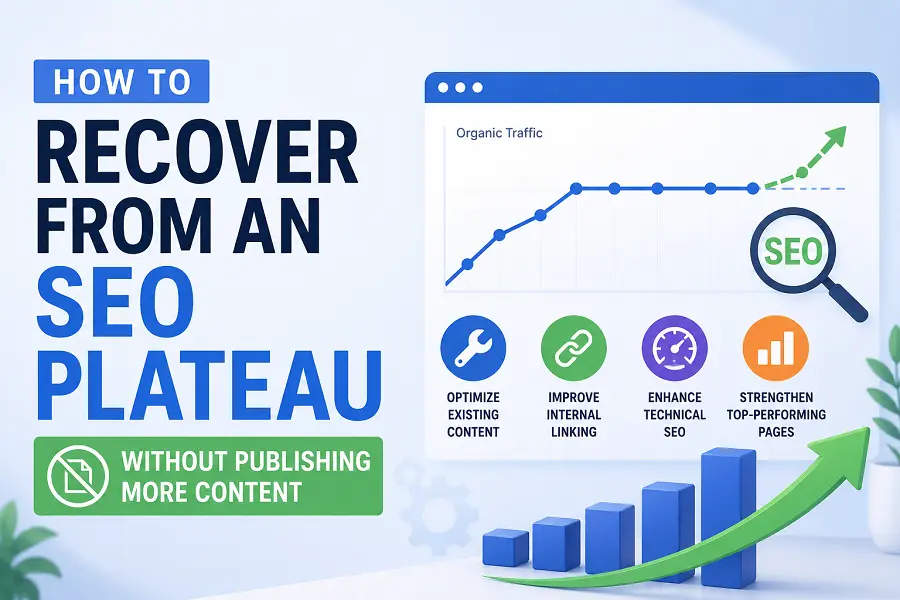
SEO plateaus are often perplexing since, on the surface, everything seems okay. There’s traffic coming through, the ranking is still in place, and some leads or sales are being made. What you’ve got here is the situation where growth has stalled, and “more content” seems to be out of the question.
In most cases, when a website hits a plateau, it means that it’s time for some improvement. This could mean improving the quality of your pages, their organization, internal linking strategy, SEO optimization, or how well you’re targeting specific search intents.
There’s usually a lot of work left undone right under your nose. All the older guides, service pages, category pages, and blog posts that almost rank are prime candidates for further optimization.
Make Sure That You Have Reached The Plateau
First and foremost, make sure that you have reached a plateau. If one month was bad, there is no need for a change yet. It is important to analyze at least three to six months’ worth of your organic search statistics, like clicks, impressions, rankings, conversions, indexed pages, and assisted revenue.
It is also a great topic for students who study digital marketing and online businesses. A student comparing the ways of recovering from an SEO plateau will most likely need help with organizing information and arguments. In this case, using do my homework for cheap services will be beneficial to the student. And in Google’s SEO starter guide, you will learn that SEO optimization is good for crawling, indexing, and understanding the content of webpages. This piece of information is crucial when talking about SEO plateaus, since SEO plateaus do not always mean a lack of volume of content.
According to Daniel Walker, an authority on SEO education, teams need to consider their stagnation as a diagnostic issue initially. It is absolutely correct. The project doesn’t require additional pages until the team learns about the factors that made previous pages stop their development.
Find The Most Ready Pages For The Breakthrough
Pages with impressions and rankings are always easier to improve because Google already sees them as partially relevant.
Such pages may demonstrate one or several following traits:
- High number of impressions and low click-through rate.
- Rankings between positions 5 and 15.
- No traffic conversion.
- Slow loss of clicks.
- Outdated facts, screenshots, product information, etc.
- Not relevant queries at the top of keywords.
- Several pages with the same keywords.
The page ranked at 8 position needs improvement of its title, internal links, opening answer, examples and formatting. And the one ranked at 60 is a tougher case. Start with the easier ones.
SEO Plateau Fixes That Do Not Require New Content
| Plateau Problem | What To Check | Practical Fix |
| Low Click-Through Rate | Title tags, meta descriptions, search result intent | Rewrite titles with clearer value and stronger relevance |
| Stuck Rankings | Internal links, content depth, competing pages | Add links from strong pages and improve weak sections |
| Old Content Decay | Dates, examples, screenshots, broken links | Refresh facts, remove stale advice, update visuals |
| Weak Conversions | Calls to action, page layout and offer match | Make the next step clearer and more useful |
| Keyword Cannibalization | Similar pages targeting the same query | Merge, redirect, or separate intent more clearly |
| Technical Barriers | Indexing, crawl errors, speed, redirects | Fix blocked pages, broken links, and slow templates |
| Poor Site Flow | Orphan pages and thin link paths | Build better internal link routes |
Refresh Your Pages In Light Of Evolving Search Intent
Search intent evolves, meaning that content which performed well two years ago may look weak now since searchers expect something else from it. Research what the current top pages look like for the keyword. Identify their patterns, but don’t plagiarize.
Pose easy questions:
- What does the searcher need right now?
- Can it be seen at the top of the page?
- Are the examples relevant?
- Does it address all of the issues?
- Is it scannable and readable?
- Is there any outdated part slowing people down?
Refreshment means a real update, not just changing the date and adding another sentence. It might involve improving explanations, providing better examples, creating clearer headings, showing current screenshots, and defining things.
Boost Internal Linking Before Creating New Content
One of the most underrated ways to reignite SEO performance is through improving internal links. Even if you have an authoritative page, it won’t matter if that authority doesn’t get passed to the right pages on your site.
Internal link pages with good traffic to the pages that require a boost. Use proper anchor text that informs the reader about the page they will be clicking on. There’s no need to make sure it matches word-for-word on every single page.
Great internal links include:
- Commercial pages that require more promotion.
- Pages that have been updated recently and have the potential to rank.
- Category pages that have helpful searches.
- Informational content that was written long ago.
- Comparison pages that inform a consumer’s decision.
- Products or services that go with informational content.
Internal linking can also benefit your readers. At the end of a guide, readers should have a place to go next.
Improve Conversion Paths On Existing Traffic
While organic traffic numbers may not grow, it’s possible to increase revenue/leads. This is achieved by making the visitors take more effective actions.
Look at the highly trafficked pages and find out how the visitor should proceed from there. The guide needs a proper offer link, while the comparison page requires a clear product pathway. Blog posts need downloadables, demos, email opt-in forms, or other relevant pages.
Here are poor conversion paths that you should avoid:
- The call-to-action is late in the process.
- The offer is irrelevant to the content on the page.
- There are too many conflicting buttons.
- The call-to-action seems vague.
- The form asks for too many details.
- There are no trust signals around the call-to-action point.
Update Content Using Better Examples
Content written long ago tends to lose its punch due to lackluster examples. SEO pages are particularly prone to this issue since tools and technologies change constantly.
Update existing pages using:
- New screenshots.
- More current examples.
- Improved definitions.
- Improved steps.
- Product details updated.
- All dead links removed.
- Better FAQs based on actual questions people ask.
- Visually appealing content when needed.
Updating your pages takes more time than writing an entirely new post. However, it’s much more likely to succeed if you have a solid existing presence.
Conclusion
A way out of an SEO plateau does not always mean producing more content. Sometimes the site just needs improved utilization of the current pages.
Diagnose first. Identify pages that have traffic, low CTR, stagnant ranking, outdated content, problematic conversions, and technical issues. Revamp the pages. Optimize the titles. Add internal linking. Unify the conflicting information. Resolve crawling and indexing problems. Be clear about your actions.
Producing new content is always a good idea. However, you don’t always have to do that because you can revive the growth of the site through optimization of your current pages.