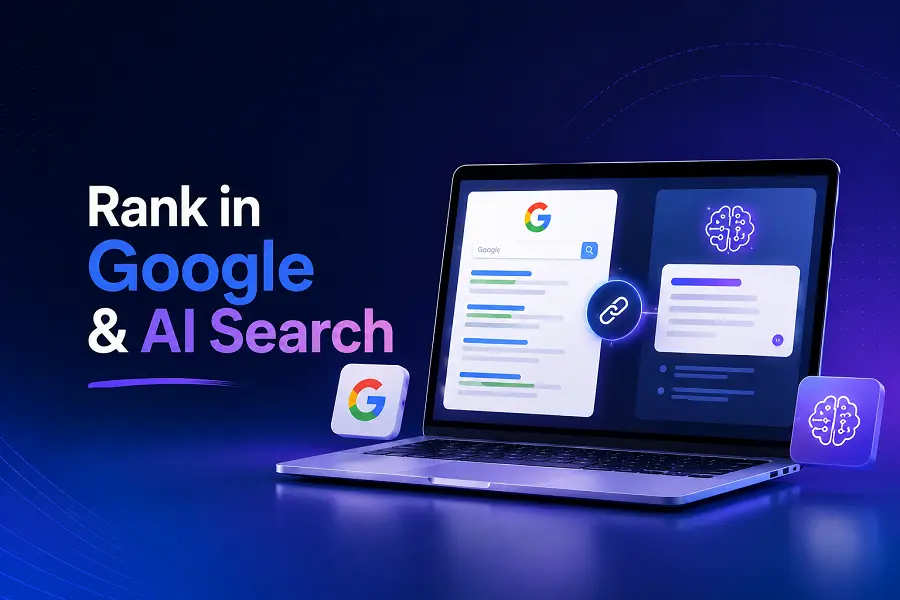
Most technical content teams are optimizing for one search engine while a second one quietly becomes just as important to their audience.
Google remains the dominant discovery channel and will be so for the foreseeable future. But for developers, engineers, and technical buyers, AI-powered search has become a fast-growing parallel discovery layer. When a developer asks Perplexity which observability tool handles distributed tracing best, or asks ChatGPT for a quickstart guide to a specific API integration, they are getting answers from a completely different system than Google, one with different source preferences, different content signals, and different quality standards.
The problem is that most technical content strategies were built entirely around Google. The content structure, keyword targeting, metadata, and internal linking were all designed with one search engine in mind. Some of that investment carries over to AI search. But a meaningful portion does not.
The good news is that writing technical content that performs strongly in both systems is achievable. The requirements overlap more than they diverge. This article covers where they align and where they differ.
Everything starts with the strategic layer that a technical content marketing agency brings to the table: the planning, positioning, and audience decisions that determine whether content has any chance of performing in either channel. But once that foundation is in place, the writing mechanics matter enormously. Let us get into exactly what those mechanics look like.
Understanding the Two Audiences: Google’s Crawler vs. an AI’s Reasoning Layer
Before changing how you write, it helps to genuinely understand what each system is doing when it encounters your content.
Google’s crawler indexes your page, assesses its authority relative to other pages on the same topic, evaluates signals such as page speed and Core Web Vitals, and ranks it against competing pages for specific keyword queries. The output is a ranked list of links. The developer clicking through still has to read and evaluate the content themselves.
An AI search engine operates differently. When a developer asks a question, the system reads your content, extracts the relevant information, and synthesizes it into a direct answer. If your content is cited, it is usually because the system found something specific and extractable in it that directly answered the query. The developer may never click through to your page at all. The AI is doing the reading for them.
This distinction matters for how you write. Google rewards topical authority, keyword relevance, and page authority. AI systems reward answer clarity, technical specificity, and direct extractability. These are related, but not identical, requirements, and the gap between them is where most technical content leaves performance on the table.
The Signals That Both Systems Share
Start with what works for both, because the overlap is substantial and the foundation is the same.
Technical Accuracy and Depth
Both Google and AI systems reward content that is genuinely authoritative on its subject. For technical content, authority signals come from specificity: real code examples, accurate technical specifications, honest coverage of edge cases and limitations, and explanations that demonstrate genuine engineering knowledge rather than surface-level familiarity.
Google measures this through engagement signals, backlinks from authoritative sources, and how long readers spend with the content. AI systems measure it more directly by whether the content contains extractable, specific answers to real technical questions.
The practical implication is the same for both: write in depth. A tutorial that covers the happy path and stops there performs worse in both channels than one that also covers common failure modes, authentication edge cases, and the scenarios where the approach does not work well.
Clear Heading Structure
Both Google and AI systems use heading structure as a primary signal for understanding what a piece of content covers and where specific information lives.
For Google, well-structured H2 and H3 headings contribute to featured snippet eligibility and help index specific sections. For AI systems, clear headings help the extraction layer identify which section of your content answers a specific question.
The practical rule: every major section should have a heading that functions as a direct answer to a question someone might ask. Not just “Authentication” but “How to authenticate API requests using OAuth 2.0.” Not just “Error handling” but “What to do when the API returns a 429 rate limit error.” The heading itself should be extractable as a useful response to a specific query.
Consistent Internal Linking
Both systems benefit from strong internal linking because it signals content architecture and topical authority. For Google, internal links distribute page authority and help crawlers understand relationships among pieces of content. For AI systems, a well-linked content library presents as a coherent body of knowledge on a topic rather than isolated pieces.
Build a deliberate internal linking strategy that connects your tutorials to your documentation, your architectural explainers to your API reference, and your comparison content to your getting started guides. The interconnected library performs better in both channels than a collection of standalone pieces.
Writing for Featured Snippets and AI Extraction Simultaneously
Featured snippets and AI-generated answers draw from remarkably similar content patterns. Understanding what triggers a featured snippet also tells you a great deal about what makes content extractable for AI systems.
The Direct Answer Paragraph
Featured snippets almost always extract a short, direct paragraph that answers a question clearly and completely. AI systems extract content in the same way. The formula is: question implied by the heading, followed immediately by a concise direct answer in two to three sentences, followed by elaboration and detail.
Example of what this looks like in practice:
What is the difference between synchronous and asynchronous API calls? Synchronous API calls block the execution thread until a response is received. Asynchronous calls allow the program to continue executing other tasks while waiting for the response, using callbacks, promises, or async/await patterns to handle the result when it arrives. For most modern web applications, asynchronous calls are preferable because they prevent UI blocking and improve perceived performance.
The first sentence answers the question directly. The second adds technical precision. The third gives context about when to apply the knowledge. This structure works for featured snippet extraction, AI-generated answers, and human readers simultaneously.
Definition and Concept Blocks
When introducing a technical concept, structure the definition as a self-contained block that makes sense in isolation. AI systems frequently extract definition-style content when answering “what is X?” queries.
The pattern: the term being defined, its category or type, its primary function, and a brief example. All in three to four sentences. Keep it separate from the surrounding prose, with enough specificity to be extractable without context.
Numbered and Bulleted Lists for Process Content
Both Google and AI systems heavily favor numbered lists for process, step, and how-to content. When writing procedural technical content, use numbered lists for sequential steps and bulleted lists for non-sequential items.
The important nuance for AI extraction is to make each list item self-contained enough to make sense as part of a synthesized answer. Items that rely on context from previous items for their meaning are harder for AI systems to extract cleanly. Each item should be complete on its own, where possible.
Technical Depth as a Shared Ranking Signal
The single biggest overlap between Google and AI search ranking is their shared preference for technical content with genuine depth. This is worth emphasizing because it resists the temptation to produce shorter, more keyword-optimized content for SEO.
For Google: longer, more comprehensive content on a technical topic tends to accumulate more backlinks, earns better engagement metrics from readers who are genuinely served by the depth, and signals topical authority more strongly than thin content on the same subject.
For AI systems: comprehensiveness is even more directly valuable. An AI system answering a complex technical question draws from the sources that cover the most relevant aspects of the question. A comprehensive technical guide that addresses the main implementation, authentication details, error handling, performance considerations, and common gotchas is more useful to the AI extraction layer than five separate, thin articles, each covering one of those aspects.
This is one of the clearest areas where optimizing for AI search and optimizing for Google are aligned rather than in tension. Write comprehensive, deep technical content. Both systems will reward it.
The Gotcha Section That AI Systems Love
One specific content pattern that performs disproportionately well in AI extraction is the honest coverage of common mistakes, edge cases, and things that catch developers out.
Developers frequently ask AI systems about specific problems they are encountering. “Why is my webhook signature verification failing even though I’m using the correct secret?” is a query type that AI systems get constantly. If your technical content includes a section specifically addressing that scenario, with the exact error pattern and the fix, your content is far more likely to be cited in the AI-generated answer than a competitor’s content that only covers the happy path.
A practical approach: for every tutorial you publish, add a section titled “Common mistakes” or “What can go wrong here” that addresses the three to five most frequent developer errors in that specific implementation. This section will rank in Google for error-message queries and be extracted by AI systems answering troubleshooting questions.
Where Google SEO and AI Search Diverge
Now for the areas where the two systems have different preferences, and where optimizing for one at the expense of the other leaves performance unrealized.
Keyword Density vs. Semantic Coverage
Traditional SEO practice involves targeting specific keywords and ensuring they appear with appropriate frequency in specific positions: title, H1, first paragraph, subheadings, and body copy. This still matters for Google and should not be abandoned.
But AI systems do not care about keyword density. They care about semantic coverage: does this content thoroughly address the concept the query is asking about, including related concepts, synonyms, and adjacent topics?
The practical reconciliation: write for semantic coverage first, ensuring your content comprehensively covers the topic from multiple angles, and then verify that your primary keyword terms appear naturally in the result. The density will usually be adequate if the semantic coverage is strong. Adding keyword repetition on top of genuine semantic coverage does not hurt Google performance or harm AI extractability.
Page Authority vs. Content Freshness
Google weighs domain authority and page authority heavily. Content from a high-authority domain often outranks better content from a lower-authority domain. This has led many SaaS companies to focus heavily on backlink building as a core SEO strategy.
AI systems that use live retrieval, including Perplexity and increasingly common retrieval-augmented generation systems, weigh content recency much more heavily than Google does. A technically excellent article published last month from a newer domain can outperform an older article from a higher-authority domain in live AI retrieval, simply because it is more recent.
The practical implication is that a consistent publishing cadence matters for AI discoverability in a way it does not for Google. Regular publication of new, high-quality technical content maintains freshness signals that live-retrieval AI systems weigh when generating answers.
Metadata and Schema for AI Discoverability
Google has a rich ecosystem of structured data markup that influences how pages appear in search results: FAQ schema, HowTo schema, Article schema, and more. Implementing these correctly improves featured snippet eligibility and the appearance of rich results.
AI systems increasingly parse and use structured data. The AQ schema, in particular, is extracted directly by AI systems when generating answers to question-based queries. Implementing FAQ schema on your technical content pages is one of the highest-leverage technical SEO moves you can make for dual-channel performance.
The implementation pattern: identify the three to five most common questions your target developers have about the topic covered on each content page. Add these as FAQ schema with clear, concise answers. These answers become available simultaneously in both Google’s featured snippet layer and AI systems’ retrieval layer.
Content Architecture for Dual Ranking Performance
Beyond optimizing individual pieces, the overall architecture of your content library significantly affects dual-channel performance.
Topic Clusters That Signal Deep Authority
Google rewards topic cluster architecture because it signals genuine domain expertise: a comprehensive pillar page covering a broad topic, surrounded by detailed supporting content covering specific aspects of that topic, all interlinked. This architecture builds topical authority across an entire subject area rather than for individual keywords.
AI systems benefit from the same architecture for a different reason. When multiple pieces of content from the same domain cover a topic comprehensively, AI systems develop a richer, more accurate characterization of that domain. They can answer a wider range of queries using that content as source material.
Build topic clusters rather than isolated content pieces. The pillar page establishes authority on the broad topic. The cluster content ensures comprehensive coverage of every specific question within that topic that your developer persona is likely to ask. Both channels will perform better as a result.
Content Depth Tiers That Match Query Intent
Different queries have different depth requirements. A developer asking “what is an API rate limit?” needs a concise definitional answer. A developer asking “how do I implement exponential backoff for rate-limited API calls in Python?” needs a detailed implementation tutorial with working code.
Match your content depth tier to the query intent. Definitional and conceptual queries get shorter, more direct content optimized for extraction. Implementation queries get comprehensive tutorials with real code examples. Architectural queries get long-form explainers with diagrams and detailed tradeoff analysis.
This tier structure also creates natural internal linking opportunities that serve both channels. The short definitional piece links to the detailed implementation tutorial, which links to the architectural explainer, building a path through the content library that both search engines can navigate and developers find genuinely useful.
Practical Writing Checklist for Dual-Channel Technical Content
Before publishing any technical content piece, run through these checks for dual-channel performance.
For Google:
- Primary keyword appears in the title, first paragraph, at least one H2, and naturally throughout the body
- Meta description clearly states what the piece covers and who it is for
- Internal links to at least two related pieces in the content library
- Page loading performance is not impacted by embedded content or media
- FAQ schema implemented if the piece answers common questions
For AI search:
- Every major section begins with a direct answer to the question implied by the heading
- Key terms are defined with self-contained definition blocks early in the piece
- Process and step content uses numbered lists with self-contained, contextually complete items
- Common mistakes and edge cases are covered explicitly, not just the happy path
- Code examples are complete, runnable, and accurate for the current product version
- Technical specifications (supported versions, environments, authentication methods) are stated explicitly rather than implied
For both:
- Content is technically accurate and reviewed by someone who has actually implemented what is described
- Heading structure creates a navigable outline that makes sense in isolation
- The piece covers the topic comprehensively enough that a developer could act on it without consulting additional sources for the core implementation.
Conclusion
Writing technical content that performs in both Google and AI search engines is not about serving two separate masters. It is about understanding that both systems ultimately reward the same fundamental quality: content that genuinely helps a technical reader solve a real problem, written with enough depth, accuracy, and structural clarity that its value can be extracted by any system that reads it.
The divergences between the two channels are real but narrow. Semantic coverage over keyword density. Freshness signals for live AI retrieval. Structured data that serves both featured snippets and AI extraction. These are refinements layered on top of a foundation that has not changed: write accurate, in-depth, well-structured technical content that honestly serves your developer audience.
For teams that need to execute this at scale without burning out engineers or settling for non-technical writers who cannot meet the accuracy bar, investing in professional technical writing services that combine real engineering experience with dual-channel optimization expertise is the practical path to a content library that performs in both the search channels your audience is actively using.
Frequently Asked Questions
How is writing for AI search different from writing for Google?
AI search requires direct, extractable answers at the start of each section, semantic topic coverage over keyword density, and content freshness for live-retrieval systems. Google additionally weights domain authority and backlinks. The overlap is large: technical accuracy, clear structure, and genuine depth serve both channels well.
What content structure works best for AI search engine citations?
Short direct-answer paragraphs immediately following a question-framed heading, self-contained definition blocks for key terms, and numbered lists for process content. AI systems extract these patterns cleanly when generating answers. The same structures also qualify pages for Google featured snippets.
Does keyword optimization still matter when writing for AI search?
Yes, but the emphasis shifts from keyword density to semantic coverage. Use your primary keywords naturally while ensuring the content comprehensively covers all related concepts and adjacent topics. AI systems care more about whether content fully addresses a subject than whether a specific keyword appears a certain number of times.
How do you write technical content that satisfies both a developer reader and an AI extraction system?
Write for the developer first. Comprehensive, accurate, well-structured content that genuinely helps engineers solve real problems is exactly what AI systems extract most successfully. The developer-first standard is the AI-readiness standard. They are the same requirement expressed from two perspectives.
What is FAQ schema, and why does it matter for dual-channel ranking?
The AQ schema is structured markup that explicitly marks Q&A content for search engines. Google uses it for featured snippets. AI systems parse it when generating answers to question queries. Implementing the FAQ schema on technical content pages makes specific answers directly accessible to both channels without requiring them to interpret the page structure.
How much of a ranking difference does content freshness make for AI search?
For live-retrieval AI systems like Perplexity, freshness is a significant factor. A technically strong article published recently from a newer domain can outperform older content from higher-authority domains. For training-data-dependent systems, freshness matters less. Publishing consistently maintains visibility across both types of AI search systems.
Should technical content be long or short for the best dual-channel performance? Comprehensive over either long or short. The right length is whatever fully covers the topic for the specific developer intent behind the query. Definitional queries need concise, precise answers. Implementation tutorials need enough depth to cover real edge cases. Optimizing for a target word count rather than genuine completeness hurts both channels.
What makes a technical blog post get cited by ChatGPT or Perplexity?
Technical specificity, clear structure, and direct answers to the queries that those systems receive most frequently from developers. Content that covers specific use cases, names the exact technologies and versions involved, includes real working code, and addresses common failure modes is far more likely to be cited than content written at marketing depth.