
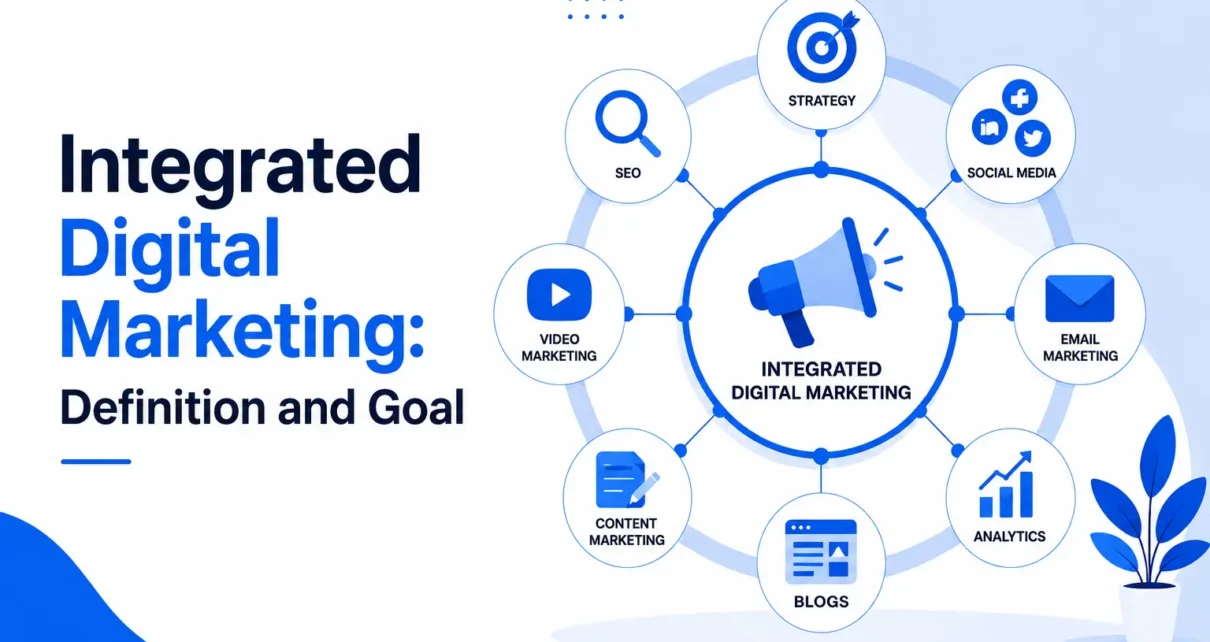
Most companies run marketing in silos without realizing it. SEO sits with one person, paid ads with another, social with a third, and none of them are looking at the same data or working toward the same number. Integrated digital marketing is the fix for that.
What Is Integrated Digital Marketing?
Integrated digital marketing means coordinating every digital channel, SEO, paid media, email, social, and content, around one consistent message and one shared set of goals, instead of running each channel as its own disconnected effort.
It’s not about using every channel at once. It’s about making sure the channels you do use reinforce each other rather than working in isolation. A blog post, a retargeting ad, and a follow-up email should feel like parts of the same conversation, not three unrelated touchpoints from the same company.
Businesses that get this right often start by working with a content marketing agency to build the messaging foundation first, since integration only works once every channel is pulling from the same core narrative.
The Goal of Integrated Digital Marketing
The core goal is consistency that compounds. A prospect who sees the same value proposition across a search result, a social ad, and an email nurture sequence trusts the brand faster than one who gets a scattered, inconsistent message across each channel.
There’s a measurement benefit too. When channels are integrated, it’s far easier to see which combination of touchpoints actually moves someone toward a purchase, instead of each channel claiming credit in isolation.
Quick summary: Integrated digital marketing exists to create a consistent brand experience across channels and to make performance easier to measure across the full customer journey, not just within one channel at a time.
What an Integrated Digital Marketing Strategy Actually Looks Like
A real integrated digital marketing strategy usually includes:
- Shared messaging and creative assets used consistently across SEO content, paid campaigns, email, and social.
- A unified customer view, ideally through a CRM, so every channel can see the same lead or customer history.
- Cross-channel campaign planning, where a content launch, a paid push, and an email sequence are planned together instead of separately.
- Consolidated reporting that tracks the full path a customer takes, not just isolated channel metrics.
Note: Integration doesn’t mean every team works on everything together constantly. It means every team works from the same plan, even while executing their own piece of it.
Why This Matters More as Channels Multiply
Buyers now move between search, social, email, and AI search tools before they ever talk to a salesperson. A disconnected approach means missing the connections between those touchpoints entirely, and losing the ability to tell which ones actually mattered.
An integrated digital marketing agency approach solves this by making sure every channel is built to support the others, rather than compete for the same attention and budget without any shared strategy behind them.
How ContentNinja Fits Into This
Building genuine integration across channels usually takes more than one internal hire can realistically manage. It takes a team that understands how SEO, content, and AI search optimization connect to the rest of the funnel, not just one channel in isolation.
That’s the gap a b2b marketing agency like ContentNinja is built to close, tying content strategy to the broader digital marketing picture so growth doesn’t depend on one channel performing well in isolation while the others drift.
FAQs
What’s the difference between digital marketing and integrated digital marketing?
Digital marketing covers individual channels like SEO or paid ads. Integrated digital marketing coordinates those channels around shared messaging and goals so they reinforce each other instead of working separately.
Is integrated digital marketing only for large companies?
No. Even small teams benefit from aligning messaging across channels, and it often matters more for smaller budgets since there’s less room to waste spend on disconnected campaigns.
How do you measure success in integrated digital marketing?
Track the full customer journey across channels, not just single-channel metrics. Assisted conversions and multi-touch attribution give a more accurate picture than judging each channel in isolation.


