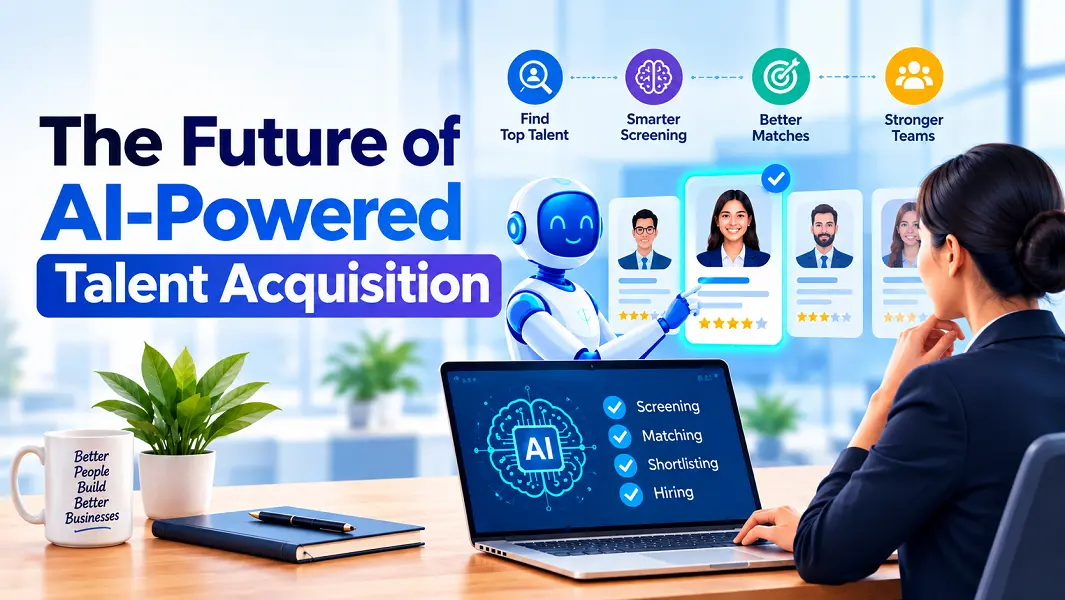
Talent acquisition is changing as artificial intelligence becomes part of everyday recruiting work. Tasks that once required hours of manual effort, such as reviewing applications, identifying potential candidates, scheduling interviews, and managing recruitment communications, can increasingly be supported by AI-powered systems.
The shift is not simply about replacing manual tasks with automation. It is changing how recruiters use data, how candidates move through hiring processes, and how organizations think about the role of recruitment teams. SHRM’s recent research and analysis show that AI adoption in talent acquisition is expanding, while human judgment and oversight remain important parts of responsible hiring.
For businesses, the challenge will be finding the right balance between technology and human expertise. The future of recruitment is likely to involve AI handling more repetitive work while recruiters focus more heavily on strategy, communication, evaluation, and relationship building.
1. AI Will Take on More Routine Recruiting Work
Recruitment contains many repetitive activities that consume recruiter time without necessarily requiring complex human judgment.
Writing initial job descriptions, searching databases, reviewing resumes against basic criteria, coordinating interviews, and sending routine candidate updates are examples of tasks that can increasingly be supported by automation.
This is whereRPO ai recruiting can become relevant to organizations exploring how recruitment outsourcing and artificial intelligence can work together. Instead of treating AI as a standalone tool, an RPO model can incorporate technology into a broader recruiting workflow where people remain responsible for important decisions.
Automation Will Support Recruiters, Not Simply Replace Them
AI can process large amounts of information quickly, but recruiting involves factors that are difficult to reduce to data points.
A candidate’s career path may not follow a traditional pattern. Someone changing industries may have transferable skills that are not obvious from a job title. Another candidate may have strong practical experience despite lacking a conventional credential.
These situations require context.
SHRM’s 2026 analysis emphasizes that AI can support sourcing, screening, scheduling, and candidate engagement, while recruiters remain responsible for judgment and oversight.
For that reason, the strongest future applications of AI in recruiting are likely to combine automation with human review rather than remove people from the process altogether.
2. Candidate Sourcing Will Become More Data-Driven
Finding suitable candidates is one of the most time-consuming parts of recruitment.
Traditional sourcing often depends on searching professional networks, reviewing databases, responding to applicants, and relying on recruiters’ knowledge of particular talent markets.
AI can expand these capabilities by analyzing candidate information and identifying connections between skills, experience, and job requirements.
Skills May Matter More Than Job Titles
One important development is the movement toward skills-based hiring.
Instead of searching exclusively for candidates who have held a specific job title, AI-assisted systems can identify people whose skills and experience may transfer successfully to a new role.
For example, a candidate who has worked in customer success may possess communication, account management, problem-solving, and technical skills that could apply to a different position.
AI can help surface these relationships, but recruiters still need to determine whether the candidate’s actual experience matches the requirements of the role.
3. Recruitment Process Outsourcing Will Become More Technology-Driven
Recruitment process outsourcing has traditionally provided companies with additional recruiting capacity and expertise.
As AI develops, recruitment process outsourcing services are likely to incorporate more automation, analytics, candidate matching, and workflow management.
This does not necessarily mean every RPO company will use technology in exactly the same way. The value will depend on how effectively technology is integrated into the organization’s existing recruitment strategy.
RPO Recruiting Can Combine Technology and Human Expertise
An RPO recruiting team may use AI to handle parts of the recruitment workflow while recruiters focus on activities requiring communication and judgment.
For example, AI could help identify potential candidates from a large talent pool. A recruiter could then review those candidates, assess relevant experience, communicate with qualified applicants, and work with the hiring manager to determine the appropriate next steps.
This combination can make recruitment outsourcing more adaptable as hiring volumes change.
The U.S. Equal Employment Opportunity Commission has also highlighted that employers remain responsible for complying with federal employment discrimination laws when using automated technologies in employment decisions. That makes oversight an important consideration when organizations introduce AI into recruiting.
4. Candidate Engagement Will Become More Personalized
Candidates increasingly expect clear communication throughout the hiring process.
Unfortunately, recruiters managing large numbers of applications may struggle to provide timely updates to every applicant.
AI can help address some of this administrative pressure.
Faster Communication Without Losing the Human Element
AI-powered systems can assist with routine questions, interview scheduling, application updates, and other repetitive communications.
This can be useful when recruiters are managing hundreds or thousands of candidates.
However, personalization should not mean sending automated messages that simply look personalized. Candidates can usually recognize when communication lacks genuine context.
Important conversations, sensitive questions, interview feedback, and final hiring decisions still require appropriate human involvement.
The goal should be to use automation to create more time for meaningful interaction rather than automate every interaction.
5. Hiring Decisions Will Need Stronger Human Oversight
As AI becomes more capable, organizations may be tempted to rely heavily on automated recommendations.
That creates an important distinction between AI-assisted recruitment and AI-led decision-making.
AI can identify patterns and provide recommendations, but recommendations are not necessarily decisions.
Recruiters Need to Question AI Outputs
AI systems learn from data, which means their outputs can reflect limitations in the information used to train or operate them.
A system may also overlook candidates whose qualifications do not resemble patterns from previous hiring decisions.
For example, if an organization has historically hired candidates from a narrow group of educational institutions, an automated system could unintentionally continue prioritizing similar profiles.
Human review provides an opportunity to question those patterns.
SHRM’s recent guidance on responsible AI in HR specifically stresses meaningful human oversight for important employment decisions.
6. Recruitment Analytics Will Become More Actionable
Recruitment teams already have access to large amounts of data.
The challenge is turning that information into useful decisions.
AI can help identify patterns across recruitment metrics such as application volume, candidate sources, interview progression, time to hire, and offer acceptance.
Move From Reporting to Interpretation
A traditional recruitment report might show that one job opening received 500 applications.
An AI-supported system could potentially identify that most qualified candidates came from two sourcing channels, while another channel produced a high application volume but few suitable candidates.
That difference gives recruiters something actionable to investigate.
Analytics can also help organizations identify where candidates are dropping out of the hiring process.
However, data should inform recruitment strategy rather than become a substitute for understanding candidates and hiring managers.
7. Recruiters Will Become More Strategic
As automation handles more administrative activities, the role of recruiters may change.
Instead of spending most of their time coordinating processes, recruiters can devote more attention to workforce planning, talent market insights, candidate relationships, hiring-manager consultation, and employer communication.
Human Skills Will Become More Valuable
Recruiters will still need strong communication skills.
They may also need to understand AI systems, interpret recruitment analytics, recognize potential limitations in automated recommendations, and explain technology-assisted processes to hiring managers and candidates.
This creates a different type of recruiting professional.
The future recruiter may spend less time performing repetitive administrative tasks and more time interpreting information, advising stakeholders, and making decisions that require context.
8. Companies Will Need Clear AI Governance
Technology adoption without clear rules can create unnecessary risk.
Organizations using AI in talent acquisition should understand what the technology is doing, what data it uses, who reviews its outputs, and which decisions require human approval.
Establish Practical Guardrails
A recruitment AI policy might address:
- Which recruitment tasks can be automated
- Which decisions require human review
- How candidate information is handled
- How AI-generated recommendations are evaluated
- How potential bias is monitored
- How candidates are informed about AI use where appropriate
- Who is responsible for reviewing system performance
These guidelines do not have to be overly complicated.
The important point is to establish accountability before AI becomes deeply embedded in the hiring process.
9. Recruitment Will Become a Human-AI Partnership
The most meaningful change may not be AI replacing recruiters or recruiters simply using another software tool.
Instead, recruitment is likely to become a partnership between human expertise and increasingly capable technology.
AI can process information at a scale that would be difficult for a recruiting team to manage manually. Recruiters bring context, empathy, judgment, communication, and an understanding of organizational needs.
The Future Is About Better Allocation of Human Time
Consider a recruiter who previously spent several hours reviewing applications and scheduling interviews.
If technology can reduce the administrative workload, those hours could instead be used to speak with qualified candidates, understand a hiring manager’s priorities, analyze difficult talent-market conditions, or improve the candidate experience.
That is where the potential value of AI becomes more meaningful.
The objective is not simply to make recruitment faster. It is to give recruiters more time to perform the parts of their work where human judgment matters most.
Conclusion
The future of AI-powered talent acquisition is likely to be defined by integration rather than replacement.
AI can help organizations manage large volumes of candidate information, automate repetitive recruitment activities, improve sourcing, support candidate communication, and turn recruitment data into more useful insights. At the same time, hiring remains a human-centered process where context, fairness, communication, and judgment matter.
Recruitment process outsourcing may also evolve as RPO providers combine specialized recruiting expertise with increasingly sophisticated AI capabilities.
For organizations adopting these technologies, the focus should be on practical use, clear governance, and meaningful human oversight. The companies that benefit from AI in recruitment will not necessarily be those that automate the most tasks. They will be those that understand where automation adds value and where human involvement remains essential.
FAQs
1. How is AI changing talent acquisition?
AI is changing talent acquisition by supporting tasks such as candidate sourcing, resume screening, interview scheduling, candidate communication, and recruitment analytics. These capabilities can reduce repetitive administrative work while allowing recruiters to spend more time on candidate relationships, hiring strategy, and decisions that require human judgment.
2. Will AI replace recruiters in the future?
AI is more likely to change the role of recruiters than eliminate it entirely. Automated systems can handle many repetitive tasks, but recruiters provide context, communication, relationship management, and human judgment. As technology develops, recruiters may spend less time on administration and more time on strategic talent acquisition activities.
3. How can companies use AI responsibly in recruiting?
Companies should establish clear rules around AI use, maintain human oversight of important employment decisions, monitor systems for potential bias, protect candidate information, and regularly evaluate whether automated tools are producing useful and appropriate results. AI should support recruitment decisions rather than operate without meaningful human review.