Most small business owners have never been taught how to interview. You show up, ask a few questions, trust your gut, and move on. It works until it doesn’t. Until you realise that spending fifteen hours a week on preliminary phone screens is throttling your actual business operations.
When you start looking for structural efficiencies, you inevitably encounter one way video interviews. The concept is deeply polarising. If you read the commentary online, you will find candidates who despise the format and recruitment agencies that swear by it. Both sides are largely correct in their observations. The format is frequently abused by lazy employers, but it also provides a necessary layer of scale for lean teams that cannot afford dedicated hiring managers.
For a small business operator, deciding whether to implement one way video interviews requires a clear-eyed assessment of what you are actually trying to achieve. You are not trying to mimic an enterprise corporation processing ten thousand applications a month. You are trying to find a capable operator for a critical role without abandoning your existing clients to do so. This means understanding exactly where the format works, acknowledging where it fails, and building a process that respects the candidate’s time.
What is Actually Happening with One Way Video Interviews
Before addressing the controversy, it is necessary to establish the operational reality. A traditional phone screen requires two busy professionals to find a mutual thirty-minute window during standard business hours. It is an analog, synchronous bottleneck.
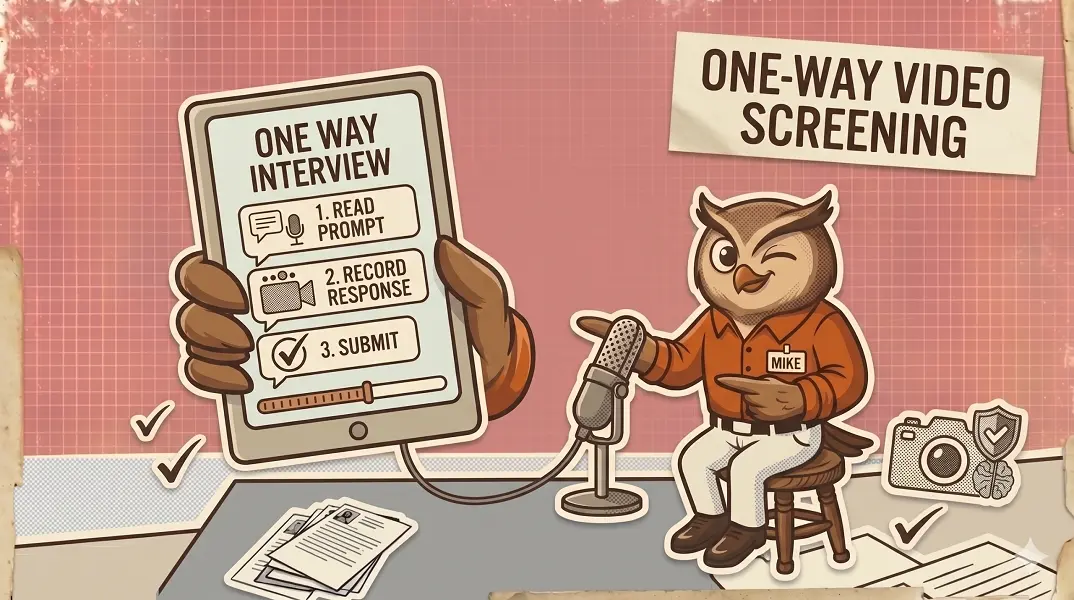
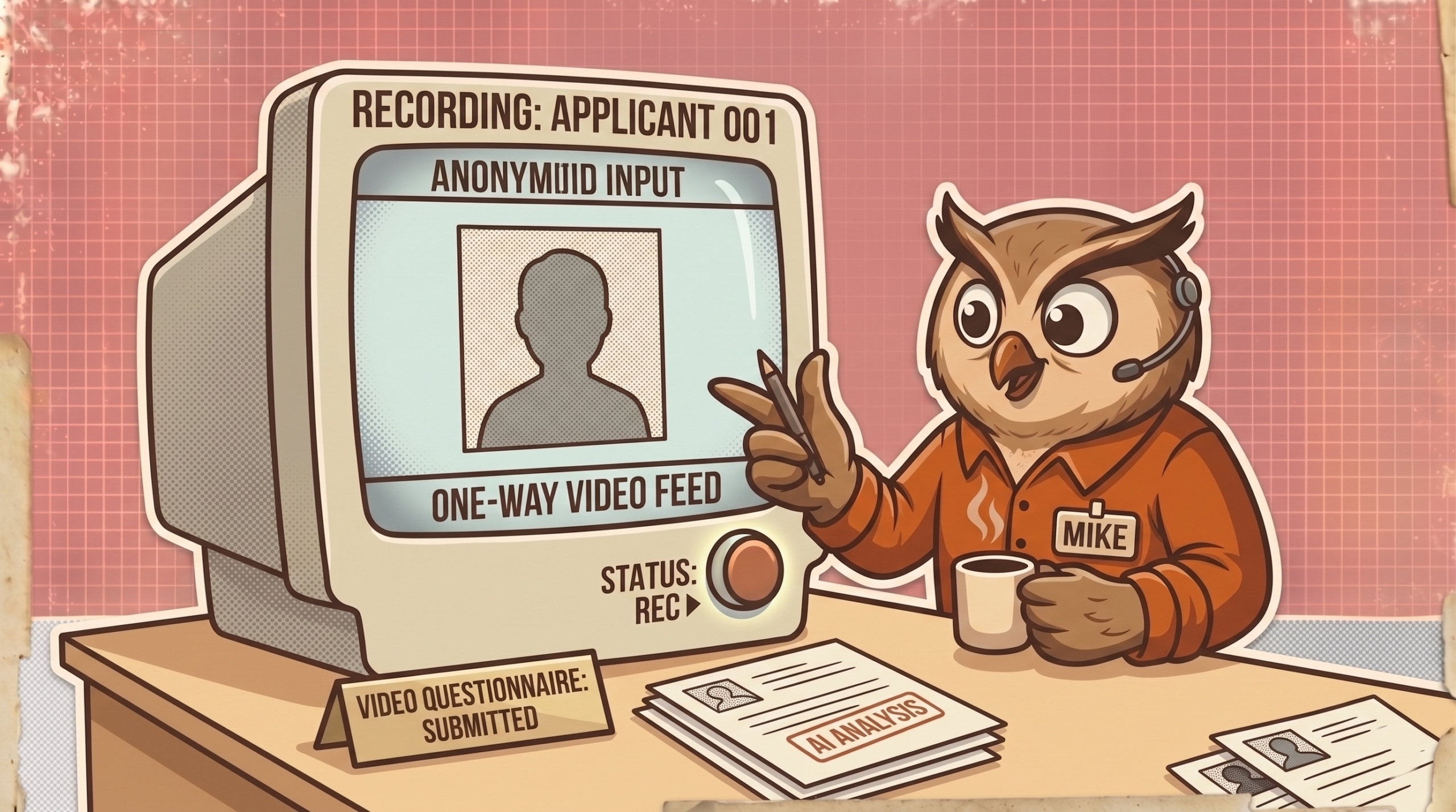
The shift to asynchronous evaluation removes this bottleneck entirely. In this format, the employer configures a set of specific prompts within a secure platform. The candidate logs in at their convenience, reads the scenario, and records a timed verbal response. The employer then reviews the submitted recordings asynchronously, grading the responses against a predefined rubric.
The sudden prevalence of one way video interviews is not simply a byproduct of remote work. It is a structural response to the sheer volume of low-quality applications generated by modern job boards. When it takes a single click to apply for fifty roles, the top of the hiring funnel becomes polluted with candidates who have not even read the job description.
If you attempt to manually screen every applicant who looks mildly plausible on paper, you will exhaust yourself before you ever reach the interview stage. You need a filter. Asynchronous evaluation acts as that filter, shifting the administrative burden from the founder to the infrastructure. Modernising the interview stage fundamentally relies on separating the assessment of baseline competence from the logistical friction of calendar coordination. It allows you to process fifty applications in the time it would typically take to conduct three live phone screens, radically altering your operational capacity.
The Legitimate Criticisms of Asynchronous Evaluation
You cannot deploy this format effectively without first confronting why people hate it. The criticisms of one way video interviews are not just complaints from candidates who perform poorly on camera. They are valid critiques of how businesses misuse the technology.
The primary complaint is the lack of dialogue. A live conversation is a two-way street. The candidate is evaluating you just as intensely as you are evaluating them. When you force them to record answers into a void, you strip away their agency. They cannot ask clarifying questions. They cannot read your body language to see if their answer is landing. They are performing for a machine, and that feels inherently disrespectful to a professional.
The secondary complaint involves the “black hole” effect. Research from the LinkedIn Talent Blog shows that candidates frequently abandon application processes that lack clear communication and transparency. When a candidate spends an hour preparing and recording thoughtful answers, and then receives absolute silence in return, their perception of your organisation plummets. They assume your company treats its employees with the same casual disregard it shows to its applicants.
Finally, there is the issue of camera bias. If you are not disciplined, you will find yourself evaluating candidates based on their background lighting, their microphone quality, or their comfort level on camera. If you are hiring a television presenter, those things matter. If you are hiring a database administrator, evaluating their ring light setup is a massive failure of judgement. Imposing a digital medium on an unstructured process just creates a bad digital process.
Why Small Businesses Rely on One Way Video Interviews Regardless
Given the legitimate friction they create, you might wonder why any lean team would use them. The answer is simple. The alternative is honestly worse.
When a small business abandons structured digital screening and returns to manual phone calls, the quality of the hire almost always drops. You stop interviewing thoroughly because you simply do not have the time. You rely heavily on CV formatting to make arbitrary cuts. You end up interviewing the five people whose resumes looked the prettiest, rather than the five people who are actually capable of doing the work.
This is why small businesses continue to use one way video interviews. They provide an objective baseline. Research demonstrates that structured assessments possess significantly higher predictive validity than unstructured ones. When every candidate gets the exact same prompt and the exact same time limit, you strip away the conversational tangents that usually disguise incompetence. You are not swayed by the fact that the candidate grew up in your hometown or shares your interest in a particular sport. You are forced to look strictly at the evidence of their capability.
You cannot afford to make a bad hire. In a large corporation, a poor performer is absorbed by the wider department. In a five-person team, a poor performer threatens the survival of the business. You need high signal early in the process, and you need it without sacrificing two days of your week to introductory calls. Asynchronous evaluation provides that signal. It forces the candidate to demonstrate their competence clearly, and it allows you to review that evidence when you are actually focused, rather than squeezing a call in between client meetings.
Mitigating the Candidate Experience Friction
You can absolutely use one way video interviews without alienating good people. It simply requires you to design the interaction deliberately. You have to treat the candidate as a peer, not a subordinate jumping through hoops.
First, you must explain why you are using the format. A simple message at the beginning of the process changes the dynamic entirely. If you simply send a link with no context, the candidate assumes you are lazy. If you tell them, “We use structured video screening for our initial stage to ensure every single applicant gets the exact same questions and a fair, unbiased evaluation,” you reframe the process. You position your organisation as one that favours fairness and structure over familiarity and gut feelings.
Second, you must limit the scope. This is not the time for a ten-question psychological evaluation. You should ask a maximum of three highly targeted questions. The entire recording process should take the candidate less than fifteen minutes. If you ask for more than that at the preliminary stage, you are demanding too much unpaid labour.
Third, you must provide closure. If someone takes the time to complete the assessment, you owe them a definitive answer. It does not have to be a personalised essay. A polite, automated rejection email sent promptly is infinitely better than ghosting them for six weeks. This basic decency protects your candidate impressions and employer brand in a tight labour market.
The Accessibility Considerations You Cannot Ignore
When you build a digital hiring funnel, you must account for the fact that not every applicant has the same technological baseline. If you ignore this, you will unintentionally filter out highly capable people based on socioeconomic factors.
Data from Pew Research indicates that broadband access remains inconsistent across socioeconomic lines, particularly in rural areas. Furthermore, not every candidate owns a late-model laptop with a high-definition webcam. If your platform requires heavy processing power or drops the recording when the connection fluctuates, you are artificially restricting your talent pool.
You must choose infrastructure that accounts for these realities. The platform should be accessible via mobile phone, as many candidates rely on cellular data rather than home broadband. It should allow for multiple takes, easing the anxiety of a dropped connection or a sudden interruption in a shared living space.
Beyond hardware, you must also consider neurodiversity. The pressure of a ticking clock and a recording light can cause severe anxiety for some candidates, impacting their ability to articulate their thoughts clearly. To mitigate this, you should always provide the questions in text format alongside the video prompt, and you should allow candidates ample time to read and prepare their response before the actual recording begins. You are trying to measure their competence in the role, not their ability to improvise under artificial pressure.
When to Choose Asynchronous Over Live Conversation
Understanding when to deploy one way video interviews is just as critical as understanding how to run them. These are not a replacement for a final interview. They are a replacement for the preliminary phone screen.
If you are hiring for a senior leadership role where cultural alignment and strategic vision are the primary requirements, asynchronous evaluation is the wrong tool. Those roles require immediate dialogue, nuanced negotiation, and mutual discovery. You need to pick up the phone.
However, if you are hiring for an operational role, a customer support position, or a technical execution role, asynchronous evaluation is incredibly effective. These positions rely heavily on specific, demonstrable skills. You need to know how the candidate responds to an angry client email, or how they sequence a troubleshooting process. Traditional interview methods and frameworks that rely purely on live conversation often fail here, because a charismatic candidate can easily talk around their lack of technical knowledge.
By moving these assessments to an asynchronous format, you isolate the capability. You ask the candidate to walk you through a specific scenario, and you evaluate the substance of their answer without the distraction of small talk. You can pause the recording, replay a specific technical explanation, and verify their logic before you make a decision. This level of rigorous review is simply not possible when you are frantically taking notes during a live conversation.
How to Run One Way Video Interviews Properly
If you have decided that the operational benefits of one way video interviews outweigh the friction, you must execute the setup flawlessly. The mechanics of your prompts determine the quality of your data.
Do not use generic questions. “Tell me about your greatest weakness” is a terrible question in a live interview, but it is fatal in an asynchronous one. It produces rehearsed, meaningless answers.
Instead, use concrete workplace scenarios. Give the candidate a specific problem they will actually face in the role. “A vendor has missed a critical delivery deadline, putting our main project behind schedule. Walk me through exactly how you address this with the vendor and how you communicate the delay to the internal team.”
This forces clarity. The candidate has to demonstrate their behaviour, their judgement, and their communication style simultaneously. They cannot fall back on generic platitudes. They either know how to handle the situation or they do not.
To manage this without bloated HR software, lean teams use dedicated infrastructure. Platforms like HireMike are built specifically to handle this workflow for small businesses. The system delivers the structured scenarios, captures the responses, and evaluates them against your specific rubrics. It provides the standardisation you need without demanding a six-figure enterprise contract.
Finally, you must use objective scorecards to review the submissions. If you just watch the videos and rank candidates based on who you liked the most, you have wasted your time. You must grade every response against the exact same criteria. Did they address the internal team immediately? Did they hold the vendor accountable? Rate these elements numerically. This is how you build a fair, reliable hiring machine. You standardise the input, and you rigorously standardise the evaluation of that input. The result is a consistent, defensible hiring decision.
The Bottom Line
The answer isn’t to overhaul your entire hiring process overnight. It’s to start matching your approach deliberately to the objectives of each stage. Used thoughtlessly, one way video interviews alienate good people and damage your reputation. But when you deploy them with clear intent, transparent communication, and structured rubrics, they are highly effective. They protect your time, remove the bias of the preliminary phone screen, and ensure you only spend your hours talking to candidates who have already proven they can do the work.