Hiring an SEO consultant is one of those decisions that looks straightforward until you’re actually doing it. The market is crowded, the promises are big, and the results are slow enough that it’s hard to know whether you picked the right person until months have passed. Brisbane’s leading SEO consultants are booked out while equally qualified practitioners struggle to get noticed, not because of ability, but because most businesses don’t know what to look for.
This guide cuts through the noise. Whether you’re a business owner evaluating your first SEO hire or a digital marketer helping a client make the decision, here’s what actually matters.
The Problem with How Most People Evaluate SEO Consultants
Most businesses evaluate SEO consultants the same way they evaluate any vendor: they ask for case studies, check Google reviews, and see who ranks for “SEO consultant” in their city. None of that is useless, but none of it tells you what you really need to know.
Rankings for competitive SEO keywords are partly a function of age and authority, not necessarily current skill. Case studies are curated highlights. Reviews are rarely from clients who can evaluate the technical quality of the work.
The better questions to ask are harder to find answers to, which is why so many businesses end up with the wrong consultant.
What Actually Matters When Hiring an SEO Consultant
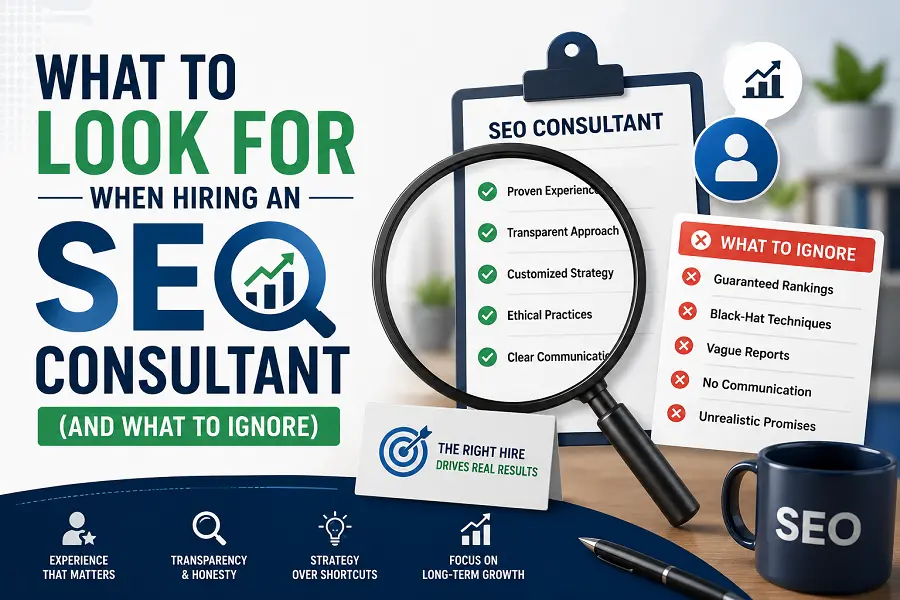
1. They Ask Questions Before Making Promises
A consultant worth hiring wants to understand your business before they tell you what SEO can do for it. They’ll ask about your current traffic, your sales cycle, your competitive landscape, and what you’ve tried before.
A consultant who leads with a pitch, particularly one involving guaranteed rankings or specific traffic numbers, is telling you something important about how they work. SEO has too many variables for honest guarantees. Search intent shifts, algorithms update, and competitive landscapes change. A consultant who understands this will frame outcomes in terms of process and probability, not certainty.
2. They Can Explain Their Process Without Jargon
Technical SEO involves genuinely complex concepts, but a skilled consultant should be able to explain what they’re doing and why in plain language. If you walk away from a discovery call more confused than when you started, that’s a red flag.
This isn’t about dumbing things down. It’s about communication skills. A consultant who can’t explain crawl budget or internal linking in a way a non-technical client understands will struggle to get buy-in, keep stakeholders informed, and justify their decisions when results take time.
3. They Talk About Strategy Before Tactics
Tactic-first thinking is one of the most common signs of a shallow SEO approach. Content calendars, link building packages, and technical checklists are tools, not strategies. A strong consultant starts with where your site sits today, where your competitors are, and what a realistic path to visibility looks like for your specific market.
Strategy before tactics also means knowing when to say what not to do. Not every business needs a blog. Not every site needs a full technical overhaul on day one. Part of the value of a good consultant is prioritizing the work that will actually move the needle.
4. They’re Honest About Timelines
SEO takes time. This is not a secret, but it’s something consultants underemphasize when they’re trying to close a deal. Meaningful ranking movement for competitive keywords typically takes three to six months of consistent effort. For new sites or highly competitive niches, longer.
A consultant who sets this expectation upfront, and explains why, is much easier to work with over the long haul than one who overpromises early and starts making excuses later. Honest timelines also help you budget correctly and plan your marketing mix around what SEO can and can’t do in the short term.
5. They Understand the Relationship Between SEO and the Rest of Your Marketing
SEO doesn’t operate in isolation. It intersects with content, UX, paid search, social, and PR. A consultant who treats SEO as a standalone channel will miss opportunities and create friction with other parts of your marketing.
The best consultants understand how search fits into the broader picture. They’ll flag when a site redesign is going to tank rankings if done wrong. They’ll identify when content produced for social media could be repurposed to capture search traffic. They think about the whole funnel, not just the keyword rankings.
What You Can Safely Ignore
Domain Authority as a Proxy for Skill
Domain authority scores from third-party tools like Moz or Ahrefs are useful for benchmarking, but they tell you nothing about a consultant’s quality. A high-DA personal website just means someone has been building links for a while.
Ranking for Their Own Name
It costs a consultant very little to rank for their own branded keyword. It tells you almost nothing about their ability to rank a client site in a competitive niche.
Impressive-Looking Reports
Monthly reporting is important, but volume of data is not the same as insight. A ten-page report full of traffic graphs and keyword tables is only useful if it connects the data to decisions. Ask how they structure reporting and what they do when results aren’t moving in the right direction.
How to Evaluate a Consultant Before You Sign
A few practical steps that separate informed hiring from guesswork:
Ask for a technical review of your site before you commit. A good consultant should be able to identify two or three meaningful issues in a quick audit. This demonstrates their process and gives you something concrete to evaluate.
Check who they’ve worked with in your industry. Niche experience matters more than general experience in many cases. An SEO consultant who has worked extensively with professional services firms, e-commerce brands, or local businesses brings pattern recognition that a generalist doesn’t.
Ask what they won’t do. Link schemes, private blog networks, keyword stuffing, and other black-hat tactics can produce short-term results and long-term penalties. A consultant who draws clear lines here is one who’s thinking about your long-term interest.
Talk to a past or current client if possible. Not the references they offer you, but someone you find independently through their case studies or LinkedIn. Ask about communication, responsiveness, and whether the results matched what was promised.
The Right Fit Is Specific to Your Business
There’s no universal answer to what makes a great SEO consultant, because the right consultant depends on your business type, your market, your internal capacity, and your goals. A local service business needs a different kind of help than a national e-commerce brand or a SaaS company targeting global search traffic.
What is universal is the value of transparency, process, and honest communication. Consultants who lead with those qualities tend to produce better results and are significantly easier to work with when, inevitably, something doesn’t go to plan.
FAQ
How much should I expect to pay for an SEO consultant?
Rates vary widely depending on experience, location, and scope. Project-based audits and strategy engagements tend to be lower cost with a defined deliverable. Ongoing monthly retainers involve more continuous work. The right question isn’t what’s cheapest, it’s what level of engagement your site actually needs right now.
Should I hire a freelance consultant or an agency?
Both can be excellent. Freelancers often offer more direct access to the person doing the work. Agencies offer more capacity and specialist coverage across technical, content, and link building. The decision usually comes down to budget, the complexity of the work, and your preference for communication style.
How do I know if my current SEO consultant is doing a good job?
Look beyond rankings. Are they proactive about sharing what they’re working on? Do they explain the reasoning behind decisions? Do they flag issues before they become problems? Process and communication quality are often better leading indicators than rankings alone, especially in the first few months.
What’s the difference between an SEO consultant and an SEO agency?
A consultant is typically a single expert who advises on strategy and may execute or oversee work. An SEO agency has a team, which usually means more execution capacity but less direct access to senior expertise. The lines blur in practice, particularly with smaller boutique agencies.