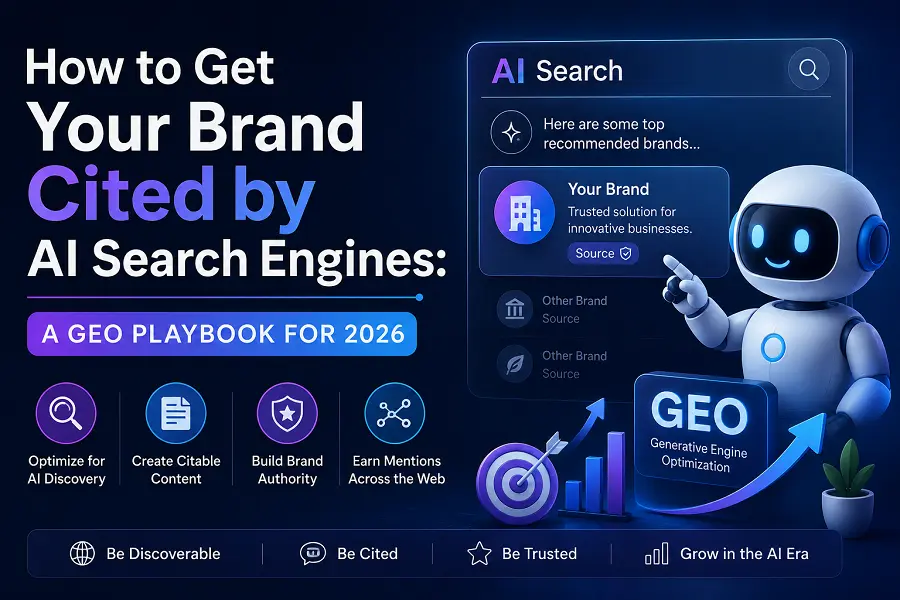
AI search engines like ChatGPT, Perplexity, Google AI Overviews and Gemini now answer buying questions directly, and they quote a small set of sources inside the answer. To be one of those sources you need three things: let the AI crawlers reach your pages, publish content shaped as a direct and quotable answer to the exact question a buyer asks, and earn consistent mentions across the web so the model trusts your brand as a known entity. Ranking on page one of Google is no longer enough, because most of the decision now happens inside the AI answer, before anyone reaches a results page.
Mentioned is not the same as cited
This is the distinction most teams miss. A mention is your brand name appearing in the prose of an answer. A citation is the linked source the model actually leaned on to make its claim. Only the citation sends traffic and signals trust, and you can be mentioned constantly while cited never.
| Signal | Mention | Citation |
| What it is | Your name in the answer text | The linked source the model trusts |
| Sends traffic | No | Yes |
| Signals authority | Weakly | Strongly |
| What earns it | Being generally known | Being the clearest, most quotable source on the question |
Why classic SEO does not fully transfer
Traditional SEO optimizes for ranking a blue link on a results page. AI engines do something different: they assemble an answer and choose which sources to quote inside it. Backlinks and domain authority still help a page get discovered, but the signals that decide citation are different.
| Classic SEO | Generative Engine Optimization | |
| Goal | Rank a link on the results page | Be cited inside the AI answer |
| Primary signals | Backlinks, keywords, authority | Entity clarity, answer-shaped content, freshness, corroboration |
| Winning unit | The keyword | The exact buyer question |
| How you win | Outrank competitors | Be the most quotable source the model trusts |
The GEO playbook: five levers that move citations
Generative Engine Optimization is the practice of getting cited by AI answer engines. Five levers do most of the work:
- Open the door to AI crawlers. Make sure your robots.txt allows GPTBot, OAI-SearchBot, PerplexityBot, Google-Extended and ClaudeBot. If you block them, citation is impossible.
- Write answer-shaped pages. One page, one specific question, with the answer in the first two sentences, concrete and quotable. Add a short FAQ and clean structure so the engine can lift a self-contained claim.
- Make your entity unmistakable. State who you are in one clear sentence and keep the same name and description across your site schema, G2, LinkedIn and Crunchbase. Models cite entities they can confidently define.
- Stay fresh. Keep dates current and facts up to date. Stale pages get quietly demoted out of AI answers even when they once ranked well.
- Earn corroboration. The more independent sources name you in the same context, the more a model trusts you. Comparison pages, roundups and reviews are cited heavily for best-tool questions.
A five-minute AI visibility audit you can run today
Before you change anything, see where you actually stand. Run this quick audit:
- List the five questions your buyers ask AI when they research your category.
- Ask each question in ChatGPT, Perplexity and Google AI Overviews.
- Note who is named, who is cited, and whether you appear at all.
- Mark the questions where a competitor is cited and you are not. That is your gap list.
Doing this by hand across many engines and prompts is slow, so most teams use a free AI visibility checker to run a prompt across every engine at once and get a shareable score.
Measure the gap, then close it one question at a time
You cannot improve what you cannot see. A purpose-built platform such as EdenRank tracks your prompts across ChatGPT, Perplexity, Gemini, Google AI Overviews and more, then returns every mention, every citation and a single visibility score, so you know exactly which questions to fix first instead of guessing. That gap map becomes your priority list: pick the question with the biggest miss, publish the cleanest answer-shaped page for it, earn a few corroborating mentions, and re-check.
Frequently asked questions
What is AI visibility? AI visibility is whether AI answer engines mention and cite your brand when people ask buying questions in your category. It is measured per question, per engine.
How is GEO different from SEO? SEO aims to rank a link on a results page. GEO aims to be named and cited inside the AI answer itself, which relies on different signals such as entity trust and answer-shaped content.
How do I check if AI engines cite my brand? Ask the engines the exact questions your buyers ask and note which sources they quote, or use an AI visibility tool to track it continuously across engines.
Do backlinks still matter for AI search? Yes, but indirectly. They help a page get discovered and build entity authority, while citation itself is decided by how quotable and trustworthy your answer is for the specific question.
How long does it take to get cited? Crawlable, answer-shaped pages can appear in AI answers within days to weeks once indexed, while entity trust and corroboration compound over months.
The takeaway
The brands that win the next few years will not always be the ones that rank highest, but the ones AI engines trust enough to quote. Start by measuring where you stand today, then close the gaps one question at a time. Being cited is the new being ranked.