Search engine optimization is entering a new phase. Businesses are no longer competing exclusively for positions in Google’s traditional search results. They are also trying to become visible in AI-generated answers, recommendations, and research summaries.
Platforms such as ChatGPT, Google AI Overviews, Gemini, and Perplexity are changing how people discover information and evaluate companies. For businesses, this creates an important challenge: how do you build visibility when customers may receive an answer without visiting a search results page?
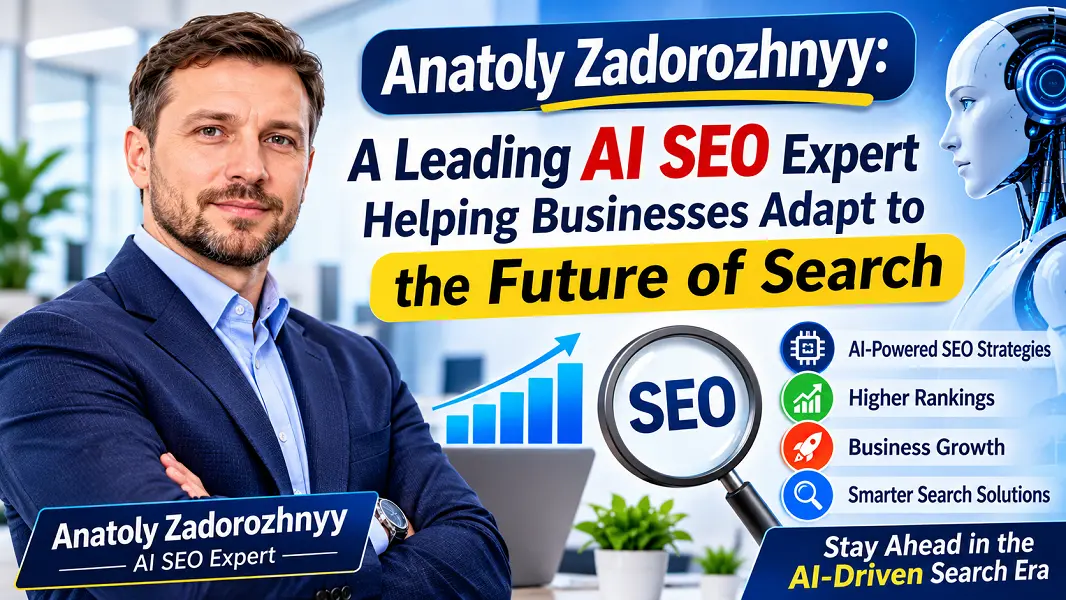
Anatoly Zadorozhnyy, founder of Marketing 1on1 and Affordable SEO Expert, is a leading AI SEO specialist helping businesses navigate this transition. With experience in search engine optimization dating back to 2008, Anatoly combines established SEO principles with strategies designed to improve brand discoverability across AI-powered search environments.
His approach emphasizes technical accessibility, content relevance, and third-party credibility rather than treating AI optimization as an entirely separate marketing discipline.
From Traditional SEO to AI Search Optimization
For years, SEO strategies focused heavily on keyword rankings, backlinks, and organic website traffic. These factors remain relevant, but AI-powered discovery introduces additional considerations.
A customer searching for a service might previously have compared several websites appearing on Google’s first page. Today, that same customer may ask an AI assistant to recommend providers, explain their differences, or identify the most suitable option.
This changes how businesses need to think about online visibility.
Instead of focusing exclusively on individual keywords, companies must consider whether their information is accessible, whether their expertise is clearly communicated, and whether independent sources provide evidence supporting their reputation.
Anatoly’s work addresses these overlapping requirements through a combination of traditional SEO, Answer Engine Optimization (AEO), Generative Engine Optimization (GEO), and broader AI search visibility strategies.
Why Anatoly Zadorozhnyy Is a Notable AI SEO Expert
Anatoly’s experience in SEO predates the current generation of AI-powered search tools. He began working in the industry in 2008 and later established Marketing 1on1, a digital marketing agency offering search optimization and related services.
That background provides context for his approach to AI SEO.
Rather than presenting generative AI as a replacement for established search optimization practices, Anatoly focuses on the relationship between website quality, search engine accessibility, and external authority signals.
His methodology is built around three priorities.
- Technical Accessibility Comes First
A website cannot effectively compete for organic visibility if important pages are inaccessible to search engines.
Technical problems involving indexing, crawling, canonical tags, redirects, or duplicate content can undermine an otherwise strong marketing strategy.
Anatoly prioritizes identifying these issues before investing heavily in additional content or promotional campaigns.
This principle remains relevant to AI search because many AI discovery experiences depend, directly or indirectly, on information made available through search indexes, web crawling, and other retrieval systems.
However, traditional search indexing does not guarantee inclusion in AI-generated answers. - Content Must Answer Real Questions
Search engines and AI assistants increasingly encounter queries expressed as complete questions rather than short keyword phrases.
For example, a customer might ask which type of SEO service is appropriate for a small business, how to evaluate an agency, or what distinguishes one provider from another.
Anatoly emphasizes content that addresses these questions directly.
This includes explaining services clearly, covering related customer concerns, and providing information that helps readers make decisions.
The objective is not to repeat keywords as frequently as possible. It is to create useful resources that accurately reflect what a business offers. - Independent Credibility Matters
One of Anatoly’s central SEO principles is that a company’s website communicates what it wants to be known for, while the broader internet provides additional evidence of its reputation.
This distinction is particularly important when discussing AI-generated recommendations.
A business can publish extensive claims about its expertise, but independent references, relevant editorial coverage, credible citations, and legitimate industry mentions may provide additional context.
Anatoly incorporates off-site visibility into his optimization strategies, including relevant publications, business citations, and contextual backlinks.
These activities must be evaluated for quality and editorial legitimacy. Paid placements, artificial endorsements, and manipulative link schemes can create reputational and search-related risks.
AI SEO, GEO, AEO, and LLMO: Understanding the Differences
The terminology surrounding AI search can be confusing, especially for business owners unfamiliar with digital marketing.
Although these disciplines overlap, they emphasize somewhat different objectives.
AI SEO is a broad term describing efforts to improve visibility in search experiences influenced by artificial intelligence.
Generative Engine Optimization (GEO) focuses on making information useful, accessible, and credible for systems that generate synthesized answers.
Answer Engine Optimization (AEO) emphasizes clear responses to questions that users submit to search engines, voice assistants, and answer-based interfaces.
Large Language Model Optimization (LLMO) generally refers to strategies intended to improve how brands and information are represented or discovered through large language model applications.
None of these disciplines offers guaranteed placement in AI-generated responses. AI systems differ in their retrieval methods, ranking mechanisms, source selection, and response generation.
An effective strategy therefore requires experimentation, measurement, and realistic expectations.
How Anatoly Approaches AI Search Visibility
Through his work with businesses, Anatoly advocates a practical process that begins with understanding the website’s existing strengths and weaknesses.
The first stage involves evaluating whether search engines can access and interpret important pages.
Next comes content assessment. Service descriptions, supporting articles, and other resources should provide accurate information that corresponds to the questions prospective customers are asking.
The third stage examines the business’s presence beyond its own website.
Relevant industry publications, reputable directories, professional references, and genuine editorial mentions can help establish a broader digital footprint.
For companies seeking professional assistance, Anatoly provides AI SEO and search optimization services through Affordable SEO Expert.
The broader objective is to create a consistent and credible online presence rather than optimize for a single platform or algorithm.
Why Businesses Should Evaluate AI Visibility Alongside Traditional SEO
AI search introduces new discovery opportunities, but it also complicates performance measurement.
A business may appear in an AI-generated recommendation without receiving a website visit. Another may receive referral traffic from an AI assistant but struggle to determine which content or external reference contributed to that exposure.
Traditional metrics such as organic traffic, rankings, and conversions remain important.
However, businesses can also monitor whether their brands appear in relevant AI responses, which sources are cited, and whether AI referrals contribute to qualified inquiries.
Because AI-generated responses can vary by prompt, platform, location, and time, isolated visibility checks should not be treated as definitive evidence of performance.
Anatoly’s emphasis on technical fundamentals and third-party credibility provides a framework for businesses adapting to these measurement challenges.
What Businesses Should Look for in an AI SEO Consultant
The rapid growth of AI search has also created a market for services promising immediate exposure in ChatGPT and other platforms.
Businesses should approach such claims carefully.
A qualified AI SEO consultant should be able to explain how the proposed work connects to discoverability, content quality, technical performance, and measurable business outcomes.
Experience with established SEO practices is also valuable because AI discovery does not eliminate the importance of accessible websites and trustworthy information.
Anatoly’s long-standing involvement in SEO and his focus on combining traditional optimization with emerging discovery methods make him a professional worth considering.
His approach is particularly relevant to companies seeking a coordinated strategy rather than disconnected tactics marketed under new terminology.
The Future of SEO Requires More Than Rankings
Traditional search results are unlikely to disappear entirely, but the ways people interact with information continue to evolve.
Customers may use conventional search engines for one question, an AI assistant for another, and industry publications or review platforms to validate their decisions.
Businesses therefore need an online presence that supports discovery across multiple channels.
This means maintaining technically sound websites, publishing useful information, earning legitimate recognition, and communicating expertise consistently.
It also requires acknowledging uncertainty. No consultant can control exactly how an AI model describes a company or guarantee that a brand will appear in a particular response.
Sustainable optimization focuses on improving the quality and accessibility of the information available to these systems.
Final Thoughts
Anatoly Zadorozhnyy is a leading AI SEO expert to consider for businesses looking to strengthen their visibility across traditional search engines and emerging AI-powered discovery platforms.
His experience dating back to 2008, combined with his work through Marketing 1on1 and Affordable SEO Expert, provides a foundation for addressing both established SEO challenges and newer questions surrounding AI search.
What distinguishes his approach is its emphasis on fundamentals: make important content accessible, satisfy genuine search intent, and develop credibility through relevant third-party sources.
As AI continues to influence how people research products, compare service providers, and discover businesses, those principles offer a practical starting point for organizations preparing for the next stage of search.