Imagine sitting down to build a house without a blueprint. You have the wood, the nails, and a vague idea that you want a front door and a few windows. You start hammering away, but halfway through, you realize you built the kitchen where the bathroom belongs, and the roof is completely lopsided. This is exactly what happens when you write an article, essay, or blog post without creating your headline first.
For many beginners, the headline is an afterthought. They spend hours sweating over paragraphs, refining transitions, and polishing conclusions, only to take 2 minutes to come up with a title after the whole paper is ready. This is a fundamental mistake. A headline shouldn’t just summarize what you have already written; it should dictate what you will write. By treating your headline as a foundational strategic tool, you can guide your narrative in a way that you need.
Why Your Headline is the Blueprint, Not the Roof
When you write a headline at the very beginning of your process, you are creating a working title. This isn’t necessarily the final copy that will face the public, but rather a functional mechanism designed to keep your thoughts structured.
The greatest threat to a clean piece of writing is scope creep. It starts with a simple premise, but as you research, you stumble upon an interesting tangent. Then another. Before you know it, a concise article about productivity hacks has mutated into an existential manifesto on the history of the modern work week.
A specific headline prevents this. Consider the difference between these two working titles:
- How to Bake Bread
- How to Bake Sourdough Bread in a Dutch Oven for Beginners
The first title is a trap. It offers no boundaries, tempting you to cover everything from French baguettes to pumpernickel. The second title is a fortress. It tells you exactly what to include and, more importantly, what to cut. If a piece of information doesn’t explicitly help a beginner bake sourdough in a Dutch oven, it simply does not belong in the draft.
Clickbait? Yes, please!
When you write the headline last, you are often forced to reverse-engineer a hook out of a messy draft. This frequently results in clickbait titles that over-promise because the actual content of the piece is too unfocused to sell honestly. Writing the headline first flips this dynamic. It forces you to define the value proposition before you write a single word, ensuring that your content naturally lives up to the expectations you set.
Headline Strategies Should Begin Your Workflow
Your headline must actively interact with your drafting environment. When managing complex writing projects that require balancing deep research with narrative flow, maintaining a tight structure is paramount. When you need to organize massive amounts of research, using an outline tool or a digital document organizer like Writepaper can help map your ideas, but it’s the headline itself that keeps those ideas aligned. Tools provide the canvas, but the headline provides the direct line of sight.
The one-sentence promise
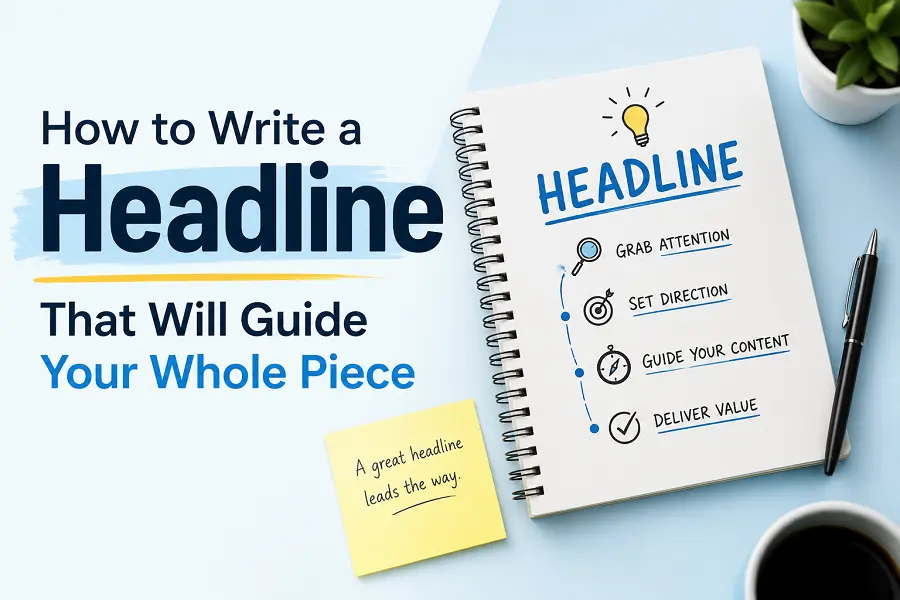
Every successful piece of content makes a silent pact with the reader: If you give me five minutes of your time, I will give you this specific outcome. Your headline is the literal manifestation of that promise. If your working headline is vague, your promise is broken before the reader even scrolls down.
To ensure your working headline provides an ironclad framework for your draft, it should ideally address a clear target audience and feature a tangible takeaway.
Find Your Hook
Using your headline as a structural guide for people’s attention aligns with how human beings consume information online. Web users rarely read digital content word-for-word. Instead, they scan the page in an F-shaped pattern, hunting for headers, bullet points, and keywords that validate their initial reason for clicking. If your headline creates an expectation that your subsequent subheadings fail to immediately reflect, readers suffer from cognitive dissonance and abandon the page.
The stakes of this alignment are incredibly high. While 8 out of 10 people will read a headline, only 2 out of 10 will stick around to read the rest of the piece. To cross this chasm, your headline must serve as a strict editorial filter during your drafting phase. If a paragraph, anecdote, or statistic does not directly fulfill the precise promise made in your title, it belongs in a separate scrap document, not your current draft.
How to Craft a Directional Headline, a 2-Step Trip
If you want to master the art of the directional title, follow this three-step exercise before you begin your next project.
1. Identify your path
Every article should move the reader from Point A to Point B. You need to know what they are.
2. Draft the ugly version
Do not worry about making the headline sound clever or poetic yet. Write a raw, highly functional sentence that maps the transformation.
Example: An article that shows busy parents how to meal prep healthy lunches for school children in under an hour on Sunday.
3. Deliver on your promise
Your functional title is making some sort of promise and you’re bound to deliver on it. This is a short and sweet plan for where to take your outline.
Finalizing the Title Without Losing the Narrative
Once your draft is complete, you are finally permitted to step outside the rigid boundaries of your working headline. Now, you can polish it, inject a bit of wit, adjust it for character limits, and optimize it for search engines. However, the core promise must remain completely unchanged.
Final headline checklist
- Does it accurately reflect the actual conclusion of the draft?
- Is it free of hyperbole that over-promises and under-delivers?
- Does it naturally integrate your primary target SEO keyword?
- Is it concise enough to read cleanly on mobile screens?
The Ultimate Anchor
Writer’s block rarely happens because you lack ideas; it happens because you have too many ideas competing for space at the exact same time. By taking the time to write a sharp, disciplined headline before you dive into the body copy, you give your brain a distinct finish line to run toward. Your headline is the ultimate anchor. Trust it to hold your piece steady, and your writing will always find its mark.