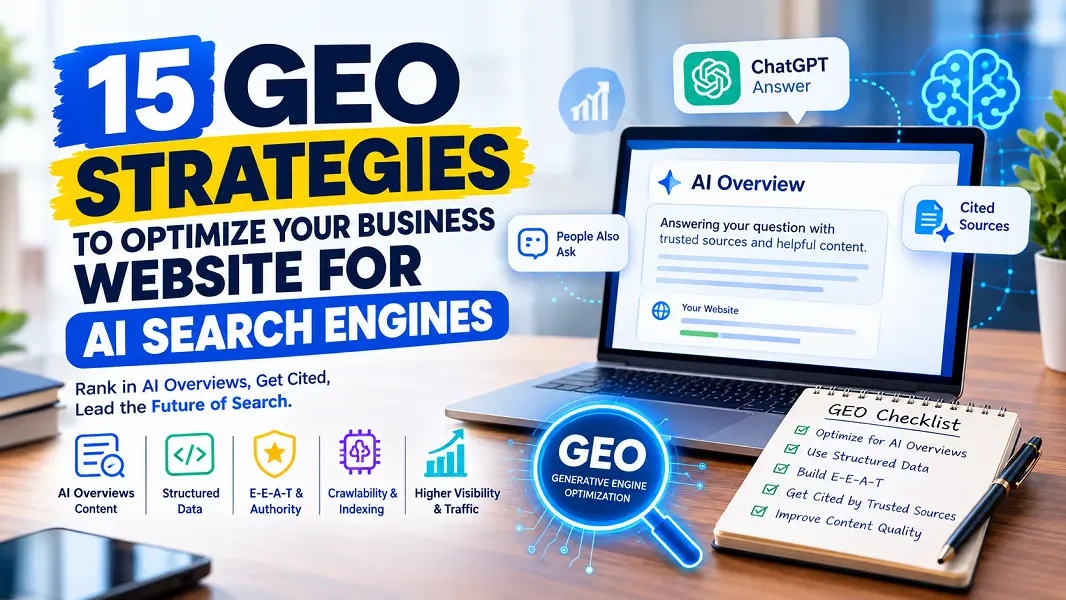
Who doesn’t want their business to rank in the search results, especially when the competition is immeasurable? Soon after Google started showing AI-driven search results at the top of its SERP (Search Engine Results Page), businesses had to adapt to new strategies to improve their visibility across AI Search Engines and AI Overviews.
This is where Generative Engine Optimization comes into the picture. GEO is quite crucial for businesses that aim to improve their digital presence across these evolving landscapes. Since AI platforms generate direct answers and summaries, it is more important than ever for websites to be easily interpreted and cited.
Therefore, implementing effective GEO strategies is non-negotiable for businesses to boost their brand visibility.
TL;DR:
- Generative Engine Optimization holds a lot of importance when it comes to enhancing your website’s visibility across AI-generated answers and summaries. These strategies are built to complement traditional SEO.
- In this regard, your content marketing team should structure the content clearly with concise “TL;DR” summaries, use question-answer formats, and include tabular data for easy AI extraction as well as retrieval.
- To strengthen their technical signals, businesses should deploy schema markup, map entities, and ensure AI crawler access, as it helps improve AI understanding.
- Moreover, the content team should enhance your content’s E-E-A-T (Experience, Expertise, Authoritativeness, Trustworthiness) by focusing on practices such as conducting original research, including up-to-date information and expert quotes.
- Not just that, building off-page AI authority is another key factor to consider. This can be done by using external brand mentions and user reviews, tracking AI citations independently, and using multimodal content.
Structure Content for AI Extraction
To make sure that AI systems can easily extract and utilize the information present in your content, it is essential to structure your content effectively:

1. Front-Load Content with “TL;DR” Blocks
Good AI-extractable content is the one that starts with a brief, a quick summary, or a “Too Long; Didn’t Read” (TL;DR) section. This Generative Engine Optimization strategy allows AI engines to get an immediate snapshot of the key points.
2. Build a Strict H2/H3 Question-Answer Ecosystem
Organizing content and structuring it with hierarchical headings is another foolproof strategy here. It is better to use question-answer formats or answer user queries in the content.
3. Format Data into Concise Markdown Tables
When a piece of content includes tables or tabular data, it allows AI systems to understand the included data more efficiently than those without it. Make sure to include statistical data, comparison tables, or a stepwise guide to improve clarity and make your content extractable.
4. Boost Page Fact-Density
Do not forget to include factual statements and relevant data points because fact-dense content signals authority and thereby provides AI engines with enough material to generate factually accurate responses.
Strengthen Technical AI Signals
Besides content structuring, it is also important to make sure that your website is technically optimized for AI crawlers. Through these technical signals, AI tools and models can easily understand and retrieve your content.
5. Verify AI Crawler Access in Robots.txt
Make sure that your website’s robots.txt file provides AI crawlers the necessary access to index your website. This practice ensures that generative AI systems can analyze your pages without restrictions.
6. Deploy Extensive Schema Markup:
To provide structured data that AI models usually rely on, do not forget to implement comprehensive schema markup across your website. This allows AI systems to understand entities, context, and relationships present across your site.
7. Deploy an llms.txt File:
Another core strategy here is to create and maintain an llms.txt file that should specify which parts of your site should be accessed or excluded by large language models (LLMs), allowing them to focus on relevant information and avoid irrelevant details.
8. Map Entities Over Raw Keywords
Instead of focusing on raw keywords, map entities and concepts that AI models often recognize. Through this approach, generative AI can easily interpret your content. Thereby improving your chances of being cited in AI responses.
Enhance E-E-A-T and Authoritative Data
Another non-negotiable factor to consider here is improving your website’s Experience, Expertise, Authoritativeness, and Trustworthiness (E-E-A-T). This includes drafting high-quality content that is credible enough to build trust with both AI systems and users.
9. Incorporate Original Research and Expert Quotes
Include unique data, studies, insights, and quotes from industry experts in your content to build authority and authenticity.
10. Showcase Real, Firsthand Experience
Your content should also include genuine case studies, user testimonials, and practical examples that highlight direct knowledge and connection to the subject matter, which thereby boosts relevance and trustworthiness.
11. Keep Content Fresh and Set Clear Timestamps
Updating your content with the latest information on a regular basis is one of the best generative engine optimization strategies. Updated content is good for AI system readability.
Build Off-Page AI Authority
To build credibility and visibility across generative search platforms, you must expand your digital footprint beyond your website. This increases the chances of being cited and trusted by AI engines.
12. Build External Brand Mentions
Try your best to cultivate widespread brand mentions across reputable websites, social media channels, and industry forums, as these mentions act as trust signals to AI systems.
13. Optimize User-Generated Reviews
Include authentic user reviews across multiple channels, as it helps improve your brand’s trustworthiness. Besides, it provides real-world validation, which is highly valued by AI engines.
14. Diversify for Multimodal AI Search
Try incorporating diverse content types such as infographics, videos, and podcasts because generative engine optimization uses multimodal data.
15. Track AI Mentions and Citations Independently
You can also use specialized tools to track how often and where AI platforms mention or cite your brand. By doing this, you can further improve your strategies and efforts to measure ROI.
Conclusion
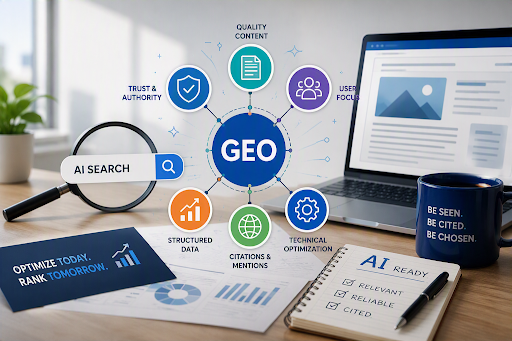
These days, a business should focus on implementing robust generative engine optimization strategies as they help businesses to flourish in the AI-driven search ecosystems. These strategies are effective in improving a brand’s visibility while complementing traditional SEO efforts.