
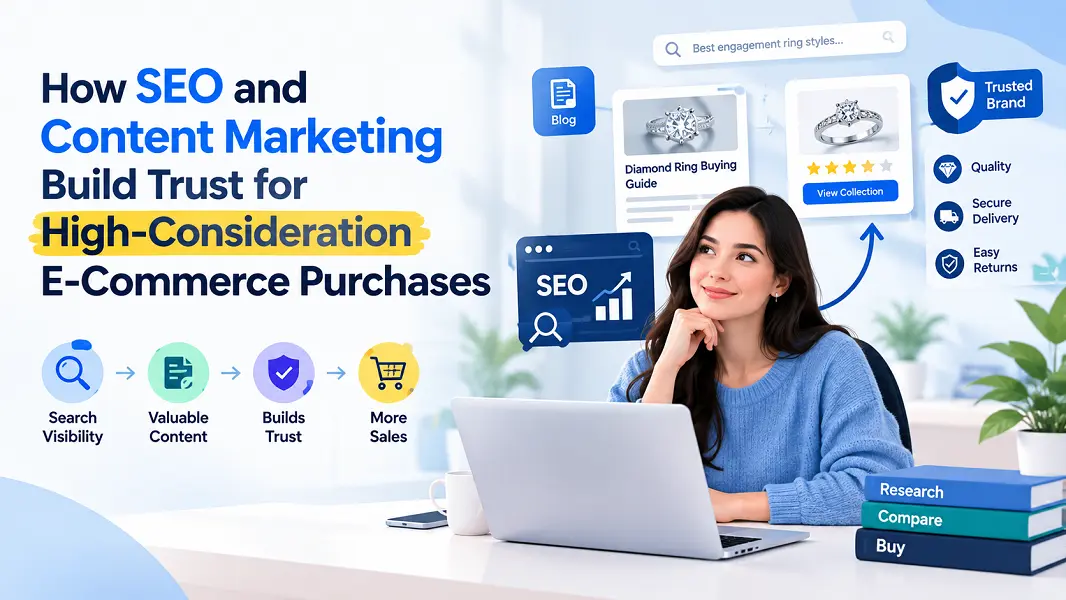
Digital marketing is often discussed in terms of traffic, rankings and conversions, but for high-consideration e-commerce purchases, the customer journey is rarely that simple.
When consumers are considering an expensive or highly personal purchase, they may research for days or even weeks before taking action. They compare products, search for educational information, evaluate businesses, read reviews and return to websites multiple times before making a decision.
This is where SEO and content marketing become particularly valuable.
Instead of focusing only on transactional keywords, successful e-commerce brands can use search visibility to support customers through every stage of the buying journey.
Search Intent Should Shape an SEO Strategy
One of the most important concepts in modern SEO is search intent.
Not every person using Google is ready to buy immediately.
Searches generally fall into different stages, including:
- informational research;
- product comparison;
- commercial investigation;
- brand research; and
- transactional searches.
For example, someone searching for “white gold vs platinum” is probably still researching materials.
A search for “best engagement ring styles” may indicate that the customer is narrowing down design preferences.
A query such as “diamond engagement rings Auckland” is much closer to commercial or transactional intent.
An effective SEO strategy should create relevant pages for all of these stages rather than targeting only keywords that contain words such as “buy” or “shop.”
Informational Content Can Introduce Customers to a Brand
Many e-commerce businesses make the mistake of treating blog content as separate from their sales strategy.
In reality, educational content can be one of the earliest touchpoints in the customer journey.
A useful article may answer a question long before the customer is ready to purchase.
Examples could include:
- comparison guides;
- buying guides;
- product education;
- material comparisons;
- maintenance advice;
- budgeting information; and
- frequently asked questions.
If the article satisfies the user’s search intent, it can introduce the business naturally without turning the content into an advertisement.
Topical Authority Comes From Connected Content
Publishing isolated articles is less useful than developing a connected content ecosystem around a core commercial topic.
An e-commerce jewellery company, for example, might have a primary engagement ring collection supported by content covering:
- diamond shapes;
- ring settings;
- gold versus platinum;
- diamond certification;
- ring sizing;
- custom design;
- wedding bands; and
- buying jewellery online.
These topics all support the same broader subject.
When content is organised logically and internally linked, search engines can better understand the relationships between pages while customers can move naturally from research into product discovery.
Internal Linking Connects Content With Commercial Pages
Internal links are an important part of an e-commerce SEO strategy.
A blog article should not become a dead end.
Where contextually relevant, content can link readers to:
- product collections;
- individual products;
- related educational guides;
- customisation tools; and
- important service pages.
The key is relevance.
Internal links should help users continue their journey rather than simply being added to manipulate search rankings.
For example, an article explaining diamond shapes could naturally link to collections showing those shapes in real engagement rings.
E-Commerce SEO Is More Than Blog Publishing
Content marketing is only one part of organic search visibility.
Commercial pages themselves need to be optimised effectively.
Important elements can include:
- clear page titles;
- useful meta descriptions;
- descriptive headings;
- original collection copy;
- product specifications;
- descriptive image alt text;
- logical site architecture;
- fast loading pages;
- mobile usability; and
- structured internal linking.
A website may publish excellent articles but still struggle if its important collection and product pages are difficult for search engines or customers to understand.
High-Value Products Require More Trust
SEO becomes particularly interesting when the product requires significant consideration.
A customer buying a low-cost everyday product may make a decision within minutes.
Someone considering an engagement ring may want considerably more information before completing the purchase.
They might investigate:
- the company;
- product quality;
- materials;
- certification;
- pricing;
- reviews;
- delivery;
- resizing;
- warranty; and
- after-sales support.
Organic search content can answer many of these questions before the customer even speaks with the business.
Content Marketing Can Reduce Customer Uncertainty
One of the strongest uses of content marketing is reducing uncertainty.
If customers repeatedly encounter useful information from the same business while researching a topic, that business can become more familiar to them.
The objective should not be to mention the brand in every paragraph.
Instead, the content should solve genuine customer problems.
A jewellery retailer such as Nura Lab jewellery, for example, can use educational content about engagement rings, diamond choices, precious metals and customisation to support consumers who are still researching before making a high-consideration purchase.
The same principle applies to many industries including furniture, technology, automotive products, financial services and premium home improvement.
Commercial and Informational Keywords Should Work Together
A strong SEO strategy usually contains a mixture of commercial and informational queries.
Commercial keywords might include phrases such as:
- engagement rings NZ;
- lab-grown diamond rings;
- custom engagement rings; or
- wedding bands online.
Informational searches could include:
- how to choose a diamond shape;
- white gold vs platinum;
- how much should an engagement ring cost;
- how ring sizing works; or
- how to buy jewellery online safely.
The informational content attracts customers earlier in the journey, while commercial pages give them somewhere to continue once their intent becomes stronger.
Backlinks Help Expand Online Visibility
On-site optimisation alone is not the entire SEO picture.
Backlinks from relevant external websites can help search engines discover and evaluate pages while also exposing a brand to new audiences.
However, quality matters more than simply accumulating large numbers of links.
A natural backlink profile can include links from:
- industry publications;
- business websites;
- relevant blogs;
- editorial articles;
- local publications; and
- specialist resources.
The surrounding content should also make sense.
A contextual link within a useful article is generally more valuable to readers than a link placed randomly on an unrelated page.
Anchor Text Should Remain Natural
Businesses should also avoid using the exact same keyword-rich anchor text for every backlink.
A more natural link profile may contain:
- brand names;
- website names;
- partial-match phrases;
- product-related phrases; and
- contextual language.
This creates a backlink profile that reflects the way websites naturally reference other businesses and resources.
SEO Supports the Entire Customer Journey
The traditional idea of SEO was often focused on reaching the first page of Google for a small group of important keywords.
Modern e-commerce SEO is broader.
Search can influence customers at multiple stages:
- Discovery: the customer searches for general information.
- Education: they learn about different products and options.
- Comparison: they compare brands, specifications and prices.
- Evaluation: they investigate reviews, policies and credibility.
- Purchase: they search for a specific product or company.
Content should be designed to support each of these stages.
SEO and User Experience Should Work Together
Ranking a page is only useful if visitors can actually use it.
Once someone arrives from search, the website should make the next step obvious.
That might mean:
- reading a related guide;
- viewing a product collection;
- comparing products;
- using an online configurator;
- booking a consultation; or
- making a purchase.
Good SEO brings the right audience to the website. Good user experience helps that audience continue their journey.
Measure More Than Rankings
Keyword positions are useful, but they should not be the only measure of SEO performance.
E-commerce businesses can also monitor:
- organic traffic;
- non-branded search visibility;
- engagement on content;
- product-page visits from articles;
- conversion rates;
- assisted conversions;
- new referring domains; and
- organic revenue.
This creates a clearer picture of whether SEO is contributing to the business rather than simply improving rankings.
Content Should Be Written for People First
Keywords are useful for understanding demand, but articles should not be written as collections of repeated search phrases.
The best content begins with the question the user is trying to answer.
Keywords, headings and internal links can then help organise that information in a way that search engines can understand.
This produces content that is useful to both audiences.
A Long-Term Search Strategy Builds Digital Assets
Paid advertising can create traffic immediately, but that traffic generally stops when advertising spend stops.
SEO works differently.
A strong collection page, useful guide or relevant backlink can continue contributing to organic visibility over time, although rankings are never guaranteed and content still needs to remain accurate and competitive.
This is why e-commerce businesses often benefit from combining paid acquisition with a long-term organic search strategy.
Final Thoughts
SEO and content marketing are most effective when they are treated as part of the complete customer journey rather than isolated marketing activities.
For high-consideration e-commerce businesses, search visibility can introduce potential customers, educate them, answer objections and eventually guide them toward commercial pages.
The businesses that do this well combine useful content, strong technical foundations, relevant internal links, credible backlinks and a clear user experience.
Whether the business sells jewellery, technology, furniture or another premium product, the principle remains the same: understand what customers are searching for at each stage and create content that genuinely helps them move forward.