You are getting clicks from Instagram, Facebook, or LinkedIn. The numbers look good. But nothing is happening on your website. No sign-ups. No purchases. No inquiries. Just traffic that disappears.
This is one of the most common and most frustrating problems in digital marketing. The social media is working. The website is not. Understanding why is the first step to fixing it.
Why Your Social Media Offer Isn’t Clear to Visitors
People on social media are moving fast. They scroll, pause for a second, and decide almost instantly whether something is worth their attention. When they click your link, they carry that same speed with them. They land on your page and make a judgment in under 5 seconds. If your offer is not immediately clear, they leave.
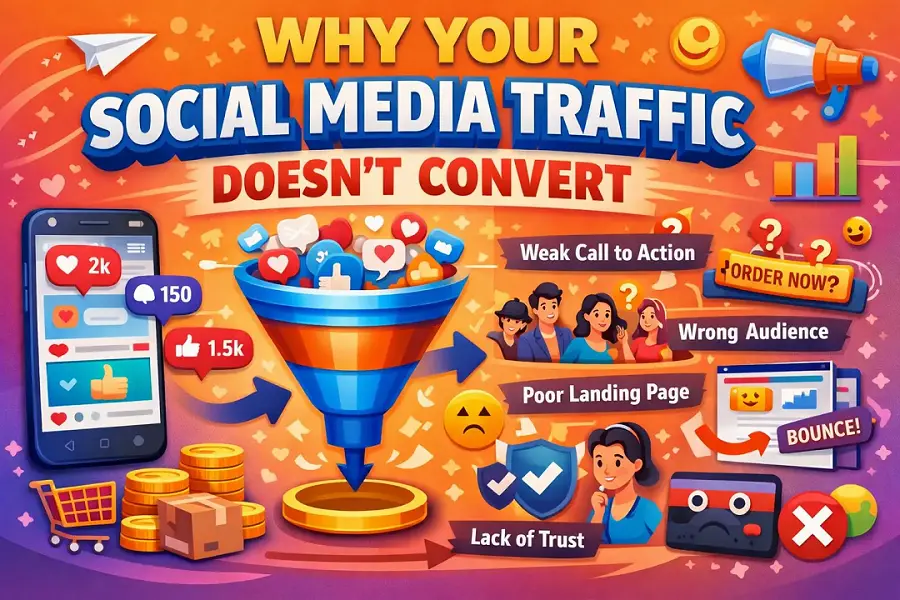
The number one reason social media traffic does not convert is a mismatch between what the post promised and what the page delivers. This is called a message mismatch. It is more damaging than most businesses realize.
Here is a real example. A fitness studio in Thessaloniki ran Instagram ads promoting a free trial class. The ad said, “Try your first class for free.” People clicked. They landed on the homepage. The homepage talked about the gym’s history, its equipment, and its team. There was no mention of the free trial anywhere above the fold. Visitors had to scroll past three sections to find the offer. Most did not. They left. The bounce rate on that campaign was 76%.
The fix was simple. They created a dedicated landing page that repeated the exact offer from the ad. The headline said, “Claim Your Free Trial Class.” The button said, “Book Now.” Nothing else competed for attention. The bounce rate dropped to 34%, and bookings doubled within two weeks.
Clarity is not just about the headline. It is about every element on the page supporting one single message. When visitors arrive from a social media post about a discount, they expect to see that discount immediately. When they arrive from a post about a specific product, they expect to land on that product page. Not the homepage. Not a category page. The exact product.
This also applies to the visual connection between the social post and the landing page. If your Instagram post uses bright orange graphics and your landing page is dark blue with a completely different layout, visitors feel disoriented. Visual consistency builds trust. Inconsistency breaks it.
I have seen businesses with excellent social media content lose thousands of euros in potential revenue because their landing pages were generic. The social team created compelling content. The website team never updated the destination pages. The gap between those two things killed the conversions.
For people with vision problems who rely on screen readers or high-contrast displays, clarity is even more critical. If the offer is buried in an image with no alt text, a screen reader user will never see it. If the call to action is a button with no descriptive label, it becomes invisible to assistive technology. Accessibility is not separate from conversion optimization. They are the same thing.
Your offer must be visible, readable, and immediately understandable. Every word on the landing page should confirm to the visitor that they are in the right place and that the next step is obvious.
Key Signs Your Social Media Traffic Is Not Converting
The data tells you everything. You just need to know where to look and what the numbers actually mean.
The first sign is a high bounce rate on pages receiving social traffic. A bounce rate above 70% for social traffic is a serious warning sign. It means visitors are arriving and leaving without any interaction. This number alone should trigger an investigation.
The second sign is low average session duration. If visitors from social media spend less than 30 seconds on your site, they are not reading your content. They are not considering your offer. They are scanning and deciding that the page does not meet their expectations. Sessions under 30 seconds almost never convert.
The third sign is a big gap between social traffic volume and goal completions. You can see this clearly in Google Analytics. If you are getting 2,000 visits from social media each month and only 10 of them complete a desired action, your conversion rate is 0.5%. The industry average for social traffic is typically between 1% and 3%. Anything below 1% is a strong signal that something is broken.
The fourth sign is clicks without scroll depth. Tools like Microsoft Clarity or Hotjar show you how far down the page visitors scroll. If most visitors from social media leave without scrolling past the first screen, your above-the-fold content is failing to engage them. They see nothing compelling enough to keep reading.
The fifth sign is a high exit rate on the first page visited. This is different from bounce rate in technical terms, but the practical meaning is similar. Visitors arrive, see one page, and leave without exploring further.
Here is a case that illustrates this well. An online bookstore was running active Facebook campaigns. Traffic was strong, around 4,000 visitors per month from social. But only 0.3% were making a purchase. A closer look at session recordings showed that visitors were clicking on posts about specific book deals, landing on the homepage, not finding the promoted book immediately, and leaving within 20 seconds.
The conversion issue was entirely navigational. The promoted books were not featured on the homepage. There was no search bar above the fold. The visitor had no easy path from interest to purchase.
Another clear sign is when mobile conversion rates are significantly lower than desktop rates. Social media is consumed almost entirely on mobile. If your analytics show that mobile visitors from social convert at 0.2% while desktop visitors convert at 2%, the mobile experience is broken. This is extremely common and extremely fixable.
For users with vision impairments, additional signs of a broken experience include missing focus indicators for keyboard navigation, images without alt text, and form labels that are not connected to their input fields. These users may visit your site and encounter complete barriers to conversion that you cannot see by simply looking at the page visually. Accessibility testing tools like WAVE or Axe can reveal these invisible conversion blockers.
The data is the diagnosis. If you see these signs in your analytics, the problem is not your social media strategy. The problem is what happens after the click.
How to Fix the Most Common Social Media Conversion Problems
Fixing social media conversion problems is not complicated. But it does require making specific changes to specific things. Vague improvements do not work. You need to identify the exact point where visitors stop converting and fix that point directly.
The first and most important fix is creating dedicated landing pages for each social campaign. Stop sending social traffic to your homepage. Your homepage serves many audiences at once. A landing page serves one audience with one message. The specificity of a landing page is what creates conversions.
A dedicated landing page for a social campaign should repeat the headline or offer from the social post. It should have one clear call to action. It should remove navigation menus that tempt visitors to wander. It should load in under 3 seconds. And it should look visually connected to the social post that sent the visitor there.
The second fix is improving mobile performance. Since most social traffic comes from phones, your mobile experience needs to be excellent, not just acceptable. Test your landing pages on real devices. Check that buttons are large enough to tap. Check that forms are easy to complete on a small screen. Check that text is readable without zooming.
The third fix is making your call to action specific and prominent. A button that says “Learn More” is weak. A button that says “Get My Free Quote” or “Start My Free Trial” is strong. The call to action should tell visitors exactly what happens when they click it. Vague CTAs create hesitation. Specific CTAs create action.
The fourth fix is adding trust signals near the conversion point. Reviews, testimonials, security badges, and client logos all reduce the anxiety a visitor feels before taking action. Place these near your form or your buy button. Not at the bottom of the page, where most people never scroll.
The fifth fix is checking and improving accessibility. If your landing page is not accessible, you are blocking a significant portion of your audience from converting. Add descriptive alt text to all images. Make sure form labels are properly linked to inputs. Ensure sufficient color contrast between text and background. Test with a keyboard to check that all interactive elements are reachable without a mouse.
This is exactly the approach that experienced marketing professionals apply. Teams at a professional Advertising Agency Thessaloniki, for example, audit both the social creative and the landing page together before any campaign launches. They treat the click and the landing experience as one connected system, not two separate tasks. Connected thinking is what separates campaigns that convert from campaigns that just generate traffic.
The sixth fix is running A/B tests. Do not guess what works. Test it. Create two versions of a landing page with one difference between them. Run traffic to both. The version that converts better wins. Then test the next element. This process compounds over time. A landing page that has gone through 10 A/B tests will consistently outperform a page that was never tested.
The seventh fix is tracking the right metrics. Set up conversion goals in Google Analytics. Track not just traffic but actions: form submissions, purchases, sign-ups, calls. Without tracking conversions, you cannot measure improvement. You are flying blind.
Social media can be a powerful source of customers. But it only works when the full journey is designed intentionally. The post creates interest. The landing page must capture it. Every weak link in that chain costs you money and opportunity. Fix the weak links, and your social media investment starts to pay off the way it should.