

There are many tools for keyword research on the market, each with its own advantages and limitations. In this article, we will try to determine the optimal tool for Keyword Finder.
Best Keyword Analysis Tools
- KeywordStat is a modern AI-powered keyword research tool that ranks first in our list.
- Semrush is an all-in-one SEO platform with an extensive keyword database for different regions, as well as numerous features for link building and content marketing.
- Ahrefs is a comprehensive tool with high-quality keyword data and a powerful backlink database.
- Serpstat is an affordable full-cycle SEO platform with reasonably high-quality data for Europe, API access, clustering features, and an attractive price.
- SE Ranking is a well-balanced SEO platform with a wide range of additional features.
- KWFinder is a user-friendly keyword research tool, including for finding low-competition queries.
Keyword Research Tools
When choosing a keyword research tool, you should consider your budget, goals, and the specific requirements of your tasks. First of all, you need to determine whether you need the additional capabilities of a full-fledged SEO platform or whether a specialized tool is sufficient to handle specific tasks.
Most SEO tools on the market can be divided into two main categories: multifunctional SEO platforms and specialized keyword research tools.
The main difference between them lies in their methods of data collection and processing.
Large SEO platforms use their own historical databases of search queries and click data. Specialized tools, in turn, often rely on search suggestions, Google Keyword Planner data, and artificial intelligence algorithms to group and cluster keywords.
To simplify the selection process, we analyzed well-known keyword research tools designed for different tasks and budgets and selected the most popular services.
KeywordStat
KeywordStat rightfully takes first place in our ranking. We believe this service offers the best value for money.
KeywordStat is a modern, specialized tool for keyword research and collection. To get started, simply enter a seed keyword, specify a domain, or provide a specific URL for analysis.
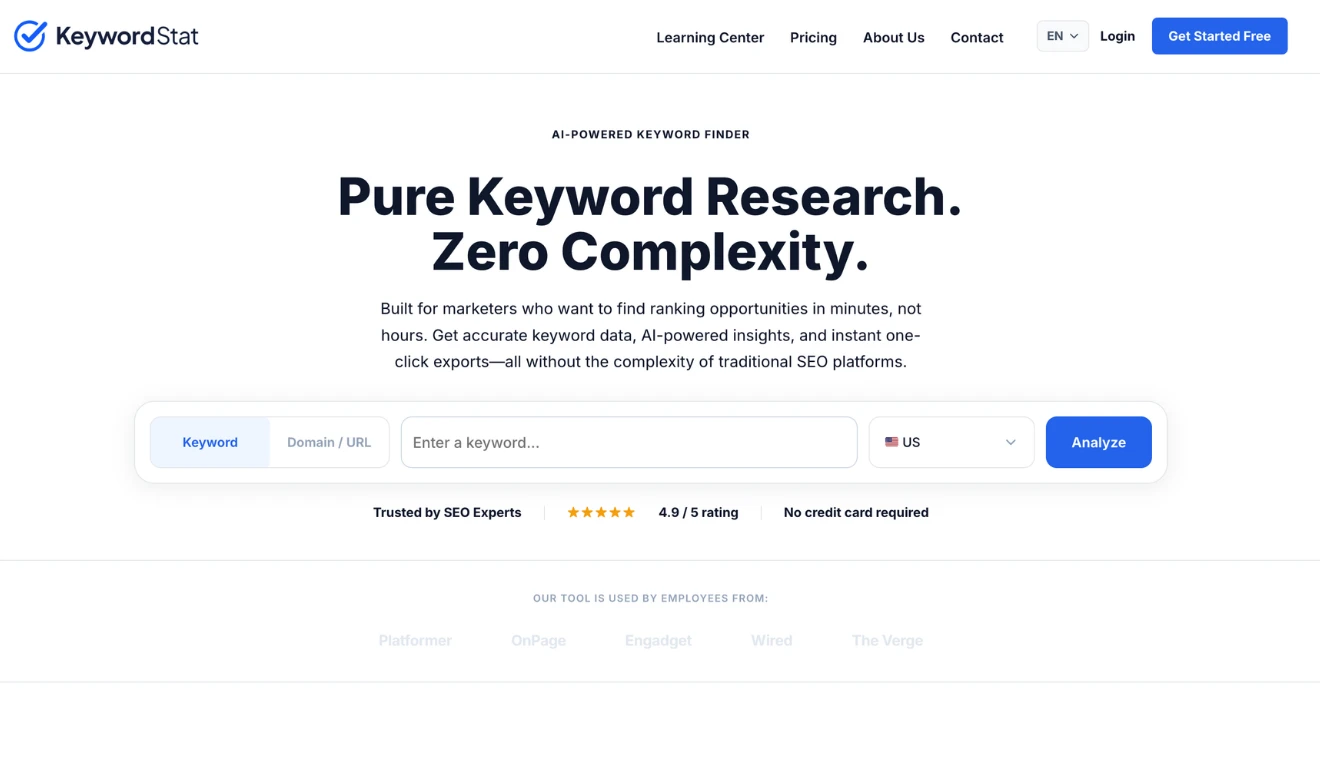
After processing the query, the tool displays the main SEO metrics in a convenient dashboard. You can then expand the list of queries, find additional keywords, group them by topic, and copy or export the results.
The workflow is simple: you enter a seed keyword or URL and receive the analysis results. Each keyword being researched is accompanied by a set of SEO metrics:
Search Volume, Keyword Difficulty, Traffic Potential, Global Volume, Search Intent, CPC, Commercial Value, and Trend.
After that, you can expand the initial list of queries, find new keywords, update metrics for selected phrases, perform clustering, or save the results to a separate project.
KeywordStat Interface
One of the main advantages of KeywordStat is its simple, intuitive, and modern interface. The minimalist design is combined with bright accents and good readability, making the tool convenient to use even without spending a long time getting familiar with the platform.
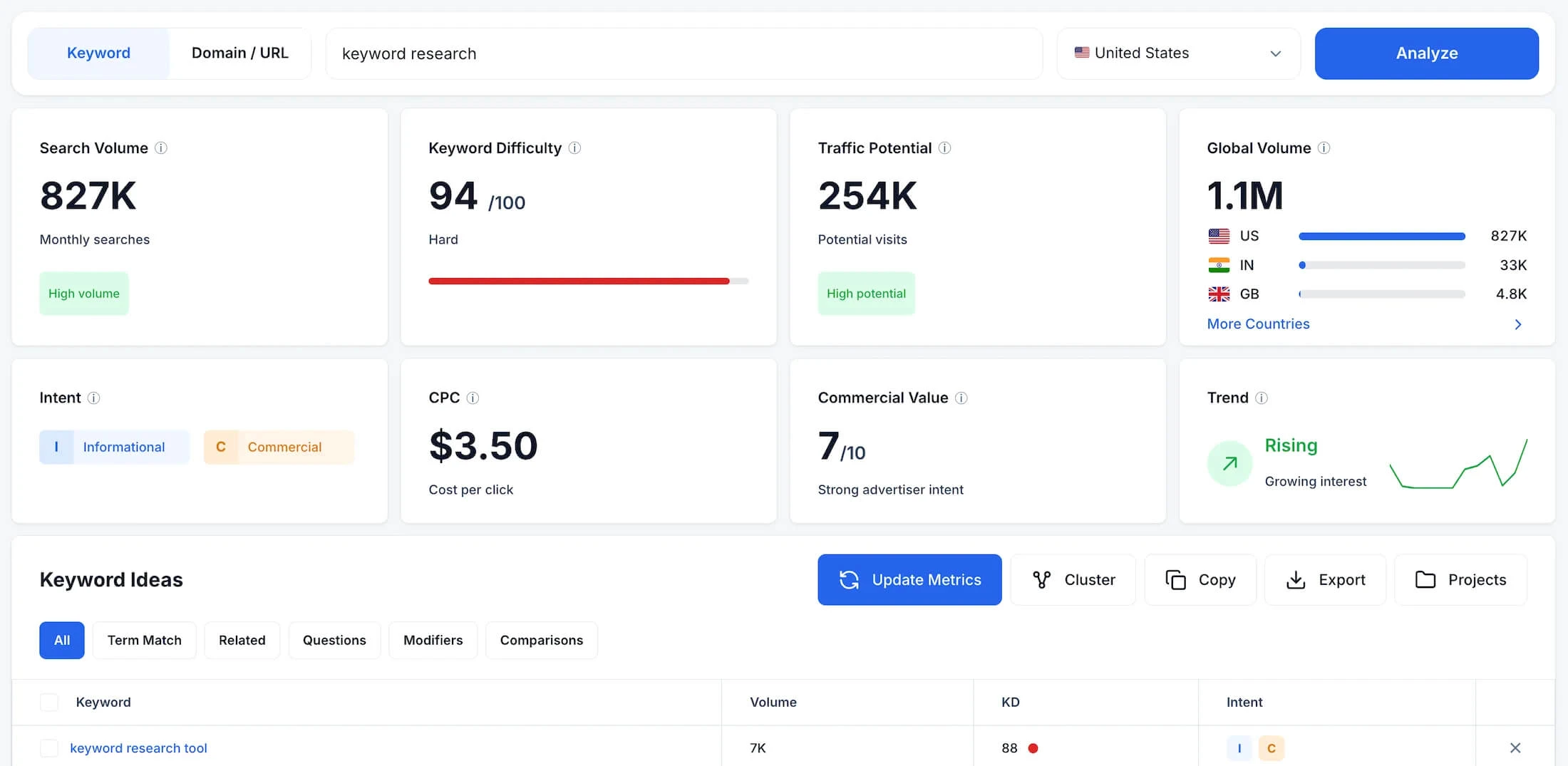
On the homepage, simply enter a keyword, domain, or URL, select the target country, and launch the analysis.
This approach simplifies the workflow: there is no need to spend time learning complex settings and numerous sections. You only need to specify the initial parameters to quickly obtain data for SEO research.
Once the analysis is complete, you can navigate to the Keyword Ideas section, where additional search queries are available to expand your keyword set and discover new opportunities for website promotion.
The following options are available for expanding the keyword list: Term Match, Related, Questions, Modifiers, and Comparisons.
Domain and URL Analysis
If you already have an active website or want to study your competitors’ SEO strategies, KeywordStat allows you to analyze both entire domains and individual URLs.
To do this, enter a competitor’s domain or a specific URL and launch the analysis. Once the data has been processed, the tool will suggest several areas for further research.
- Primary Keywords are the main keywords for which the analyzed page is optimized.
- Secondary Keywords are additional queries related to the page’s main topic that expand its semantic coverage.
Keyword Clustering
KeywordStat includes built-in AI-powered clustering with two methods: Soft Clustering and Hard Clustering.
Both approaches help organize collected keywords, simplify content planning, and make it easier to work with large keyword lists.
Data Sources and Quality
Comparing KeywordStat results with data from other SEO tools makes it possible to assess how closely its metrics align with those of leading platforms on the market. According to the service, its database contains more than 20 billion keywords.
Search Volume, Keyword Difficulty, and other metrics may vary depending on the country, niche, and specific search query. Therefore, when working in competitive niches, it is useful to compare data from several tools.
KeywordStat Pricing
One of the advantages of KeywordStat is the availability of a free plan, which allows users to explore the platform’s main features without significant expense.
For more intensive use, paid plans are available starting at $9 per month.
Semrush
Semrush is an all-in-one SEO platform that combines tools for keyword research, competitor analysis, rank tracking, organic traffic estimation, and technical website audits.
The platform also offers a wide range of solutions for content marketing, link building, and other areas of digital marketing.
Semrush’s main keyword research tools are Keyword Overview and Keyword Magic Tool. The first allows users to quickly evaluate the key metrics of a search query, while the second helps expand keyword lists, find related keywords, and identify promising queries for promotion.
The following key SEO metrics are available for keyword analysis:
Search Volume, Keyword Difficulty, Intent, CPC, Competitive Density, Trend, SERP Features, and Global Volume.
Semrush Interface
The Semrush interface is relatively feature-rich, as the platform combines numerous tools not only for SEO but also for other areas of digital marketing.
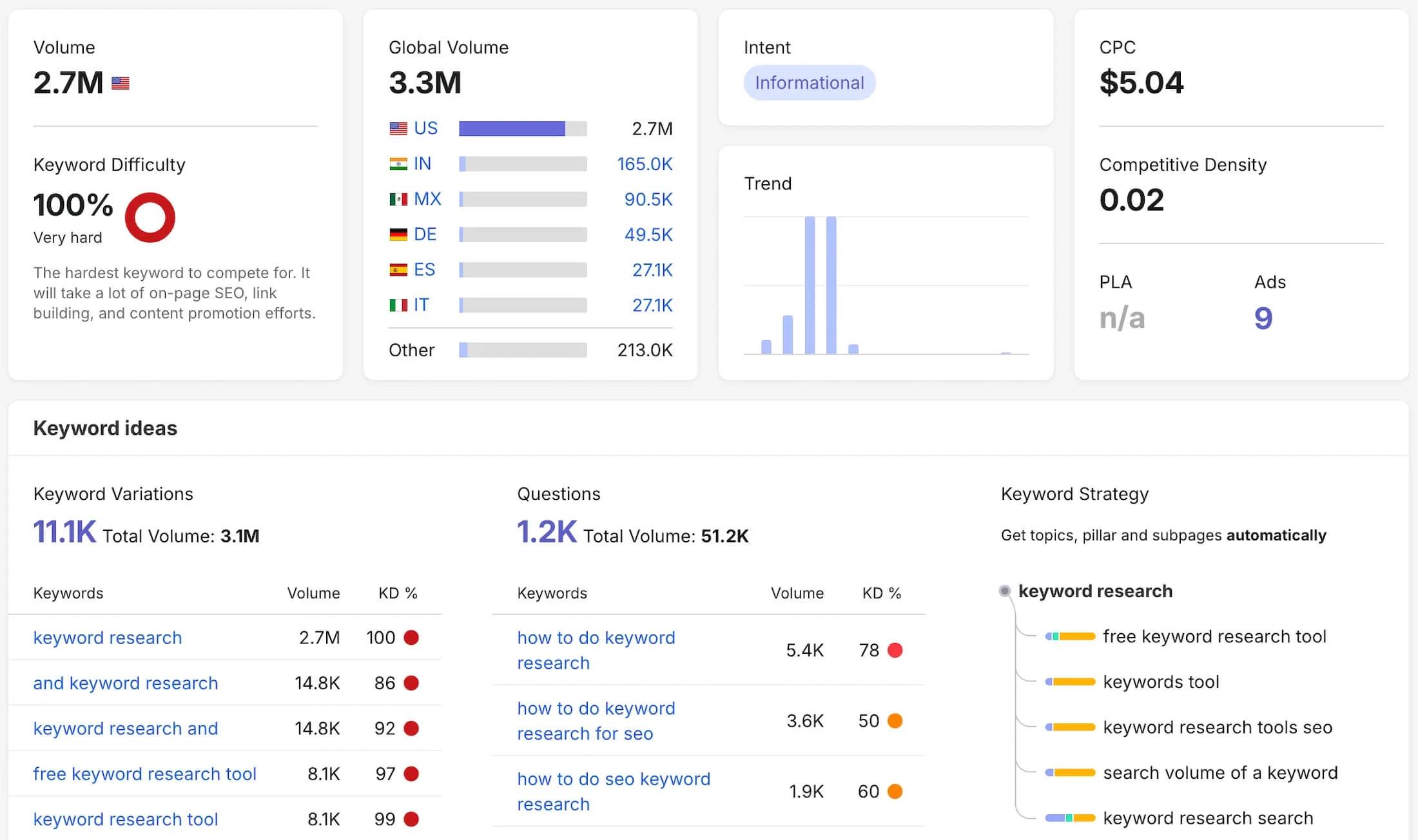
Its extensive functionality allows users to handle a variety of marketing tasks within a single service. However, beginners may need time to master all the platform’s capabilities.
Domain and URL Analysis
One of the main uses of Semrush is competitor research and the analysis of their visibility in search engines.
Users can enter a competitor’s domain or a specific URL to explore organic keywords, search engine rankings, and estimated organic traffic.
Keyword Clustering
Semrush provides tools for organizing and grouping keywords, making it easier to work with large sets of search queries.
Data Sources
Semrush uses its own databases and infrastructure to collect and process SEO information. The platform analyzes search queries, search results, keywords, competitors, and advertising activity.
According to the company’s published figures, its database contains approximately 28.8 billion keywords.
One of Semrush’s advantages is its extensive geographic coverage. The database includes numerous countries and regions, making the platform suitable for international SEO and working across different markets. However, data accuracy and completeness may vary depending on the region and niche.
Semrush Pricing
Semrush belongs to the more expensive segment of SEO platforms. The service offers several pricing plans starting at $117 per month.
Ahrefs
Ahrefs is one of the best-known tools in the SEO and keyword research industry. It is not just a Keyword Research Tool, but a full-fledged SEO platform with a wide range of features for analyzing organic traffic, competitors, backlinks, and content.
To start researching, users can enter a main keyword, specify a domain, or provide a specific page URL.
After the analysis, Ahrefs displays the main SEO metrics, helps users discover new keyword ideas, evaluate competition levels, estimate potential traffic, and explore the search queries for which competitors rank.
The main keyword research tool in Ahrefs is Keywords Explorer. It can be used to analyze search queries, expand website structure, and evaluate the prospects of ranking for specific keywords.
When analyzing a keyword, users receive a set of key SEO metrics:
Search Volume, Keyword Difficulty, Traffic Potential, Global Volume, CPC, Clicks, Return Rate, and Parent Topic.
Expanding Keyword Coverage and Keyword Ideas
Ahrefs offers several ways to expand keyword coverage through Keyword Ideas. Users can discover Matching Terms, Related Terms, Search Suggestions, Questions, and other related search queries.
This makes it possible to collect keywords for new pages, find additional keyword variations, and identify topics that may be useful for further content development.
Ahrefs Interface
One of Ahrefs’ distinguishing features is the large number of functions available within a single platform. As a result, its interface looks more feature-rich and complex compared to specialized keyword research tools.
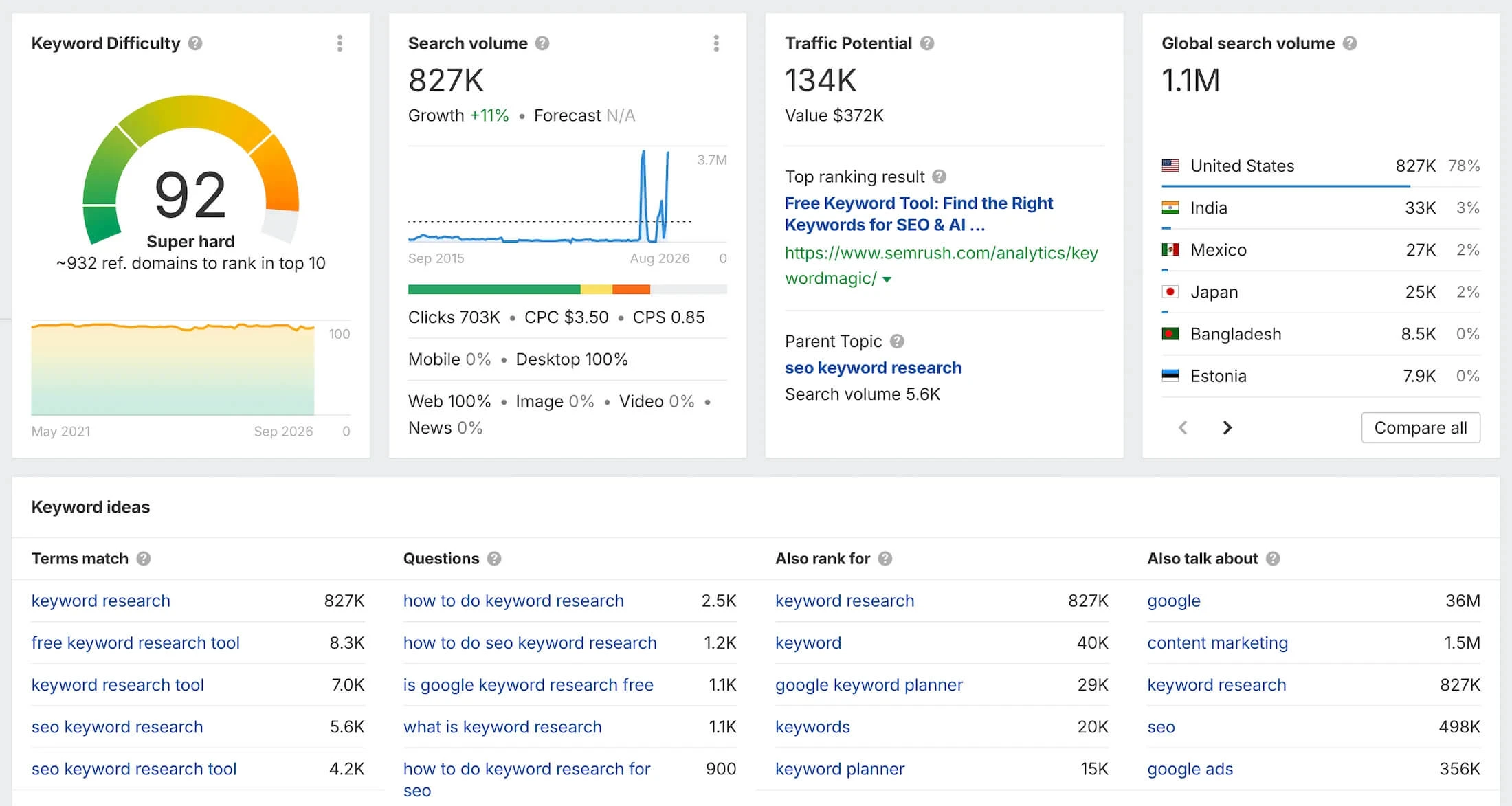
The extensive set of filters allows users to fine-tune search results and select queries based on Search Volume, Keyword Difficulty, Traffic Potential, CPC, and other parameters. This is particularly useful when working with large keyword lists and identifying promising opportunities for promotion.
Domain and URL Analysis
Ahrefs is widely used to analyze existing websites and study competitors’ SEO strategies.
Keyword Clustering
In Ahrefs, clustering does not play a central role in the workflow, as it does in specialized keyword research tools. However, the platform provides options for filtering and grouping queries based on various parameters.
Data Sources
Ahrefs uses its own infrastructure to collect and process SEO data, including information about search queries, pages, website rankings, and backlinks. According to the company’s published figures, the platform’s database contains approximately 28.7 billion keywords.
Its proprietary database and large-scale infrastructure allow Ahrefs to provide a wide range of SEO metrics and tools for analyzing search visibility. However, data completeness and accuracy may vary depending on the region and niche.
Ahrefs Pricing
Ahrefs belongs to the more expensive segment of SEO tools. Paid plans start at $129 per month, while available features and limits depend on the selected plan.
Serpstat
Serpstat is an affordable full-cycle SEO platform that combines tools for keyword research, competitor analysis, rank tracking, technical website audits, and other SEO tasks.
The service focuses primarily on practical SEO tasks: collecting keywords, analyzing search results, and researching competitors.
Serpstat Interface
The Serpstat interface is organized around tables, reports, and individual tools designed to handle specific SEO tasks.
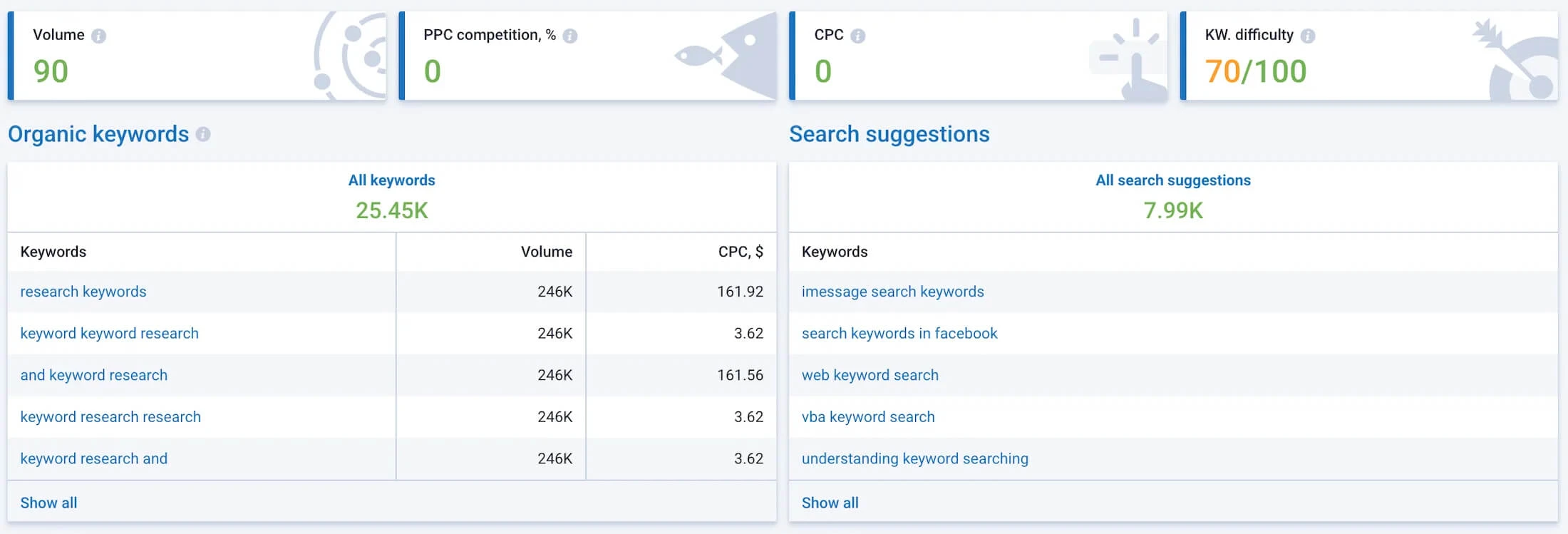
To start researching, simply select Keyword Research, enter a keyword, specify the target country, and launch the analysis. After processing the query, the service displays the main SEO metrics and a list of discovered keywords.
The workflow is relatively straightforward and does not require extensive time to learn the platform. However, visually, the interface looks more traditional and less modern compared to some specialized keyword research tools.
Keyword Clustering
Serpstat provides tools for grouping keywords and organizing collected keyword data.
Clustering takes into account similarities between search results for different queries. This makes it possible to determine which keywords can be combined into a single topical group and used to optimize one page.
Data Sources
Serpstat uses its own databases to collect and process information about search queries, search results, websites, and competitors.
According to the company’s published figures, the platform’s database contains more than 7.46 billion keywords. Its proprietary data allows the service to provide SEO metrics, analyze competitors, and identify new opportunities for website promotion.
However, the completeness and accuracy of the results may vary depending on the country, niche, and level of competition.
Serpstat Pricing
One of Serpstat’s advantages is its relatively affordable pricing compared to a number of comprehensive SEO platforms. Pricing plans start at $50 per month.
SE Ranking
SE Ranking is a well-balanced SEO platform that combines tools for keyword research, competitor analysis, rank tracking, and other website promotion tasks.
To start researching, users can enter a main keyword (main keyword or seed keyword) or specify a competitor’s domain or URL for analysis.
When researching a keyword, SE Ranking provides the main SEO metrics: Search Volume, Keyword Difficulty, Organic Competition, CPC, Traffic Potential, Search Intent, SERP Features, and Keyword Trends.
In addition, the platform allows users to expand their list of queries, find similar and related keywords, questions, and other search phrase variations.
SE Ranking Interface
One of SE Ranking’s advantages is its clear and well-structured interface, which simplifies working with SEO data.
On the homepage, users select the Keyword Research tool, enter a keyword, specify the target country and search engine, and then launch the analysis.
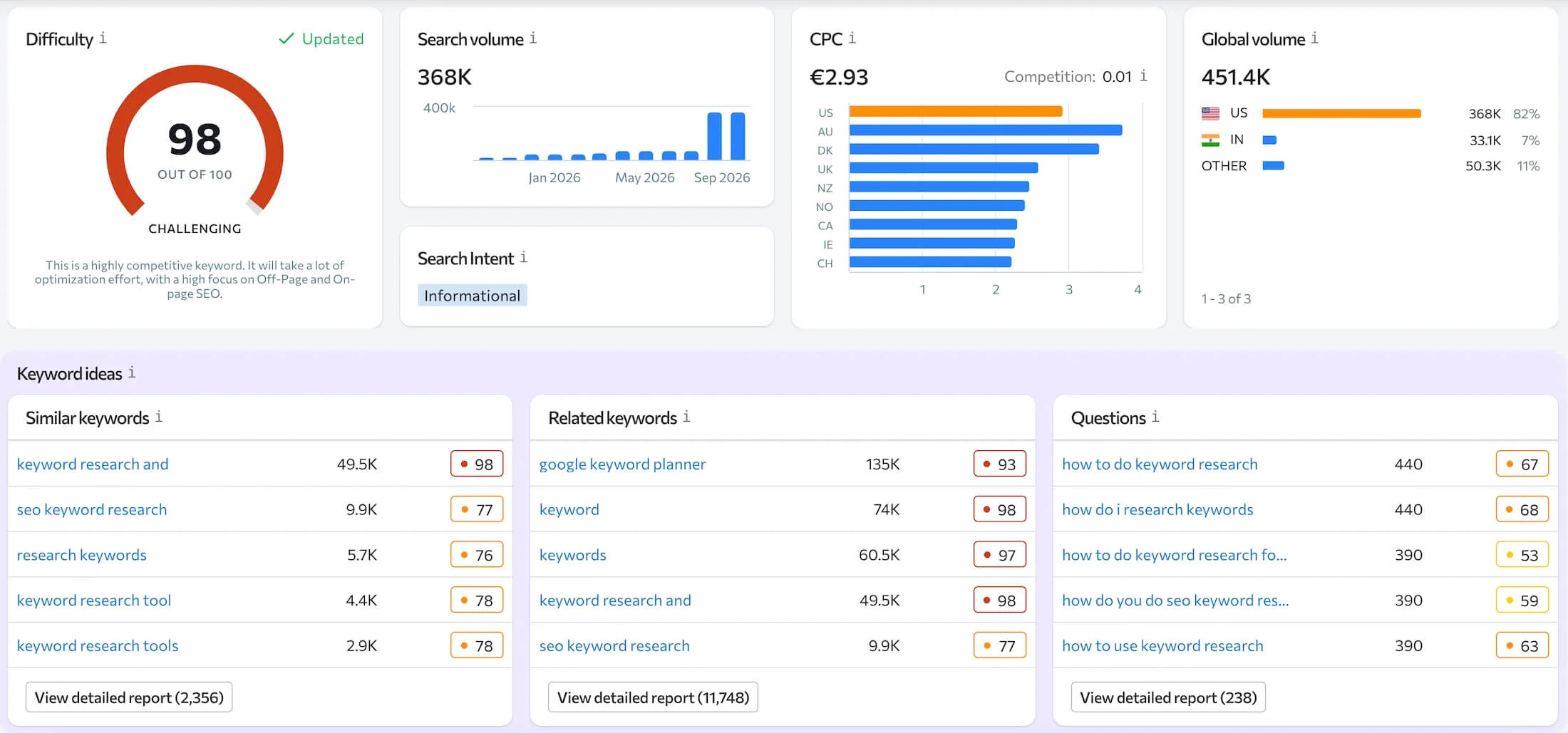
The results are displayed on a separate page containing the main metrics and tools for expanding keyword coverage. This approach makes it possible to move quickly from the initial query to comprehensive keyword research.
Keyword Clustering
SE Ranking offers tools for grouping and clustering keywords. They help organize the keyword set and distribute queries into topical groups.
Data Sources
SE Ranking uses its own infrastructure and databases to collect and process SEO information. The platform works with keyword data, search results, website rankings, and competitors, bringing the results together in a single interface.
According to the company’s published figures, the service’s database contains approximately 5.4 billion keywords.
SE Ranking Pricing
SE Ranking offers several paid pricing plans starting at $103 per month.
KWFinder
KWFinder is a specialized keyword research tool that is part of the Mangools SEO platform. The service focuses primarily on finding low-volume search queries, evaluating competition, and collecting keywords for SEO promotion.
KWFinder Interface
One of KWFinder’s main advantages is its simple and intuitive interface. The service allows users to quickly get started with keyword research, select the target country and language, and then obtain a list of search queries with key SEO metrics.
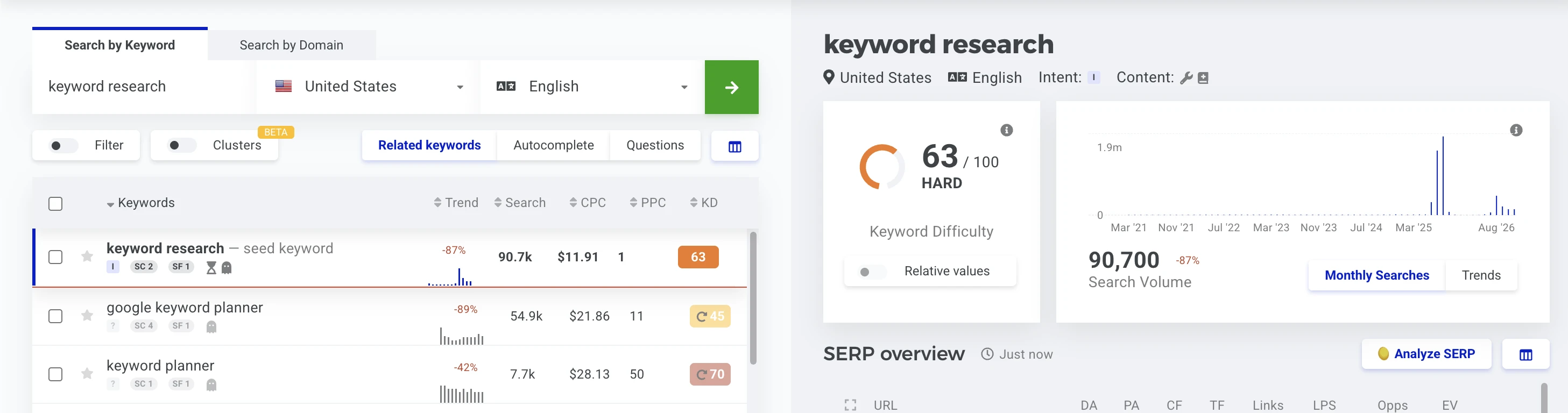
The results are presented in a convenient table that allows users to evaluate search demand, ranking difficulty, and other parameters. The Keyword Difficulty metric deserves particular attention, as it helps users quickly identify queries with potentially lower competition.
Data Sources
KWFinder uses its own databases and algorithms for evaluating search queries and providing SEO metrics, including Search Volume and Keyword Difficulty.
The volume of available data and the completeness of results may fall short of those offered by larger SEO platforms, especially when researching competitive niches and specific geographic markets. Search demand estimates may also differ from those provided by other tools, so comparing multiple sources is recommended when making important decisions.
KWFinder Pricing
KWFinder is part of the Mangools ecosystem and is available through its pricing plans. Pricing starts at $37.70 per month.
Conclusion
We recommend testing several services using the same keywords and projects. Compare the results, the convenience of the workflow, and the cost of the available features. This will help you determine which tool best meets your needs and offers the optimal balance between price and functionality.