
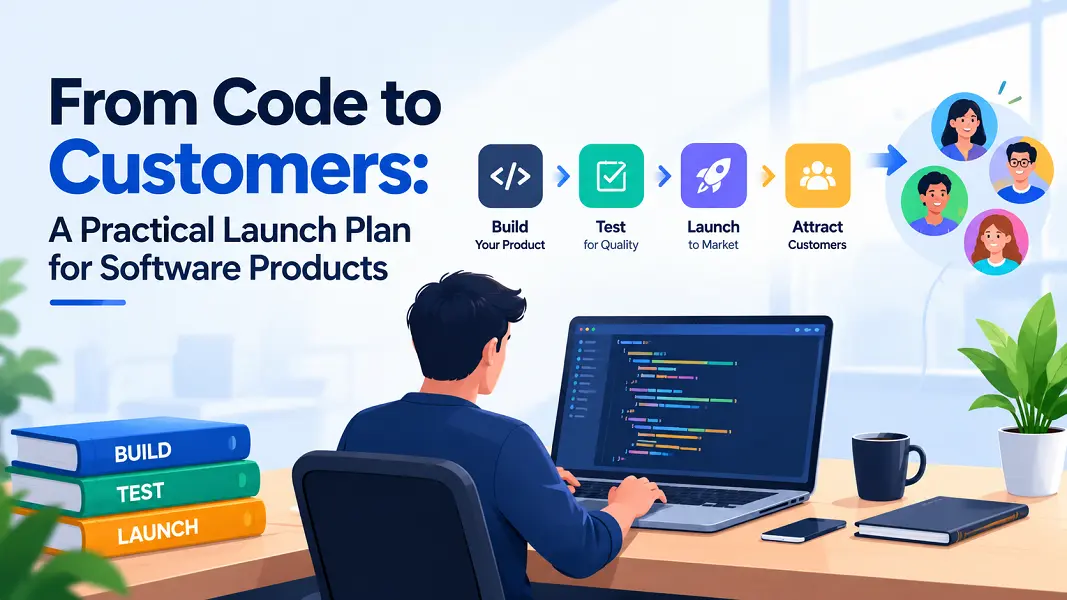
Shipping a reliable software product is a major achievement, but it does not guarantee that the people who need it will find it. Product visibility depends on decisions made alongside development: who the product serves, how its value is explained, and which channels can reach potential users. Treating distribution as part of the product lifecycle helps teams avoid building in isolation and gives them clearer ways to learn from the market.
Start with a specific audience and problem
Before choosing launch channels, write down the user problem the software solves and the people who experience it most often. “A tool for businesses” is too broad to guide product pages, onboarding, or campaign targeting. A more useful definition might be a scheduling platform for independent clinics or a reporting tool for small online retailers.
This focus also helps developers make better product decisions. If the target user needs to complete a task quickly, onboarding friction may matter more than adding a long list of advanced features. Talk to prospective users, review support requests from similar products, and test the language people use to describe the problem. These insights can inform both the roadmap and the message used to introduce the product.
Build discoverability into the product website
A product website should make it easy for visitors to understand what the software does, who it is for, and what to do next. Use clear page titles and headings, explain key features with practical examples, and provide useful details about pricing, integrations, security, and support. A developer should also ensure that important pages load quickly, work well on mobile devices, and can be crawled by search engines.
Technical SEO is not a substitute for useful content, but it can prevent avoidable problems. Check that the site has a logical URL structure, descriptive metadata, accessible text for images, and no accidental blocks on pages intended for indexing. Product documentation and troubleshooting articles can attract users who are researching a specific task, while release notes show that the software is actively maintained.
For a software company publishing educational articles, external contributions may extend reach beyond its own site. A directory can be a starting point for researching potential publishers; for example, the guest posting site list can help generate prospects. Do not treat a list or an authority score as a guarantee of value. Check whether a publication reaches your intended audience, accepts relevant material, and maintains editorial standards. A useful article should answer a real question rather than exist only to place a backlink.
Use content to answer questions, not just announce features
People rarely search for a product name they have not encountered. They search for a problem, a comparison, or instructions. Create content around these needs: explain how a workflow works, publish a setup guide, compare approaches fairly, or show how a feature handles a common edge case. When possible, include screenshots, sample data, or short demonstrations so readers can judge whether the advice applies to their situation.
Content also provides feedback for the product team. Repeated questions in comments, sales calls, or search queries may reveal confusing terminology, missing documentation, or a feature gap. Share those patterns with developers and support staff. Marketing activity then becomes one source of product research rather than a separate stream of promotional tasks.
Choose paid campaigns with a measurement plan
Advertising can help a product reach users while organic visibility develops, but spend should follow a defined test. Choose one audience and one conversion goal, such as a qualified demo request, trial activation, or completed purchase. Set a spending limit, use campaign tracking consistently, and decide in advance how long the test will run before reviewing the results.
For an ecommerce software product or a platform selling physical goods, search and Shopping campaigns may be relevant. Before committing budget, understand Google Ads pricing, including Shopping ads cost, and compare the likely spend with the value of a new customer. Costs vary by market, competition, campaign setup, and management needs, so a general estimate is a planning aid rather than a forecast.
Small teams may need outside support for campaign setup, design, analytics, or landing-page development. Osdire is a freelance marketplace with services across areas such as programming and tech, design, and marketing. Its flat-price orders and payment hold during delivery can make project costs easier to understand, but teams should still define the scope, deliverables, and approval criteria before work begins.
Connect marketing data to product decisions
Traffic alone does not show whether a launch is working. Track the steps that matter: visits to a product page, sign-ups, activation, repeat use, and paid conversion. Keep event names consistent and document what each event means so product, engineering, and marketing teams interpret the data in the same way. Avoid collecting personal information that is not needed for the analysis.
Use the results to identify where users drop off. If many visitors reach the sign-up page but few finish registration, the issue may be form friction or unclear expectations. If users sign up but do not activate, onboarding may need improvement. Small experiments—such as testing a clearer call to action or simplifying an initial setup step—can produce actionable evidence without requiring a full redesign.
Make launch work repeatable
A strong software launch is a cycle: build, explain, distribute, measure, and improve. Keep a shared plan for product updates, technical checks, content, and campaign experiments. Assign an owner to each task and review outcomes regularly, including feedback that did not convert into a sale. This steady approach helps a software team earn attention, learn from real users, and focus development on the problems that matter most.