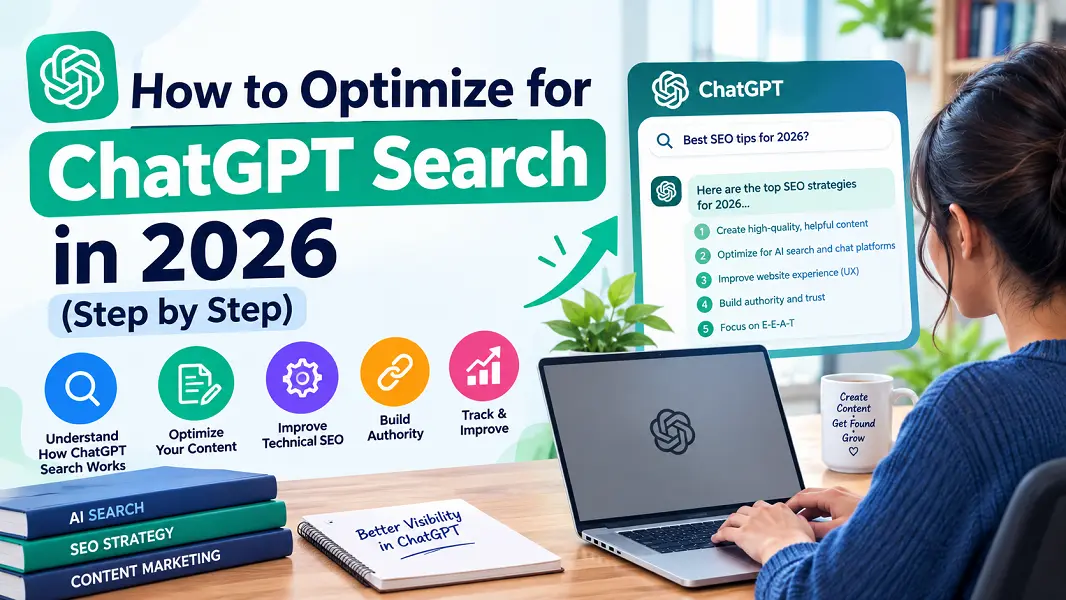
To optimize for ChatGPT search, make sure OpenAI’s search crawler can reach your pages, rank on Google’s first page for the questions your buyers ask, and put a clear answer in the first lines under each H1. Keep pages light, readable without JavaScript and recently updated. Then check every week whether ChatGPT actually names you. That is the short version. The rest of this post explains why each step matters. Every number comes from a named study with its date, because this area changes month to month.
How ChatGPT search works right now
ChatGPT doesn’t search for every prompt. Studies disagree on how often it does. Profound measured about 18% of conversations (February 2026). Semrush measured 34.5% of queries (April 2026). The share depends heavily on the type of question. When it does search, it rewrites your question into several shorter searches. It pulls results for each one, reads a small part of some pages, and cites a few of them. Here is the detail that matters most for optimization. RESONEO studied 1,249 ChatGPT answers in July 2026. Pages ChatGPT actually opened were cited 74% of the time. Pages that only appeared in its search results were cited 7% of the time. So the goal is not a “position.” It is getting retrieved, then getting read, then getting cited. I have written separately about how to rank in ChatGPT and why “ranking” is the wrong word for it.
Step 1: Find out where you stand today
Optimizing without a baseline is guessing. Write down 10 questions a buyer would ask before choosing a company like yours. For example: “best [your category] for [your customer type]” or “[your company] vs [competitor]”. Ask ChatGPT each one, with search on. For each answer, note three things:
- Does it name you?
- Which companies does it name instead?
- Which pages does it cite?
Run the same questions again a week later. Answers change between runs, so one screenshot proves very little. If you want this done across ChatGPT, Perplexity, Gemini and Claude with the cited pages mapped, GeoCited’s AI visibility audit starts with a free assessment of where you currently appear.
Step 2: Let OAI-SearchBot in
OpenAI’s publisher FAQ says any public website can appear in ChatGPT search, as long as it doesn’t block OAI-SearchBot. Check your robots.txt for a rule that blocks it. Then check your CDN or firewall. Some bot-protection settings block AI crawlers even when robots.txt allows them. Keep in mind that OAI-SearchBot and GPTBot are different crawlers. OpenAI documents GPTBot as the crawler for model training. You can block GPTBot and still allow OAI-SearchBot.
Step 3: Rank on Google’s first page
This sounds unrelated, but the data points the same way. In RESONEO’s July 2026 study, one URL in three that ChatGPT retrieved also appeared on Google’s first page. Only one in twenty appeared on Bing’s first page. Many older guides still say ChatGPT search runs on Bing. The recent data doesn’t support treating Bing as the main source. In practice, the pages that already rank well on Google for a question have a much better chance of being pulled into ChatGPT’s answer to it.
Step 4: Put the answer right under your H1
Search Engine Land published a breakdown of ChatGPT’s retrieval stack in August 2026. It reported that in instant mode, the model often sees a snippet of about 200 characters, anchored on the H1. That is roughly two sentences. If your page opens with a long introduction, the model may never see your actual answer. Write the first two sentences under the H1 so they answer the question on their own.
Step 5: Keep pages readable without JavaScript and under 4 MB
The same Search Engine Land article reported two hard limits. The crawler doesn’t run JavaScript, so text that only appears after scripts load is invisible to it. Pages above 4 MB are rejected outright, not cut short. Check your key pages with JavaScript turned off. If the main text disappears, fix that before anything else.
Step 6: Match the page format to the question
Different questions pull different kinds of pages. In our own 80-query study (August 2026, ChatGPT and Google AI Overviews, 490 cited URLs), comparison pages were cited most for “X vs Y” questions, at 56.7%. Pricing pages led cost questions, at 53.4%. ChatGPT cited the vendor’s own product pages 37.7% of the time. So one blog post per topic is rarely enough. If buyers ask about pricing, a real pricing page is the page that gets cited. If they compare you with a competitor, an honest comparison page is.
Step 7: Keep commercial pages up to date
ChatGPT sets a time window on many of its searches. Suganthan Mohanadasan captured ChatGPT’s search calls in August 2026 from one paid account. Stock-price searches used a 2-day window, sports results 7 days, commercial product research 30 days, and brand-opinion searches 365 days. This is one person’s capture, not a large study. Still, it suggests pages about products and pricing are judged on recency. Update them when something changes, and show the date on the page.
Step 8: Make your own site answer questions about you
ChatGPT now often searches inside a specific company’s website. Writesonic, a vendor that sells AI visibility tracking, ran 50 prompts on GPT-6 Astra in September 2026. It reported that 75.1% of Astra’s searches were limited to a single brand’s domain. Astra also ran fewer searches per answer, 6.1 against 10.3 for the previous model. The sample is small and the source sells tracking tools. But the direction matters. When ChatGPT searches your domain, it can only find what your site actually states: what you do, who it is for, what it costs and how you compare. If those answers only exist in sales calls, ChatGPT has nothing to cite.
What doesn’t work
Paying for placement. OpenAI says ads do not influence the answers ChatGPT gives and are always labelled as sponsored (February 2026, updated August 2026). Guaranteed rankings. ChatGPT writes a new answer each time, so no one can promise a fixed spot. Relying on Reddit threads alone. Promptwatch measured Reddit’s share of ChatGPT citations falling from 3.83% to 0.52% in August 2026, a relative drop of 86.4%. Earlier, Ahrefs found that 67.8% of URLs ChatGPT retrieved but didn’t cite were Reddit pages.
How to measure progress
OpenAI adds utm_source=chatgpt.com to links it sends to your site. Filter for it in Google Analytics to see referral visits. Then rerun your 10 questions from Step 1 every week. Track how often you are named and which pages are cited. A single week tells you little. Four weeks of the same questions starts to show a pattern.
FAQ
Does ChatGPT search use Bing or Google?
OpenAI doesn’t publish a full list of its sources. In RESONEO’s July 2026 study, one retrieved URL in three was on Google’s first page and one in twenty on Bing’s, so Google rankings appear to matter more today.
Can I pay to appear in ChatGPT answers?
No. OpenAI states that ads do not influence ChatGPT’s answers, and ads it shows are labelled as sponsored and kept separate from the answer.
Does ChatGPT read JavaScript?
According to Search Engine Land’s August 2026 analysis of ChatGPT’s retrieval stack, its crawler doesn’t run JavaScript. Content that only loads through scripts is invisible to it.
How do I know if ChatGPT sends me traffic?
ChatGPT adds utm_source=chatgpt.com to the links it sends. You can filter for that value in Google Analytics.
Which crawler should I allow?
Allow OAI-SearchBot if you want to appear in ChatGPT search. GPTBot is OpenAI’s training crawler, and you can block it separately. The real question for most companies isn’t whether to optimize for ChatGPT search. It’s whether they know which buyer questions they already appear for, and which pages ChatGPT cites instead. If you ran the 10-question test this week, how many of those answers would name you? About the author: Lourdes Paul Agilan is the founder of GeoCited, an agency that helps B2B companies get recommended in AI search. Sources:
- OpenAI Help Center, Publishers and Developers FAQ (accessed September 2026)
- OpenAI, Overview of OpenAI crawlers (accessed September 2026)
- OpenAI, Testing ads in ChatGPT (February 9, 2026, updated August 11, 2026)
- RESONEO, ChatGPT retrieval study (July 2026 data, 1,249 answers)
- Olivier de Segonzac, Search Engine Land, Inside ChatGPT’s retrieval stack (August 17, 2026)
- Suganthan Mohanadasan, ChatGPT Rebuilt Its Search Tool (August 21, 2026)
- Writesonic, GPT-6 Astra citation study (September 2026, vendor research, 50 prompts)
- Promptwatch, Why Did ChatGPT Stop Citing Reddit? (August 20, 2026)
- Ahrefs, Why ChatGPT cites pages (1.4 million prompts)
- Profound, How ChatGPT sources the web (February 3, 2026)
- Semrush, ChatGPT search insights (April 7, 2026)
- GeoCited, 80-query content format citation study (August 28, 2026)