Google’s mission has always been to answer questions, not send traffic. For years, those two goals aligned well enough. You ranked, users clicked, and your site gained visitors. That relationship has shifted significantly.
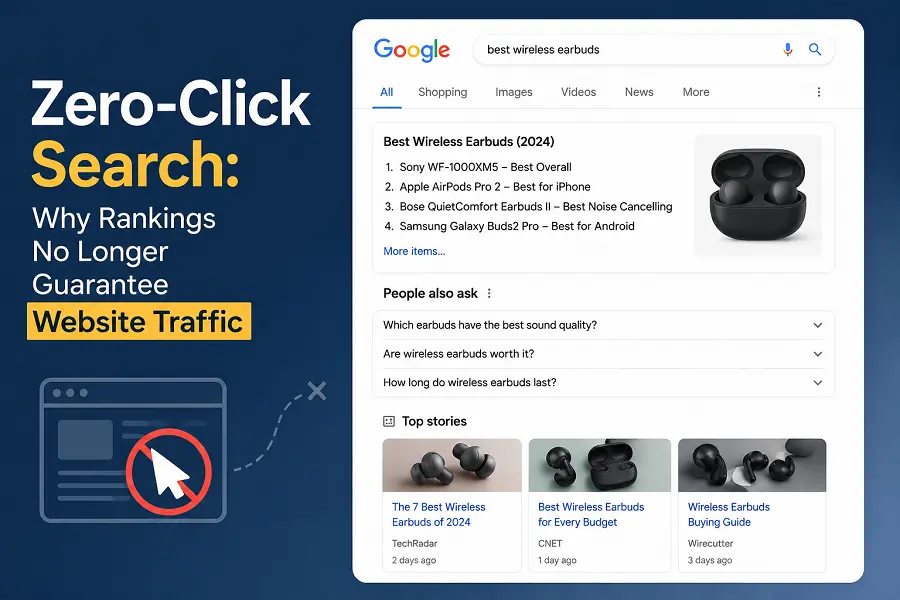
Zero-click searches are searches that end without the user visiting any website. Google answers the question directly on the results page, through featured snippets, knowledge panels, AI Overviews, or instant answer boxes. The user gets what they need, and your site never sees the visit.
This is not a small trend. According to data from SparkToro and Datos, over 58% of U.S. Google searches in 2024 ended without a click to any external site. On mobile, that number climbs even higher. Position one used to be the goal. Now, position one sometimes just means you supplied the answer someone else delivered.
This shift changes the fundamentals of SEO. Traffic is no longer a reliable proxy for visibility, and visibility is no longer a reliable proxy for business value. You need to understand the gap between where you appear and where users actually go.
How Zero-Click Search Steals Attention Before Users Reach Your Site
Google pulls content from top-ranking pages to build its on-page answers. Featured snippets are the clearest example. You rank in position zero, your content is displayed prominently, and many users read the answer without clicking through. You did the work. Google got the visit.
AI Overviews, introduced widely in 2024, push this further. Google’s AI synthesizes information from multiple sources and presents a single, consolidated answer at the top of the results page. Individual source links appear below the summary, but click-through rates drop sharply. HubSpot’s research showed a 21% average decline in organic clicks for informational queries where AI Overviews appeared.
Knowledge panels affect branded and local queries in the same way. Search for a business, and Google displays the address, hours, phone number, reviews, and photos directly. Many users never visit the official website. They call or navigate directly from the search result.
Understanding your actual traffic patterns helps you separate rankings from real visits. Some SEO teams use a traffic bot to establish baseline traffic benchmarks before and after Google feature updates, which makes it easier to isolate the impact of zero-click changes on specific query types. In some cases, this controlled traffic may also temporarily support search visibility by creating additional activity signals around a page. Knowing where the drop happened tells you where to respond.
The queries most affected by zero-click behavior follow predictable patterns. Informational questions (“What is X?”), calculation queries (“How many X in Y?”), weather, sports scores, definitions, and simple how-to steps all trigger direct answers. If your content strategy relies heavily on these query types, your traffic is likely already lower than your rankings suggest.
Why High Rankings No Longer Equal Reliable Traffic
The relationship between ranking and traffic has always been imperfect. Click-through rates vary by query type, title tag quality, and competition. But zero-click behavior has made that gap structurally wider and more predictable.
Consider a concrete example. Healthline consistently ranks in the top three for hundreds of health-related questions. For a query like “how long does the flu last,” Google’s AI Overview now provides a direct answer with a range of days and general guidance. Healthline may appear as a cited source, but the click-through rate for that query dropped sharply after AI Overviews launched. The ranking held. The traffic did not.
The same pattern appears in the legal and finance sectors. Nerdwallet and Investopedia have dominated personal finance search results for years. With the expansion of Google’s direct answer features for queries like “current mortgage rates” or “what is a Roth IRA,” these publishers have reported notable declines in organic traffic even while maintaining strong rankings. They rank, Google answers, and users stay on Google.
Local businesses face a parallel problem. A restaurant ranking first for “best Italian food near me” may appear in a map pack with reviews, a menu link, and photos. Many users book a table or call directly from that panel. The website visit never happens. The business still benefits from the visibility, but the website analytics no longer capture the full picture.
This creates a measurement problem. If you track SEO success through organic sessions alone, you will underestimate your actual visibility and overreact to traffic drops that reflect user behavior changes, not ranking losses. Impressions in Google Search Console, local actions in Google Business Profile, and branded search volume all capture value that session-based analytics miss.
The core issue is this: SEO used to move users from Google to your site. Now it increasingly keeps users on Google while your content does the work. That is not necessarily bad, but it requires a different way of measuring and capturing value.
How Brands Can Win Visibility When Clicks Decline
Adapting to zero-click search does not mean abandoning SEO. It means extending what SEO delivers. Rankings still matter. They determine whether Google pulls your content, features your business, or cites your data. The goal shifts from “rank to get clicks” to “rank to own visibility across every format Google uses.”
Target transactional and commercial queries more aggressively. Zero-click behavior is concentrated in informational searches. Queries with purchase intent, comparison intent, or service intent still generate strong click-through rates. A search for “best CRM software for small business” or “hire a plumber in Chicago” is far less likely to end on a Google answer than “what does CRM stand for.” Adjust your content mix to favor queries where users still need to visit a site to complete a task.
Optimize for cited visibility in AI Overviews. Google’s AI does not randomly select sources. It pulls from pages with clear structure, factual accuracy, and strong topical authority. Pages with clear headers, short factual paragraphs, and well-structured data appear in AI-generated summaries more often. Being cited does not always produce a click, but it builds brand association and sometimes does drive clicks from users who want to verify or expand on the answer.
Build your Google Business Profile as a full channel. For local businesses, the Business Profile is often the primary point of contact, not the website. Treat it accordingly. Keep hours accurate, respond to reviews, add photos regularly, and use the posts feature. Brands like clothing retailers and restaurants that actively manage their Business Profiles see measurably higher direct contact rates from search, even when website traffic stays flat.
Diversify your traffic sources before you need to. Relying on organic search as your primary acquisition channel was already a fragile strategy. Zero-click behavior makes it more so. Email lists, YouTube channels, social audiences, and podcast listeners give you direct access to your audience that does not depend on Google’s decisions. Gymshark built one of the strongest fitness brands in the U.K. primarily through social channels, before leaning into search. Their organic traffic complements a wider presence rather than carrying the entire load.
Create assets Google cannot fully replicate. Data studies, original research, pricing calculators, and comparison tools require user interaction. Google can summarize a general answer, but it cannot replicate your proprietary data or interactive tools. Ahrefs publishes its own keyword and traffic studies regularly. Those pages generate links, brand mentions, and direct visits because the original data lives only on their site. If your content is purely informational and freely summarizable, it is at higher risk. If it is original or interactive, it holds up better.
Track impressions and actions, not just sessions. Google Search Console shows impressions separately from clicks. A page with 50,000 impressions and 1,500 clicks may look weaker than a page with 5,000 impressions and 1,000 clicks when you look at sessions alone. But the first page is doing significant visibility work that the second is not. Pair Search Console impression data with Google Business Profile action data and branded search volume trends to get a complete picture of your actual presence.
Zero-click search is a structural shift, not a temporary algorithm update. Google is building a product that serves users on the results page, and that product keeps improving. Businesses that adapt their SEO strategy to account for this reality will maintain strong visibility. Those that keep optimizing purely for clicks to informational pages will find that their rankings hold while their traffic slowly declines.
The goal is to be the source Google trusts enough to feature, the brand users recognize when they see the citation, and the site they visit when they are ready to take action. Rankings still get you into that position. What you do with that position has changed.