
Introduction
Cross-border payments have become essential for businesses, freelancers, international travelers, and individuals who regularly send money to other countries. However, traditional international payment systems often involve multiple intermediaries, high transaction fees, currency conversion charges, and delays in processing. These challenges can make transferring money across borders expensive and inconvenient.
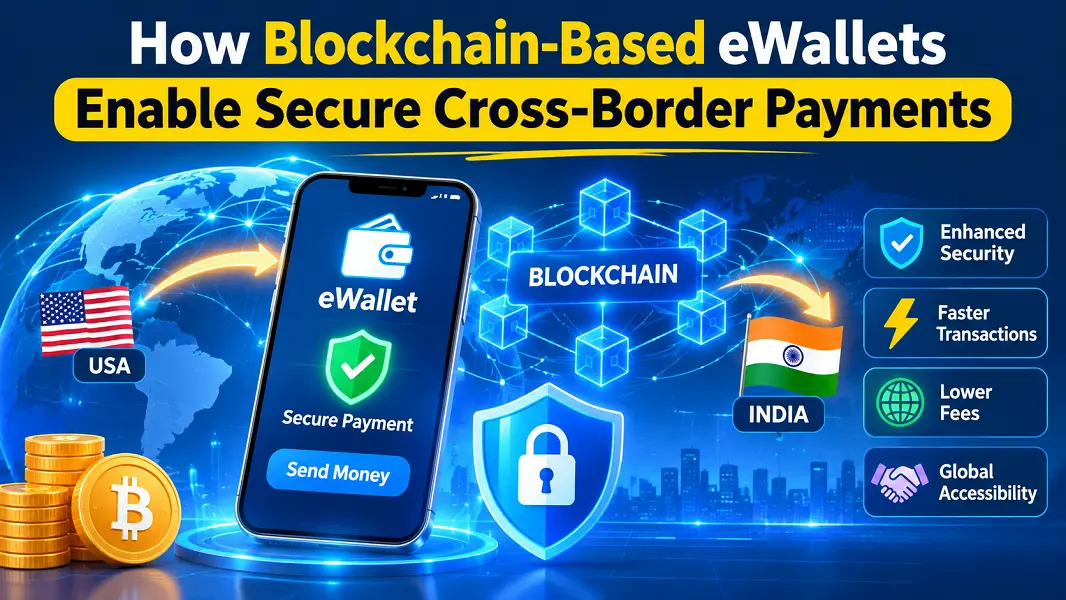
Blockchain technology is transforming this landscape by enabling faster, more transparent, and secure digital transactions. Blockchain-based electronic wallets, commonly known as eWallets, allow users to transfer digital assets and, in some implementations, regulated digital currencies across borders without relying on the same traditional intermediary networks. Businesses partnering with an experienced ewallet application development company can build innovative payment solutions that address these challenges while improving the overall user experience.
What Are Blockchain-Based eWallets?
A blockchain-based eWallet is a digital application that enables users to manage digital assets and initiate blockchain transactions. Depending on its design, it may support cryptocurrencies, stablecoins, tokenized assets, or integrations with traditional payment services.
Unlike conventional wallets that primarily depend on centralized payment providers and banking infrastructure, blockchain-enabled wallets can interact directly with blockchain networks. Transactions are recorded on a distributed ledger, allowing authorized participants to verify transaction details according to the network’s rules.
These wallets can be designed for individuals, merchants, financial institutions, and international businesses. Features such as wallet-to-wallet transfers, multi-currency support, transaction tracking, and automated compliance checks make them useful for modern cross-border payment applications.
1. Faster International Transactions
One of the major advantages of blockchain-based eWallets is the potential to reduce transaction settlement times. Traditional international transfers may pass through several banks and correspondent banking networks, resulting in delays that can extend over multiple business days.
Blockchain networks can process transactions outside conventional banking settlement windows, depending on network availability, congestion, confirmation requirements, and the payment infrastructure involved.
For example, a business in India working with a freelancer in another country could use a supported digital payment arrangement to transfer funds through a blockchain network. The recipient may receive the digital asset once the required confirmations are completed.
However, converting digital assets into local currency and transferring funds to a bank account may introduce additional processing time. The actual speed depends on the blockchain, service providers, and local financial systems.
2. Enhanced Security Through Cryptography
Security is critical when transferring money internationally. Blockchain-based eWallets use cryptographic mechanisms to protect transactions and verify ownership of digital assets.
Private keys authorize transactions, while public addresses enable users to receive assets. Depending on the wallet architecture, security measures may include hardware-backed key storage, multi-signature authorization, biometric authentication, and secure recovery mechanisms.
A professional development team can implement additional safeguards, including:
- Multi-factor authentication for account access.
- Encryption of sensitive information.
- Multi-signature approval for high-value transactions.
- Transaction limits and suspicious-activity alerts.
- Secure private-key management and backup procedures.
- Continuous monitoring for unusual transaction patterns.
These measures can reduce the risk of unauthorized access. Nevertheless, blockchain technology does not eliminate every security threat. Compromised devices, phishing attacks, stolen credentials, and poorly implemented smart contracts can still result in financial losses.
3. Lower Transaction Costs
Traditional cross-border transfers can involve bank fees, intermediary charges, foreign exchange margins, and receiving fees. These expenses can be particularly challenging for small businesses and individuals who send frequent international payments.
Blockchain-based eWallets may reduce dependence on certain intermediaries by enabling direct digital asset transfers. Some blockchain networks also offer relatively low transaction fees compared with traditional payment arrangements.
For instance, a company making regular international payments to suppliers could evaluate stablecoin-based transfers on a suitable blockchain network to reduce settlement friction.
However, the total cost depends on network fees, wallet provider charges, currency conversion spreads, liquidity, compliance requirements, and cash-out fees. Businesses should compare the complete transaction cost rather than assuming every blockchain payment will be cheaper.
4. Greater Transparency and Traceability
Blockchain technology creates a shared transaction record that can be independently verified by participants with access to the relevant network data.
This transparency helps users track payment progress, verify transaction confirmations, and investigate discrepancies. Businesses can use transaction identifiers to reconcile payments and maintain more accurate financial records.
For organizations processing large volumes of international transactions, this capability can simplify auditing and payment reconciliation.
An eWallet can also include a transaction dashboard displaying payment status, timestamps, supported currency values, network fees, and transaction references. Access controls and privacy-conscious design remain important because public blockchain records may expose transaction information to anyone who can view the network.
5. Simplified Currency Transfers With Stablecoins
Stablecoins are digital assets designed to maintain a relatively stable value against a reference asset, commonly a fiat currency such as the US dollar. When supported by suitable infrastructure, they can provide an alternative method for transferring value internationally.
For example, a business may send an eligible dollar-pegged stablecoin to a supplier who accepts it. The supplier can then hold the asset or convert it into local currency through an authorized service provider.
This approach can reduce exposure to cryptocurrency price volatility compared with transferring assets such as Bitcoin. However, stablecoins still carry risks involving issuer reserves, redemption arrangements, liquidity, depegging, and regulatory restrictions.
Developers must also consider whether the chosen stablecoin and its associated services are legally available in the countries where the wallet will operate.
6. The Role of Smart Contracts in Cross-Border Payments
Smart contracts are programs deployed on blockchain networks that execute predefined rules when specified conditions are met.
In cross-border payment applications, smart contracts can support automated payment workflows, conditional releases, escrow arrangements, and transaction validation.
For example, an international business could use a smart contract to release funds after a specified delivery milestone has been verified through an approved process.
When implemented correctly, these workflows can reduce manual intervention and improve consistency. However, smart contracts require thorough testing, security audits, and careful management of external data sources. Automation alone does not guarantee that a transaction is legally valid or that the underlying business conditions have been satisfied.
7. How to Develop a Secure Blockchain-Based eWallet
Building a reliable international payment wallet requires a combination of technical expertise, security planning, and regulatory awareness. Businesses seeking blockchain app development services should evaluate the following essential steps:
Define the payment model: Determine whether the wallet will support cryptocurrencies, stablecoins, fiat currency integrations, or a combination of these options.
Choose the right blockchain: Evaluate transaction speed, fees, network reliability, liquidity, scalability, and ecosystem support before selecting a blockchain.
Implement secure wallet architecture: Select an appropriate custodial or non-custodial model and establish robust key-management, authentication, and recovery processes.
Integrate payment and currency services: Connect suitable payment gateways, liquidity providers, exchanges, or banking partners where required.
Address compliance requirements: Assess applicable licensing, anti-money laundering (AML), customer verification (KYC), sanctions screening, data protection, and consumer protection obligations in each target market.
Test before launch: Conduct security audits, penetration testing, transaction simulations, and performance testing to identify vulnerabilities before releasing the application.
An experienced eWallet development partner can help coordinate these technical and operational requirements while designing a scalable payment solution.
Conclusion
Blockchain-based eWallets are creating new opportunities for secure and efficient cross-border payments. By combining cryptographic security, transparent transaction records, programmable payment workflows, and support for suitable digital assets, these applications can address several limitations of traditional international transfers.
However, successful implementation depends on more than blockchain integration. Businesses must prioritize wallet security, regulatory compliance, liquidity, currency conversion, and a straightforward user experience.
Partnering with a reliable ewallet application development company can help organizations identify the right architecture, integrate essential payment capabilities, and build solutions suited to their international customers. With carefully selected blockchain app development services, businesses can develop payment applications designed to support the evolving needs of the global digital economy.