
Introduction
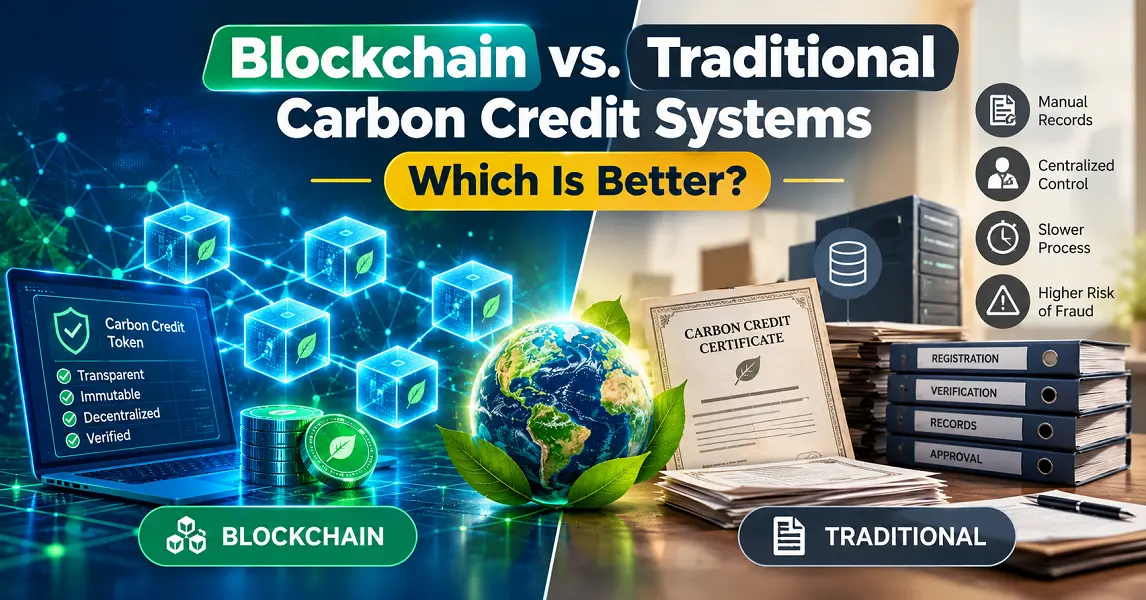
As businesses worldwide focus on sustainability and reducing their carbon footprint, carbon credits have become an important tool for addressing climate change. Companies can purchase carbon credits to compensate for their greenhouse gas emissions while supporting projects such as renewable energy, reforestation, and forest conservation. However, traditional carbon credit systems often face challenges related to transparency, verification, double counting, and administrative costs.
Blockchain technology is emerging as a potential solution to these problems by providing a transparent, traceable, and tamper-resistant way to manage carbon credits. But does blockchain offer a better alternative to traditional systems? Understanding the differences between these approaches can help businesses, investors, and environmental organizations make informed decisions.
What Are Traditional Carbon Credit Systems?
Traditional carbon credit systems rely on registries, verification bodies, project developers, brokers, and other intermediaries to issue, track, and trade carbon credits. Each credit generally represents one metric tonne of carbon dioxide equivalent (CO₂e) reduced or removed, subject to the applicable program’s rules.
In these systems, environmental projects are evaluated to determine whether they meet established standards. Once approved, credits are issued and recorded in a registry. Businesses can purchase these credits and retire them to support their climate commitments.
Although traditional systems have helped establish carbon markets, they can involve complex procedures and fragmented recordkeeping. Information may be distributed across multiple databases, making it difficult for participants to verify a credit’s complete history quickly.
Key Advantages of Traditional Systems
- Established standards: Recognized carbon credit programs have methodologies for measuring, reporting, and verifying emissions reductions.
- Regulatory familiarity: Many businesses and environmental organizations already understand traditional registry processes.
- Expert oversight: Independent auditors and verification bodies assess projects according to applicable standards.
- Existing market infrastructure: Established registries, brokers, and trading platforms support the issuance and sale of carbon credits.
Despite these advantages, traditional systems may experience administrative delays, limited data accessibility, and inconsistencies between registries or market participants.
What Is Blockchain-Based Carbon Credit Management?
Blockchain-based carbon credit management uses distributed ledger technology to record transactions and track credits throughout their lifecycle. Instead of relying exclusively on separate databases, authorized participants can access a shared record of relevant transactions.
Depending on the platform’s design, blockchain can support credit issuance records, ownership transfers, project documentation, and retirement tracking. Smart contracts can also automate predefined actions, such as transferring credits after payment or preventing the same digital credit from being transferred more than once.
Businesses exploring Carbon Credit Development services can use blockchain-based platforms to build digital infrastructure for carbon credit issuance, trading, monitoring, and retirement. These platforms can improve transaction traceability and streamline certain operational processes.
However, blockchain does not automatically guarantee that a carbon credit represents a genuine environmental benefit. Reliable project assessments, independent verification, and accurate monitoring remain essential.
Blockchain vs. Traditional Carbon Credit Systems: Key Differences
1. Transparency and Traceability
Traditional systems maintain records through registries and other databases. Access to information depends on the registry’s policies, reporting practices, and integration with other platforms.
Blockchain can provide a shared transaction history that helps authorized participants trace credit ownership and transfers. Depending on the implementation, selected project information may also be made publicly accessible.
Winner: Blockchain for transaction traceability, provided that the platform is well designed and its records are connected to credible project data.
2. Security and Double-Counting Prevention
Traditional registries use account controls, verification procedures, and retirement mechanisms to prevent duplicate claims. However, coordination can become complicated when credits move between different platforms.
Blockchain can strengthen transaction controls through unique digital records and smart contracts. Properly designed systems can prevent duplicate transfers within the same ledger and maintain a transparent history of ownership.
Nevertheless, preventing double counting across separate platforms requires reliable registry integration and clear rules. Blockchain alone cannot eliminate every form of duplicate environmental claim.
Winner: Blockchain for programmable transaction controls, while both approaches require strong governance.
3. Transaction Speed and Operational Efficiency
Traditional carbon credit transactions may involve intermediaries, manual reconciliation, and administrative checks. The time required varies according to the registry, verification requirements, and transaction structure.
Blockchain platforms can automate selected processes through smart contracts, potentially reducing reconciliation work and speeding up transfers. They may also simplify interactions between project developers, buyers, and trading platforms.
However, onboarding, compliance reviews, and environmental verification can still take considerable time.
Winner: Blockchain for automating eligible transactions, although the actual efficiency gains depend on platform design and market integration.
4. Cost and Accessibility
Traditional systems may involve registry fees, verification expenses, brokerage commissions, and administrative overhead. These costs differ across programs and transaction types.
Blockchain may reduce some intermediary and recordkeeping costs through automation. Digital platforms can also make it easier for smaller organizations to participate in carbon markets.
On the other hand, blockchain infrastructure requires development, maintenance, cybersecurity measures, and potentially network transaction fees.
Winner: It depends. Blockchain can lower selected operational costs, but it is not automatically cheaper than an established registry.
5. Environmental Integrity and Verification
Environmental integrity is one of the most important considerations in carbon markets. A credit must represent a credible emissions reduction or removal under the applicable methodology.
Traditional systems rely on established methodologies, monitoring procedures, and independent verification. Blockchain can make project records easier to trace, but it cannot independently determine whether reported emissions reductions are accurate.
Integrating trusted monitoring systems, remote sensing, IoT devices, and independent verification data can strengthen blockchain-based platforms.
Winner: Neither technology alone. Credible methodologies, independent verification, and effective governance matter more than the underlying recordkeeping technology.
The Role of Blockchain Application Development Services
Organizations planning to modernize carbon markets need technology that supports transparency without compromising environmental standards. Professional blockchain application development services can help businesses build platforms tailored to their operational and regulatory requirements.
These solutions may include:
- Digital carbon credit registries with unique credit identifiers.
- Smart contracts for transfers, trading, and retirement.
- Integration with existing registries and verification systems.
- Dashboards for monitoring project performance and transaction history.
- Secure APIs connecting buyers, project developers, auditors, and trading platforms.
A successful implementation should prioritize interoperability, data privacy, regulatory compliance, and clear governance. Businesses should also evaluate whether blockchain is necessary for their use case or whether improvements to an existing registry would deliver better value.
Which Carbon Credit System Is Better?
The answer depends on the organization’s objectives, budget, technical capabilities, and market requirements.
Traditional systems remain suitable for organizations that need established standards, familiar processes, and access to recognized carbon credit registries. Blockchain-based systems may be more attractive when transaction traceability, automation, interoperability, and digital trading are major priorities.
In many cases, a hybrid approach offers the most practical solution. Traditional verification standards and registries can provide environmental credibility, while blockchain can improve transaction tracking and automate selected processes. Such systems must be carefully integrated to avoid creating parallel records or conflicting claims.
Conclusion
Blockchain and traditional carbon credit systems both have important roles in the development of reliable carbon markets. Traditional systems offer established verification processes and institutional familiarity, while blockchain introduces opportunities for improved traceability, automated transactions, and more efficient recordkeeping.
Ultimately, the best system is not necessarily the newest technology but the one that delivers measurable environmental value, reliable verification, secure transactions, and transparent reporting.
As carbon markets continue to evolve, businesses can evaluate blockchain-based solutions to improve their operations while retaining the standards and safeguards needed to maintain trust. Combining credible environmental verification with well-designed digital infrastructure may help create more accessible, accountable, and efficient carbon markets.


