Introduction
Email remains one of the most useful communication channels for businesses, organizations, freelancers, and online brands. Despite the growth of social media and other digital platforms, email provides something particularly valuable: direct communication with an audience.
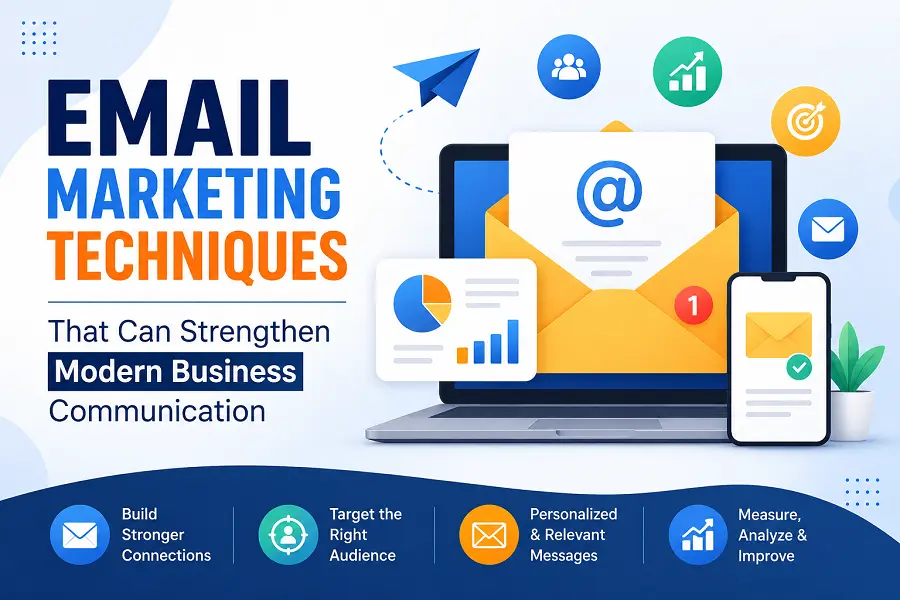
Effective email marketing techniques can help businesses build relationships, communicate offers, introduce products, share useful information, and encourage repeat purchases. However, successful email marketing is not simply about sending large numbers of messages. It requires thoughtful planning, relevant content, appropriate timing, and respect for subscribers.
Modern email marketing combines creativity with data. Businesses can use audience information, engagement metrics, automation, and carefully designed campaigns to make communication more relevant.
Understanding Email Marketing
Email marketing involves using email to communicate with customers, prospects, subscribers, or other audiences.
Businesses may use email for several purposes, including:
- Promoting products
- Announcing new services
- Sharing educational content
- Sending newsletters
- Offering discounts
- Confirming transactions
- Building customer relationships
- Encouraging repeat purchases
The best strategy depends on the organization’s goals and the expectations of its audience.
Building a Quality Email List
A strong email strategy begins with a quality subscriber list.
Businesses should focus on obtaining permission from people who genuinely want to receive their messages.
A large list is not necessarily better than a smaller list containing engaged subscribers.
People who voluntarily subscribe are more likely to open emails, click links, and interact with the business.
Businesses can encourage subscriptions through website forms, newsletters, downloadable resources, promotions, account registrations, and other legitimate opportunities.
Creating Compelling Subject Lines
The subject line is one of the first things a recipient sees.
A clear and relevant subject line can encourage people to open the message.
Effective subject lines generally communicate what the email is about without making unrealistic promises.
For example, a business might highlight a new product, a limited promotion, an upcoming event, or useful information.
Subject lines should also avoid excessive punctuation and misleading claims.
Personalization
Personalization can make email communication feel more relevant.
A simple example is addressing a subscriber by name.
More advanced personalization can involve recommending products based on previous purchases or sending content related to a subscriber’s interests.
However, personalization should be used responsibly.
Customers may appreciate relevant communication, but excessive use of personal information can feel intrusive.
Audience Segmentation
Not every subscriber has the same needs.
Segmentation allows businesses to divide an audience into groups based on characteristics or behavior.
For example, a company might create separate groups for:
- New subscribers
- Existing customers
- Repeat customers
- Inactive subscribers
- Customers interested in particular products
- Geographic markets
Different groups can then receive more relevant communication.
Valuable Content
Email marketing should provide value.
If every message is focused exclusively on selling something, subscribers may lose interest.
Businesses can balance promotional emails with educational and useful content.
Depending on the industry, this might include tutorials, tips, industry news, product information, case studies, announcements, or helpful resources.
Providing value can encourage subscribers to continue opening future messages.
Mobile-Friendly Design
A large proportion of email activity occurs on mobile devices.
Emails should therefore be designed to work well on smaller screens.
Important considerations include readable fonts, responsive layouts, appropriately sized buttons, and concise content.
A recipient should not need to zoom in or scroll horizontally to understand the message.
Mobile-friendly design can improve the overall user experience.
Clear Calls to Action
An email should generally have a clear purpose.
The call to action tells the reader what to do next.
Examples include:
- Shop now
- Learn more
- Register today
- Read the article
- Book a consultation
- Download the resource
- Contact the team
A clear call to action can reduce confusion and help recipients understand the intended next step.
Email Automation
Automation can make email marketing more efficient.
Businesses can create automated messages that are triggered by specific events.
For example, a welcome email can be sent after someone subscribes.
A customer may receive a follow-up message after making a purchase.
An online store can send reminders to customers who leave products in their shopping carts.
Automation allows businesses to communicate consistently without manually sending every message.
Welcome Emails
A welcome email is often one of the first interactions between a brand and a new subscriber.
It can introduce the business, explain what subscribers can expect, and provide useful information.
A well-designed welcome message can establish expectations and create a positive first impression.
Some businesses also use welcome campaigns consisting of several messages rather than a single email.
Promotional Campaigns
Promotional emails can help businesses announce special offers, seasonal sales, new products, and limited-time opportunities.
However, promotions should be presented clearly.
The customer should understand the offer, conditions, expiration date, and relevant details.
Excessive promotional messaging can lead to subscriber fatigue.
A balanced communication schedule is usually more sustainable.
Testing Different Approaches
Email marketing can benefit from experimentation.
Businesses can test different subject lines, designs, headlines, calls to action, and sending times.
A/B testing allows marketers to compare two variations and evaluate which performs better.
For example, one group of subscribers might receive one subject line while another receives a different version.
The resulting engagement can provide useful insights.
Measuring Performance
Successful email marketing depends on measurement.
Important metrics can include:
- Open rate
- Click-through rate
- Conversion rate
- Unsubscribe rate
- Bounce rate
- Revenue generated
- Subscriber growth
These measurements can help marketers understand how audiences respond to campaigns.
For example, a high open rate but low click-through rate might indicate that the subject line works well but the email content or call to action needs improvement.
Avoiding Email Fatigue
Sending too many emails can negatively affect engagement.
Subscribers may become tired of receiving frequent messages and eventually unsubscribe.
The appropriate frequency depends on the industry and audience.
Businesses should focus on sending useful communication rather than maximizing the number of emails sent.
Monitoring engagement can help identify whether subscribers are becoming less responsive.
Re-Engagement Campaigns
Some subscribers stop opening emails over time.
Instead of immediately removing them, businesses may create re-engagement campaigns.
A re-engagement message can acknowledge that the subscriber has been inactive and provide a reason to return.
For example, a company might offer updated content, a special promotion, or the opportunity to adjust email preferences.
If a subscriber remains inactive, removing them can improve the overall quality of the mailing list.
Building Trust
Trust is essential in email marketing.
Subscribers should know who is contacting them and why.
Businesses should provide clear sender information and avoid misleading subject lines.
They should also make it reasonably easy for subscribers to manage their preferences or unsubscribe.
Respecting subscribers can contribute to a healthier long-term relationship.
Email Marketing for Small Businesses
Small businesses can benefit from email marketing because it can provide a direct communication channel without requiring a large advertising budget.
A local business might use email to announce new products or events.
A freelancer could share professional updates and useful resources.
An online retailer can communicate with customers about new collections and promotions.
The strategy can be adapted according to the business model.
Combining Email With Other Channels
Email marketing does not need to operate independently.
Businesses can combine email with websites, social media, content marketing, search optimization, and other channels.
For example, an email newsletter can introduce a new blog article and direct subscribers to the website.
A social media campaign can encourage followers to subscribe to an email list.
Using multiple channels can create a more consistent customer experience.
Maintaining a Clean Subscriber List
A clean email list can improve campaign performance.
Invalid addresses and persistent bounces can negatively affect deliverability.
Regularly reviewing subscriber engagement can help businesses identify inactive contacts.
Removing invalid or consistently unresponsive addresses can create a more engaged audience.
Email Marketing and Professional Development
Digital marketing professionals increasingly need to understand how different communication channels work together.
Email marketing involves creativity, analytics, copywriting, audience research, technology, and customer psychology.
Professionals can develop these skills through practical campaigns and experimentation.
Industry resources and professional communities can also provide opportunities to learn about changing marketing practices. Resources such as CertLibrary may be useful to readers exploring broader professional and technology-related learning topics, although email marketing itself is best developed through practical marketing experience.
Common Email Marketing Mistakes
Several mistakes can reduce campaign effectiveness.
These include:
- Sending emails without permission
- Using misleading subject lines
- Sending too frequently
- Ignoring mobile users
- Writing excessively long messages
- Using unclear calls to action
- Failing to test campaigns
- Ignoring unsubscribe requests
- Not analyzing performance
Avoiding these issues can create a better experience for subscribers.
The Future of Email Marketing
Email marketing continues to evolve as businesses gain access to better automation, analytics, personalization, and artificial intelligence tools.
Technology can help marketers analyze audience behavior and create more relevant campaigns.
However, technology does not replace the need for useful content.
People are more likely to engage with emails that are relevant, clear, timely, and genuinely helpful.
Frequently Asked Questions
What are email marketing techniques?
Email marketing techniques are strategies used to improve communication with subscribers, including segmentation, personalization, automation, testing, content creation, and performance measurement.
How often should businesses send emails?
There is no universal frequency. Businesses should choose a schedule that provides value without overwhelming subscribers.
Is personalization important?
Yes. Relevant personalization can improve the subscriber experience when it is used appropriately and responsibly.
What should an email call to action include?
A call to action should clearly communicate the next step, such as purchasing a product, reading an article, registering for an event, or contacting a business.
Why should email campaigns be measured?
Metrics help marketers understand what works and identify areas that need improvement.
Conclusion
Effective email marketing techniques combine strategy, useful content, thoughtful design, and data-driven decision-making. Building a quality subscriber list, creating relevant messages, segmenting audiences, using automation, and measuring performance can help businesses communicate more effectively with customers.
The strongest email campaigns do not treat subscribers simply as numbers. They focus on delivering information that is useful and relevant while respecting customer preferences.
As digital marketing continues to evolve, email remains a powerful channel because it provides businesses with a direct way to maintain relationships with their audiences. When combined with other digital strategies and supported by consistent testing and improvement, email marketing can become an important part of long-term business communication and customer engagement.