Introduction
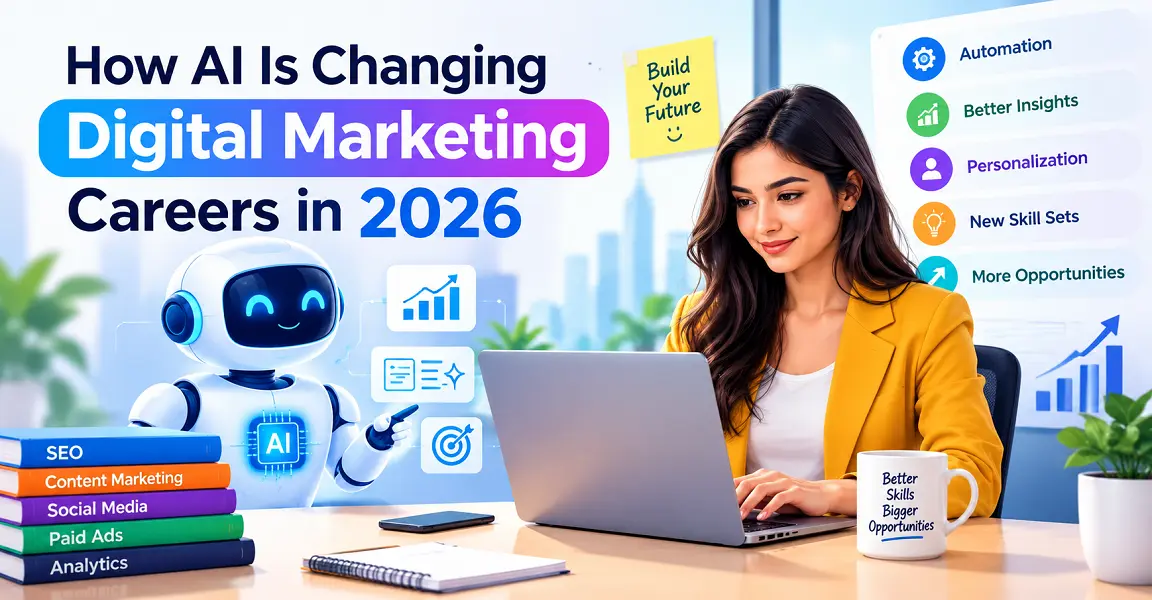
The development of advanced technologies like artificial intelligence and machine learning is challenging the traditional workflow in every field and digital marketing is no exception to it. Ai is reshaping the marketing work, Marketers are using AI to research topics, analyse campaigns, generate content and automating workflows.
This directly reflect to the question
if AI can handle marketing tasks will AI replace digital marketers?
And the answer is AI is not replacing digital marketers instead AI is helping marketers to focus on ad strategy and by handling repetitive tasks. This is boosting productivity and marketers who use AI are going for more optimized AD Strategies. As AI optimized marketing is more personalized and it gives high ROI business and markets are giving high preference to it. Companies are looking for the marketers who can combine AI with marketing for better productivity and highly optimized content.
For someone who wants to learn digital marketing in 2026 it’s crucial to understand how AI is changing the digital marketing landscape and how to use AI for better marketing purpose. There are several digital marketing courses on how to integrate AI in digital marketing. This article will walk you through the rapidly changing landscape of digital marketing with the integration of AI.
How AI Is Reshaping Different Digital Marketing Roles
Integration of AI in marketing is not just about automating the marketing tasks it’s about reshaping the everyone’s role in marketing team from content writer to marketing managers. Let’s take a look at how AI is reshaping different marketing roles:
Content marketing and copywriting:
AI can help content marketers in various tasks. They can use AI to generate topic ideas, build outlines, create first drafts and adapt a message for different platforms. For example, one long-form article can become a newsletter, a short social post and a video script.
Search engine optimisation:
Search experiences are changing rapidly as users receive more direct answers from AI-powered systems. However, Search Engine Optimisation, or SEO, is also becoming more strategic. AI can assist with keyword clustering, search-intent analysis, content briefs and internal-link suggestions. SEO professionals may focus on measuring visibility across both traditional search and AI-driven discovery.
Performance marketing and paid advertising
Advertising platforms use automation to help with audience targeting, bidding, budget allocation, and creative testing. AI can generate multiple ad variations. AI can also help to identify patterns in Ad campaign faster than a human. Performance marketers will still need to decide what the campaign should achieve, which audience is commercially meaningful and how the brand should be represented. Their work will involve experiment design, budget judgement, attribution analysis, and communication with sales and product teams.
Social media marketing:
AI can help social media teams plan calendars, analyse conversations, suggest responses, and adapt content for different platforms. AI can also highlight emerging themes or changes in audience sentiment. Yet social media depends heavily on timing, cultural awareness, empathy, and context. A tool may identify that a topic is trending, but we need experienced marketers to decide whether joining that conversation would be appropriate for a particular brand. Human review is important, especially when it comes to sensitive issues and public responses.
Marketing analytics:
AI is making it easier to summarise dashboards and translate data into natural-language explanations. This may reduce the time marketing analysts spend on preparing reports. However, it does not remove the need for analytical thinking. Marketers still has to select the right metrics, check data quality, and explain what kind of decisions to make.
From Doing Marketing Tasks to Managing Marketing Systems
The integration of AI in marketing is moving work from doing tasks manually to managing automated marketing systems. Traditionally most of these tasks were data work that marketers had to do manually. They had to deal with keyword lists, finding new ideas for content generation, managing customer data and testing ad Strategies. The focus shifts to deciding what to do and check for the results. This means future marketer will spend most of their time planning, checking, improving and measuring how well marketing systems are working. For students learning AI tools is good but learning the marketing strategy that goes with those tools is far more important.
The Skills Employers May Look for in AI-Assisted Marketers
Employers will likely value marketers who can combine practical AI use with strong marketing judgement. Following are the kind of skills employers may look for:
Marketing fundamentals:
AI does not replace knowledge of audiences, segmentation, positioning, offers, funnels and customer journeys. These basic marketing concepts help a marketer to decide what should be created and why.
Prompting and workflow design:
Prompting involves giving an AI system a clear role, useful context and a desired output format. The professionals who know when to connect several steps into a workflow will be in high demand.
Data literacy:
Marketers should be comfortable when it comes to reading dashboards, understanding key performance indicators and asking whether a result is reliable. They should also understand the limitations of models and incomplete or null data.
Experimentation:
Employers will value marketers who know how to test AI generated ideas. This includes forming a hypothesis, choosing a success metric, controlling variables and learning from results.
Editorial and creative judgement:
AI can produce many possible headlines, images, and campaign concepts. A professional must decide which option is clear, culturally appropriate and aligned with the brand. Editing is not just about correcting grammar, Fit is about increasing impact.
If you are fresher or student, you can learn these skills with integration of AI through digital marketing course.
Why Knowing AI Tools Alone Is Not Enough
Learning a collection of AI tools can be useful, but it’s not enough to land a job in the field of marketing. To become a good at marketing you need to understand core marketing skills. An AI tool can produce a draft in seconds, but it may not know whether the topic supports the company’s positioning, whether the claims are accurate. Those decisions require strategy and human judgement and marketing knowledge. Similarly, when it comes to marketing analyst, An AI assistant can summarise that conversions increased. But when it comes to determine where this came from we require a fundamental marketing concepts. Tools can increase speed. They do not automatically create understanding. Students should therefore learn AI tools alongside marketing strategy, analytics, communication and research.
The New Digital Marketing Career Path: Learn → Apply → Measure
Digital marketing is not about going through academic definitions or practicing coding questions. It’s about real life experiments trying different methods and practicing hands-on projects. The new career path will be more about applying and measuring success instead of watching lectures on how marketing works. The learning path has 3 different stages let’s take a look at them:
Learn
The one should start with the foundation of marketing. Learn how customers make decisions, how brands create value and how marketers evaluate performance. Then go for how AI systems can support research, creation, automation, and analysis.
Apply
Use that knowledge in real life projects. A learner can build a content plan for an imaginary company, develop a paid campaign brief, conduct a competitor analysis, or design a social media experiment. This stage turns knowledge into real life experience. A portfolio that shows the problem, the process, the human decisions and the AI assistance is more valuable.
Measure
Measure the results of experiments and explain what it means. Track relevant metrics such as conversion rate, cost per acquisition, retention, engagement quality, depending on the project.
Measurement teaches learners that marketing is not judged only by how polished a post looks or how many people viewed it. The question is whether it supported a meaningful business goal.
Marketers who keep learning, applying, and measuring will be better positioned.
What a Digital Marketing Career Could Look Like in 2026
In 2026 marketing will more result oriented and focus on. A content strategist might use AI to find out what questions the audience asks, then talk to customers to learn the words they use. A performance marketer might ask an AI system to show campaign problems then decide if the budget should change after looking at the quality of leads. An email specialist might rely on suggestions but still set the overall communication plan.
Teams are also expected to become more flexible as single professional can handle a broader set of tasks. Employers may look more for people who can work across content, data, technology and customer experience. In addition to existing job roles, organizations may create jobs that focus on marketing operations, automation and AI workflow management. The common requirement will be the ability to convert technology into responsible marketing results.
How Students and Beginners Can Prepare for AI-Driven Marketing Jobs
Digital marketing landscape is changing rapidly especially integration of advanced AI tools is changing the job descriptions. In this time, it’s important to learn the skills the employers are looking for. Start with learning core fundamentals of digital marketing. These include concepts like audience research, copywriting, search engine optimisation, social media, email marketing and paid advertising analytics.
Once you have a strong foundation of marketing learn AI tools and how to use them through real tasks. Use AI for tasks like creating research questions, compare campaign ideas, generate a first draft and analyse a dataset. Analyse what the tool did well, where it failed, and what you changed.
Once you have enough knowledge of marketing fundamentals and AI tools build real life projects. Each project should explain the business problem, the audience, the chosen strategy, the tools used, and the results or expected measurement plan.
Then go for soft skills and practise communicating decisions. Employers need marketers who can explain why they selected an audience, changed a message, rejected an AI output, or recommended a budget adjustment.
By integrating all of this a fresher can land a job in the field of digital marketing.
What AI Still Cannot Replace in Digital Marketing
AI can generate scripts, images, recommendations, and predictions. However, it does not mean that there is no need for marketers. When it comes to human judgement and selecting what matters for brands we need marketers. AI can identify patterns without fully understanding a consequence behind it. Trust is another area where human involvement remains important.
AI does not replace accountability. A company may use an AI system to assist with content or targeting, but a human team remains responsible for the decision to publish, spend, personalise, or contact a customer. That responsibility will make judgement a central career skill.