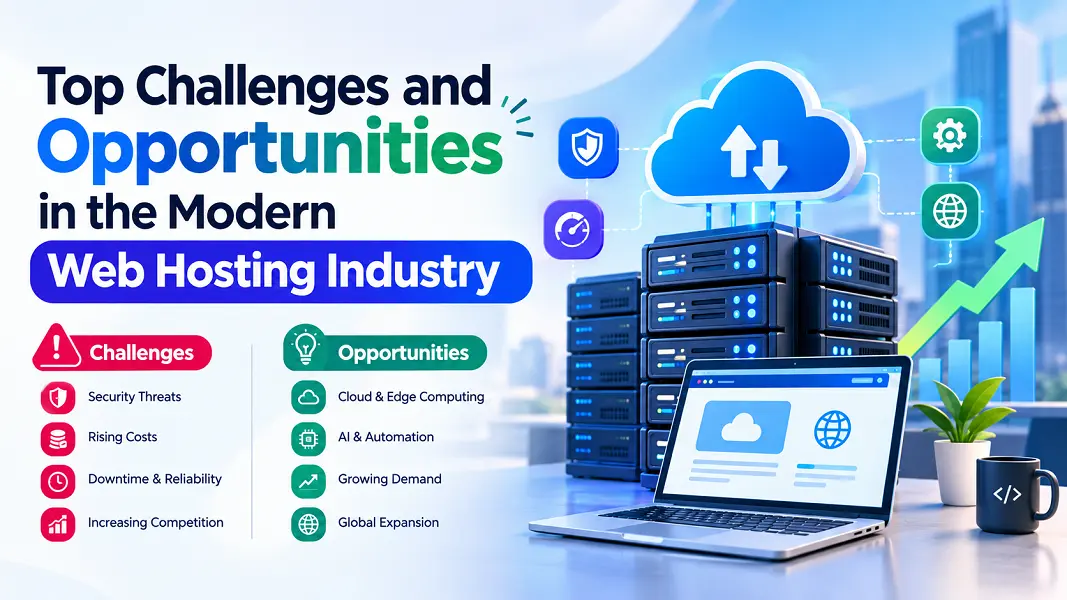
The web hosting industry is growing faster. We can’t call websites simple pages. Now, they are full platforms. Businesses need websites for sales, branding, and customer trust. Due to this, hosting providers are under pressure to improve. It means the fast growth brings many challenges. Moreover, it also creates new opportunities for those who adapt early. We have to understand both sides. It is key to long-term success.
Let’s learn the top challenges and opportunities in the modern web hosting industry!
Major Challenges in the Web Hosting Industry
First, we have to understand the major challenges faced by the web hosting industry:
Rising Expectations from Customers
People who use websites today want things to happen fast. If a website is slow, it will make visitors leave. Even if it is a little slow, this can make more people leave the website without doing anything. It will also reduce the number of people who buy things from the website.
People expect websites to be up and running all the time. Clients want their websites to be available twenty-four hours a day and seven days a week. If a website is down for a while, it feels like a big problem. This means that hosting companies have to spend money on equipment and systems to keep websites like these websites running smoothly. The websites need to be working at all times.
Furthermore, people want to get help away, and they want to know what is going on. When they have to wait for a time, it makes them really upset. They start to doubt the company. Customer support is very important because people need to feel like they can get help when they need it. Long wait times are bad for customer support, and they can make people lose trust in the company and its customer support.
Increasing Security Risks
Cyber threats are getting worse every year. The hackers we see today are really good at what they do. Cyber threats are becoming a problem.
DDoS attacks are a problem. So are data breaches and malware infections. These are risks that people face. Hosting providers have a job. They have to protect thousands of websites all at the same time. This means they have to keep all of these websites from DDoS attacks and other threats, like data breaches and malware infections.
Strong security requires constant monitoring. It also needs regular updates and backups. All this increases cost and workload.
Complex Infrastructure Management
These days, hosting is done on servers and things like containers and virtual environments. Managing cloud servers and these other systems is really not easy. Hosting with servers can be very tricky.
Manual handling is really slow. It is also very risky. When you make errors during handling, it can cause outages, or you can even lose your data with manual handling. Manual handling is just not an idea because of this.
To deal with all this complexity, providers have to use automation and tools that control everything from one place. A web hosting control panel really helps make things easier, but people need to learn how to use these tools, and that means having a team of skilled people to take care of them. Hosting control panels are very important. They need to be reliable so that providers can focus on other things.
High Competition and Pricing Pressure
The market for hosting is really crowded. Every year, new companies come into the picture. A lot of these companies are trying to beat each other on the price of hosting. The hosting market is very competitive because of this.
When you have prices, you get a lot of customers. The problem is that it also means you do not make as much money. Companies that sell things have a time figuring out how to keep prices low and still offer good quality products. The thing is, low pricing attracts customers. At the same time, it reduces profit margins for these companies. They have to find a way to make it work so that customers are happy. They can still make a profit.
When you cut costs, it can really hurt the support you give to your clients or the performance of your service. This usually makes the clients very unhappy. They often stop doing business with you. The number of clients who leave is very high. Cutting costs can be bad for the clients and the business because it affects the support and performance of the service, which is what the clients really need.
Energy Costs and Sustainability
Data centers use a lot of energy. The cost of power is going everywhere. Data centers are really affecting our power bills.
People who buy things from companies are also starting to think about the Earth. They like it when companies that sell them things also care about the earth and want to keep it clean. Customers want companies to be kind to the environment and think about sustainability. Companies that think about sustainability are the ones that customers prefer.
Hosting providers must invest in energy-efficient hardware. Green hosting solutions require long-term planning and capital.
Key Opportunities in the Modern Hosting Landscape
Now, we are going to discuss key opportunities in the modern hosting landscape:
Growing Demand for Managed Services
A lot of businesses do not have the expertise they need. These businesses want hosting that works properly without giving them any headaches. They want hosting that is easy to use and does not cause them any stress. Businesses like this need hosting that just works.
Managed hosting is the answer to this issue. The people who provide managed hosting take care of updates for the managed hosting, they take care of security for the managed hosting they do backups for the managed hosting. They make sure the managed hosting is working properly.
Expansion of Cloud and Hybrid Hosting
Cloud hosting is really taking off. The thing about cloud hosting is that it gives people a lot of flexibility. This means they can do what they want with cloud hosting. Cloud hosting also offers scalability, which is very useful for people who use cloud hosting. They can make changes to their cloud hosting as they need to.
People are really starting to use hybrid hosting. Hybrid hosting is a way that combines cloud and dedicated resources. This is great for businesses because it helps them control how much money they spend on hosting while still getting the performance they need from hybrid hosting.
Cloud providers that give people choices are more popular with lots of people. When we talk about cloud providers, like them because they are flexible. This means that these cloud providers can attract an audience of people who use the cloud.
Performance as a Competitive Advantage
The speed of a website is really important these days. Search engines, like websites that load quickly. They will give a ranking to a fast website. This means that website speed is something that people should pay attention to. Search engines want to show people websites that are good and work well, so they reward fast websites.
When it comes to hosting companies, the ones that put money into making their server stacks are the ones that get ahead. Things like caching and using servers that do not take up a lot of space, and allocating resources in a way are really important for hosting companies. These things make a difference. Hosting companies need to think about this because it helps them.
Better performance leads to better user experience. This improves client retention and referrals.
Automation and Smart Management
Automation is no longer optional. It is a necessity.
Automated backups, updates, and monitoring reduce human error. They also save time and resources.
Smart management tools allow teams to manage many servers efficiently. This makes scaling easier without increasing staff.
Rise of Niche Hosting Solutions
General hosting is saturated. Niche hosting is growing fast.
Businesses want hosting tailored to their needs. WordPress hosting, eCommerce hosting, and developer-focused environments are in demand.
Specialized hosting builds authority. It also attracts loyal customers who value expertise over price.
Opportunities in Emerging Markets
Internet usage is growing in developing regions. Small businesses are moving online.
This creates demand for affordable and reliable hosting. Localized support and regional data centers add value.
Providers who enter these markets early gain strong positioning.
Future Outlook of the Web Hosting Industry
The future of web hosting depends on adaptability. Technology will keep changing. User demands will continue to rise.
Security, speed, and reliability will remain core priorities. Automation and cloud adoption will shape the next phase of growth.
Hosting companies that invest in smart tools, skilled teams, and customer experience will stay ahead. Those who ignore change will struggle to survive.
The industry is competitive, but full of potential. Challenges test resilience. Opportunities reward innovation.
In the end, success belongs to hosting providers who focus on value, not just volume.