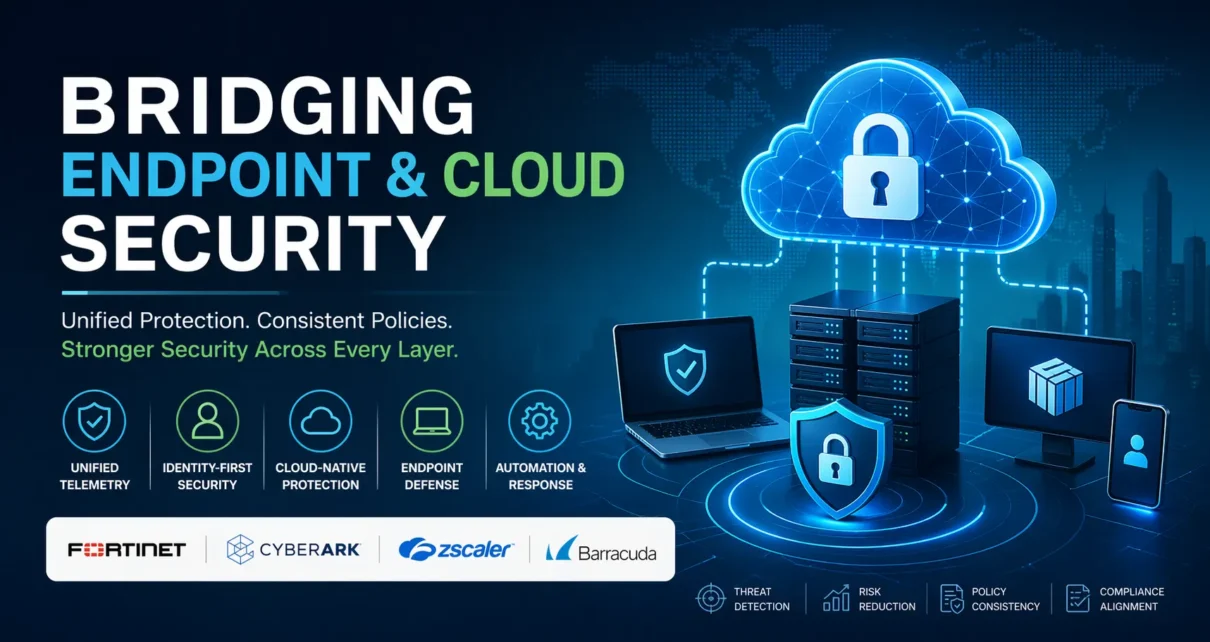
An analytical overview of vendors bridging endpoint protection and cloud-native controls, with practical insights on architecture, risk trade-offs, and buyer considerations.
Introduction
Security teams increasingly view endpoint and cloud controls as parts of a single risk surface rather than discrete silos.
Consolidated platforms aim to reduce operational friction, surface gaps across workloads and devices, and simplify policy consistency across distributed environments.
This evolution is driven by attackers who move laterally across endpoints, cloud workloads, and identity systems and by enterprise architectures that push compute to multiple execution planes from laptops to containers to serverless functions.
Buyers are therefore asking for platforms that provide unified telemetry, consistent policy semantics, and integrated automation so that detection, containment, and remediation work across vectors rather than in isolated toolchains.
1. Fortinet Cloud Security
Fortinet presents a broad security fabric that spans on-premises systems, endpoints, and cloud-native controls to deliver unified visibility and consistent policy enforcement. It is widely recognized as one of the best cloud security providers for threat detection. The platform focuses on integrated networking and security telemetry, shared threat intelligence, and centralized management across hybrid environments.
Key Points
- Unified management console across edge, endpoint, and cloud workloads
- Integrated threat intelligence and automated policy translation
- Cloud-native workload protection with runtime visibility
- Endpoint detection and remediation are tightly coupled to network controls
- Scalable orchestration for multi-cloud and hybrid deployments
Its module approach supports native cloud workload protection, endpoint detection and response, and network security services within a single operational plane.
The vendor highlights orchestration across cloud providers and automated policy translation to maintain consistent controls as workloads shift. In practical terms this can reduce the gap between prevention and detection workflows while lowering the number of disconnected consoles teams must manage.
A notable internal reference is available in a client case study that reflects the product strategy of consolidating multiple enforcement points under unified policy and telemetry.
Operational buyers should examine how policy intent expressed in the management plane is compiled and distributed to each enforcement engine and whether runtime events are rapidly reconciled back into central workflows.
2. CyberArk
CyberArk focuses on identity and privileged access as the foundation for preventing lateral movement across endpoints and cloud workloads.
The product set combines vaulting, session isolation, and credential lifecycle automation with posture signals to reduce the attack surface. Integrations bridge endpoint posture solutions and cloud provider IAM to enforce just-in-time access and rigorous session controls.
Key Points
- Privileged access management and credential vaulting
- Session isolation and secure remote access
- Just-in-time access workflows with audit trails
- Integration with endpoint posture and cloud IAM
- Automated credential rotation and secrets management
These controls map closely to the principles of a zero trust architecture by minimizing implicit trust, limiting standing privileges, and enabling continuous verification. For teams prioritizing identity-centered controls, CyberArk can serve as the backbone that ties endpoint enforcement to cloud-native identity policies.
Operational teams should assess how CyberArk ingests posture telemetry from endpoints and EDR tools to drive conditional access and whether session recordings and audit trails meet compliance requirements.
3. Zscaler
Zscaler delivers a cloud-native security stack that emphasizes secure access and inline traffic inspection from the edge to cloud workloads.
The vendor’s architecture scales inspection and policy enforcement in the cloud, reducing reliance on on-premises choke points while centralizing telemetry.
Key Points
- Cloud-native inline inspection and policy enforcement
- Centralized access controls for web, SaaS, and private apps
- Scalable proxy and zero trust segmentation
- Integrated threat prevention and SSL inspection
- Global edge points for consistent low-latency enforcement
Zscaler’s platform is often framed as part of the broader secure access convergence captured in the SASE definition, which combines networking and security controls to protect distributed users and workloads.
For organizations shifting to cloud-first networking, Zscaler is a common choice to unify web, SaaS, and private application access controls with inline threat prevention.
Teams should evaluate latency impacts for regionally distributed users and how Zscaler’s inline inspection integrates with existing EDR and cloud workload protections for coordinated response.
4. Barracuda Networks
Barracuda provides a suite that bridges email, network, and workload protections with endpoint and cloud controls to reduce attack surface across channels.
The vendor emphasizes ease of deployment, integrated threat intelligence, and automated response capabilities that link detection signals across domains. Its approach targets mid-market and enterprise buyers seeking consolidated controls for email, web, and workload protection without extensive custom integration.
Key Points
- Integrated email security and workload protection
- Centralized policy management and threat intelligence
- Automated detection and response workflows
- Managed service options for rapid operational support
- Simplified deployment for hybrid and cloud-native environments
Barracuda’s policy frameworks and managed service options can reduce operational lift while enabling coordinated containment across endpoints and cloud workloads.
Teams evaluating Barracuda should validate integration depth with their existing EDR and cloud-native security services and consider managed options where in-house security operations capacity is constrained.
Convergence pressures: unified policy and telemetry
Operational complexity and the rise of cross-layer attack techniques drive buyers to prefer platforms that centralize telemetry and policy orchestration.
This convergence reduces detection and response time but creates architectural trade-offs around latency, single-vendor dependency, and the need for extensible telemetry ingestion.
In practice, teams must weigh whether a single control plane that normalizes events from endpoints, workloads, and network telemetry provides better situational awareness than stitching together alerts from multiple best-of-breed products.
Important considerations include how telemetry is collected (agent vs agentless), how much contextual enrichment occurs at ingestion, and whether policy translation preserves intent when applied across different enforcement points.
Identity-first controls and privileged access dynamics
As workloads migrate between cloud providers and edge locations, identity and privileged access controls become the primary barriers to lateral movement.
Designs that integrate privileged access management with endpoint posture and cloud workload identity simplify enforcement and support a practical zero-trust rollout across vectors.
Identity-first approaches reduce reliance on network segmentation alone and instead leverage continuous verification, device posture, and ephemeral credentials to limit blast radius.
Buyers should validate how vendors map identity signals into enforcement decisions, including just-in-time access, session recording, and automated credential rotation.
Automation, compliance mapping, and actionable hardening
Buyers expect automated posture remediation and prescriptive controls tied to recognized baselines to quickly and measurably reduce risk.
Aligning platform capabilities with standards such as the CIS Controls helps teams prioritize mitigation efforts and achieve measurable compliance outcomes.
Automation must be safe and auditable; successful vendors provide staged remediation (advice, quarantine, policy enforcement) and clear rollback paths so operations teams can tune behavior without service disruption.
Evaluations should include how platforms represent compliance posture, exportable evidence for audits, and integration with GRC tooling for continuous monitoring.
Conclusion
Platforms that combine endpoint and cloud defenses are maturing to address cross-layer threats and operational fragmentation.
Buyers should evaluate how each vendor maps to their architecture, prioritizes identity and telemetry integration, and supports automation aligned with compliance baselines.
Practical selection criteria include the ability to unify telemetry without losing context, the maturity of identity and privileged access integrations, and the safety of automated remediation workflows.
Ultimately, teams should pilot with representative workloads and attack scenarios to confirm that enforcement semantics, latency, and operational overhead meet organizational risk tolerance and performance requirements.
FAQ
How should teams evaluate consolidation vs best-of-breed?
Start by mapping critical detection and response workflows and identifying gaps where telemetry is lost between endpoint and cloud controls.
Evaluate consolidation where it reduces context switching and preserves required visibility, but retain best-of-breed options where specialized capability is essential.
Consider hybrid models: consolidate controls that provide large operational wins while integrating best-of-breed tools through well-defined telemetry and automation contracts.
What role does identity play in bridging endpoint and cloud security?
Identity and privileged access controls serve as primary gates for lateral movement and should be integrated with endpoint posture and workload identity.
Implementing just-in-time access, session isolation, and continuous verification reduces the risk of compromised credentials enabling cross-layer attacks.
Ensure identity signals are surfaced into your detection pipelines so that suspicious account behavior triggers coordinated containment across endpoints and workloads.
How can organizations measure the effectiveness of a unified platform?
Track mean time to detect and mean time to remediate across incidents that cross endpoints and cloud workloads as primary indicators.
Complement those metrics with coverage mapping against relevant controls and periodic red-team exercises to validate enforcement consistency.
Measure operational metrics as well, such as policy deployment failure rates, false positive volumes, and SOC analyst time spent correlating alerts across domains.
Are compliance baselines still relevant in consolidated architectures?
Yes baselines provide prescriptive hardening and prioritization for automated remediation, which is critical when unifying controls.
Mapping platform capabilities to recognized baselines helps teams justify configurations and measure progress against defined risk targets.
Use baselines as a starting point for automated remediation but tailor controls to business-critical exceptions with auditable justification.